
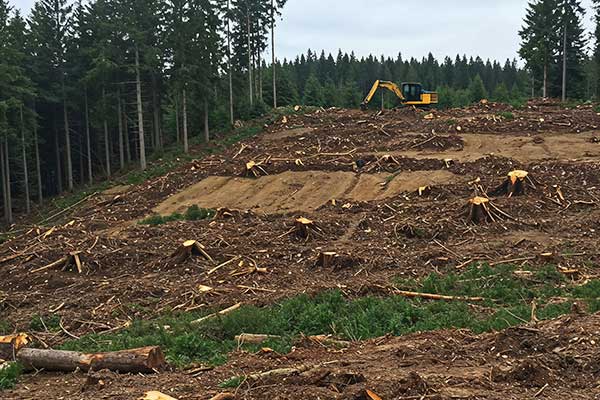
Forestry mulching grinds standing brush and small trees into chip in one pass and leaves it on the ground. On acreage it is the standard method. In Terrell Hills it is rarely the right answer, and we would rather explain why than take the job and leave you with a result you did not want.
A mulching head is a rotating drum with carbide teeth mounted on a compact track loader or an excavator arm. It cuts standing material from the top down and reduces it to chip where it stands. The machine tracks over its own mulch rather than digging. Nothing is piled, burned, or trucked away, which on a large overgrown area saves both time and disposal cost.
Three reasons, and any one of them is generally enough. The chip layer looks right on a wooded acreage and looks like a construction site on a maintained residential property, which is not what anyone here wants left behind. The machine needs maneuvering room and overhead clearance that most back gardens do not have once you account for the gate, the terrace, and mature planting. And on a property where the value sits in specimen trees, running a tracked machine repeatedly across their root zones is a poor trade for the time it saves.
This deserves stating plainly because it is the reason we turn work down. The mature oaks and pecans on these properties are worth more than any clearing job, and they are frequently sitting right where the overgrowth is. Compaction from repeated machine passes over a root zone does not show up immediately. It appears two or three seasons later as a thinning crown, long after anyone connects it to the work. Where the value of a property is in its canopy, the slower method is the cheaper one.
For most Terrell Hills work, hand crews with saws and small equipment where a gate allows it, with material carried out and hauled to disposal. It costs more per hour and it produces the result these properties need: clean ground, no chip layer, no compaction across root zones, and no damage to hardscape or planting that is staying. On a job where a machine genuinely fits and helps, we will use one, but the default here is the careful method.
A chip layer an inch to several inches deep depending on how much material was standing. It shades soil, slows runoff, suppresses some regrowth by keeping light off seed, and breaks down over a few seasons. If the area is being replanted soon after, we can thin the heaviest concentrations so material reaches soil. If the area is going to be lawn or garden, that chip has to be dealt with, which is a cost worth counting before choosing the method.
Ligustrum, privet, hackberry, chinaberry, and nandina all resprout from the crown, so mulching leaves the roots in place and the growth returns within a season or two. Cut and haul with the crowns grubbed or treated gives a considerably longer result. On a property where you want the ground to stay open, that difference matters more than the price of the initial pass.
Even where the chip layer would be acceptable, the route usually settles the question. A mulching machine arrives on a trailer and needs somewhere to unload and a passable path to the working area. On a property with a wall, a gate, mature planting down the side, and a terrace between the drive and the back garden, that path frequently does not exist. We establish it before quoting rather than arriving and discovering the machine cannot get past the gate.
Mulching throughout Terrell Hills, Alamo Heights, Olmos Park, Lincoln Heights, Northwood, Castle Hills, and neighbouring San Antonio areas where lot size and access make it practical.
Send the address and we will tell you honestly which method your job needs. Call 210-942-1961.
Usually not in Terrell Hills. The chip layer suits wooded acreage rather than a maintained residential property, the machine needs room most gardens do not have, and running it across specimen tree root zones is a poor trade. The exception is a large rear section that has gone completely wild on a deep lot.
Because on these properties the cheaper method often produces the more expensive outcome. A chip layer you then have to remove, or a specimen oak that declines three seasons later from root compaction, both cost more than the difference between mulching and hand clearing. We would rather quote the right method than the cheapest one.
Hand crews with saws and small equipment where a gate allows it, with material carried out and hauled to disposal. It costs more per hour and delivers what these properties need: clean ground, no chip layer, no compaction across root zones, and no damage to hardscape or planting that is staying.
On a large rear section of a deep lot that has gone completely wild, well away from specimen trees, where the volume would otherwise mean many truck trips, and particularly where the ground is going to be regraded or replanted afterward anyway. On those jobs it is genuinely the efficient choice.
No. The head grinds material to or slightly below grade and the root system stays in place. Ligustrum, privet, hackberry, chinaberry, and nandina all resprout from the crown, so the growth returns within a season or two. Cut and haul with crowns grubbed or treated gives a considerably longer lasting result.
It has to be dealt with, which is a cost worth counting before choosing the method. Chip left under a new lawn or garden interferes with establishment and has to be removed or thinned. If the area is going back to maintained ground, that consideration often decides the question in favour of cut and haul.
Yes, and on a large deep lot that is sometimes the right plan. Mulch the far rear section where volume is high and appearance matters less, and hand clear everything nearer the house and the specimen trees. We show that split on the quote so you can see where the line falls and why it falls there.