
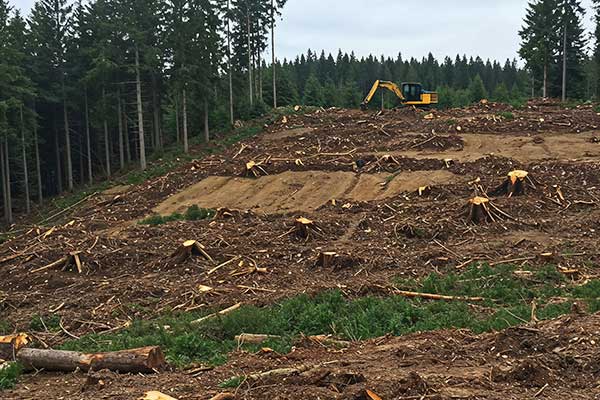
Forestry mulching grinds standing brush and small trees into chip in one pass and leaves it on the ground. On acreage it is the standard method. In Universal City it fits a narrow set of properties and is wrong for most of them, and we would rather tell you which category yours is in than take the job and hand you a result you did not want.
A mulching head is a rotating drum with carbide teeth mounted on a compact track loader or an excavator arm. It cuts standing material from the top down and reduces it to chip where it stands. The machine tracks over its own mulch rather than digging. Nothing is piled, burned, or trucked away, which on a job with real volume saves both time and a substantial disposal cost.
Three reasons and any one of them decides it. The machine needs maneuvering room and overhead clearance that a typical back yard in this city does not offer once you account for the gate, the patio, and the AC unit. The chip layer looks correct on a wooded parcel and looks like a construction site on a maintained lawn, which is not what a homeowner or a landlord preparing for a tenant wants left behind. And running a tracked machine across the root zone of a mature post oak compacts soil in a way the tree may not recover from.
This deserves its own point given how much rental and turnover work happens here. If a property is being prepared for a tenant, an inspection, or a sale, a chip layer across the back yard is the wrong result even where the machine could physically do the job. What that situation needs is clean ground, material gone, and a yard that photographs and shows well. On those jobs we cut and haul, and it is not a close call.
Mulching cuts at grade and leaves the root system. The dominant species here, hackberry, chinaberry, ligustrum, Chinese tallow, and volunteer mesquite, all resprout from the crown. A mulched area looks excellent for a season and then pushes new stems through the chip. That is the plant rather than the machine, and it means mulching here works best as a first pass that exposes ground for follow up work rather than as a standalone solution.
Soils here are typically a sandy loam surface over denser clay beneath. The top layer carries equipment reasonably when dry, but the clay holds water, so after heavy rain the ground can be firmer at the surface than a few inches down. Tracked machines spread weight better than wheels and mulching disturbs less than blade work, but we still schedule around wet conditions rather than working through them and leaving ruts.
For most residential work in this city, hand crews and small equipment where a gate allows it, with material carried out and hauled to disposal. It costs more per hour and produces what these properties need: clean ground, no chip layer, no compaction across root zones, and a yard ready for whoever is arriving. Where a machine genuinely fits and helps, we use one, but the default here is the careful method.
The honest way to choose between mulching and haul off is to estimate volume. A back corner cleanup produces a couple of loads and hauling is simple. An overgrown commercial parcel can produce ten or more, at which point disposal trips become the dominant cost and mulching removes them entirely. That calculation, rather than any general preference for one method, is what should decide it on a given property.
Mulching throughout Universal City, Selma, Live Oak, Schertz, Cibolo, Converse, Windcrest, Garden Ridge, and the surrounding northeast Bexar County area where lot size and access make it practical.
Send the address and we will tell you honestly whether mulching suits the property. Call 210-942-1961.
Usually not in Universal City. The machine needs room a typical yard does not have, the chip layer suits a wooded parcel rather than a maintained lawn, and running it across mature post oak root zones risks the tree. Most residential work here is better done with hand crews and haul off.
Because a chip layer across the back yard is the wrong result even where the machine could physically do the work. A property being prepared for a tenant, an inspection, or a sale needs clean ground and a yard that shows well. On those jobs we cut and haul, and it is not a close call.
On commercial and mixed use parcels, vacant lots, larger properties, and anywhere the volume of material would make disposal the dominant cost. Access on commercial parcels is usually straightforward, which makes those efficient jobs. If your property is one of those, mulching is genuinely the better method.
No. Hackberry, chinaberry, ligustrum, tallow, and volunteer mesquite all resprout from the root crown, so a mulched area looks excellent for a season and then pushes new stems through the chip. It works best here as a first pass exposing the ground for follow up grubbing or treatment rather than as a standalone answer.
No. The head grinds material to or slightly below grade and the root system stays in place. If you need stumps gone for a shed pad, a pool, a patio, or a driveway, that is grubbing work with an excavator and it gets quoted separately. For areas going back to turf, grinding is usually sufficient.
When dry, reasonably, since the sandy loam surface is firmer than heavy clay. The complication is the clay subsoil, which holds water, so after rain the ground can be firmer at the surface than a few inches down. We schedule around wet conditions rather than working through them and leaving ruts.
Yes, and on a larger property that is often right. Mulch the open sections where a machine can work safely away from oak root zones, and hand clear the areas nearer the house and under the canopy. We show that split on the quote so you can see where the line falls and why.