
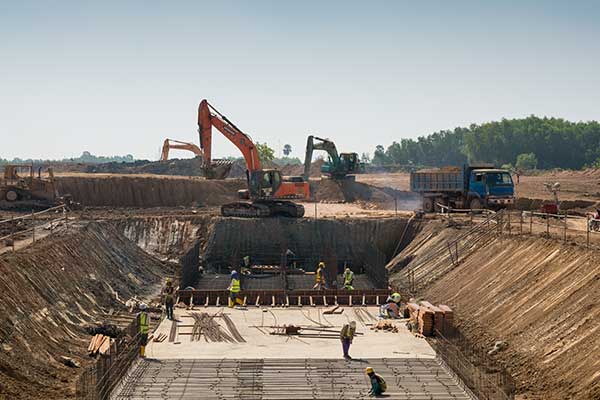
Building at Canyon Lake means building on a hill. The lots that have the view are the ones with the grade, and almost every site preparation problem here traces back to that. Hill Country Land Clearing prepares homesites, driveways, and structure pads across the Canyon Lake area, working with the slope rather than pretending it is not there.
On steep ground, cut is more stable than fill, and a pad benched into the hillside behaves far better over time than one built out on fill above a slope. Fill on grade needs proper keying, compaction in lifts, and often retention, and it is the source of a large share of the settlement and slide problems this area produces. Your engineer sets the design. What we bring is knowing where the rock sits, how water crosses that particular hillside, and where the retained edges need protection during construction.
Shallow limestone defines excavation here. Cutting a pad into a hillside frequently means ripping or hammering rather than digging, which is a real cost line. The offset is that the material coming out, processed and compacted, makes excellent driveway base, so rock that costs money to excavate offsets material you would otherwise truck in on roads where trucking is already difficult. That balance is one of the main reasons we quote from the site rather than from a plan set.
A Canyon Lake driveway has to climb or descend real grade, stay drivable when wet, shed water rather than becoming the drainage channel, and give a vehicle somewhere to turn. Getting all four is a design problem, not just a construction one. Routes often have to be lengthened or switched back to hold workable slope. Where the driveway meets the subdivision road the approach has its own constraints. We would rather solve this before the pad than after, because a finished house on an unusable driveway is a serious problem.
Rainfall here arrives hard and the ground absorbs very little of it. On slope that concentrates fast. We set positive fall away from every building footprint, shape swales that carry runoff to a controlled outlet instead of down the driveway or across a neighbor below you, and size any crossing for what it actually receives. On a hillside lot, water pushed downhill onto the property below is not a drainage detail, it is a dispute waiting to happen.
On site sewage here has to work with thin soil, shallow rock, and grade, which narrows both the system type and where it can go. In a watershed draining toward the reservoir there is good reason to take that seriously. The design comes from your designer under Comal County requirements, and the location has to be fixed before pad grading. You cannot run construction traffic across a future field or place fill over an area the design depends on.
Canyon Lake is unincorporated, so there is no city permit office. Comal County handles on site sewage, platting, and floodplain. Your deed restrictions and property owners association typically govern siting, height, driveway materials, and clearing limits, and in these subdivisions they are the rules that bite. If your lot touches federal land around the reservoir, the Corps of Engineers is involved as well. The owner or builder holds all of this.
Benching a pad into a hillside creates a cut face above and a fill edge below, and both need attention. Cut faces on rock are often stable on their own, while cut faces in soil and fill edges usually need retention, planting, or armoring so they do not ravel. Your engineer specifies the approach. What we do is build the edges to that spec and protect them during construction, which is when they are most exposed and least stable.
Delivering concrete, base material, and equipment to a steep lot on a narrow subdivision road is a logistics problem in its own right. Turning radius, driveway grade, and where a truck can stop without blocking the road all matter. It is another reason to build the driveway and a turnaround early in the sequence rather than late, since every trade behind us has the same problem and a workable approach saves money on every delivery.
Site preparation across Canyon Lake, Startzville, Sattler, Fischer, Cranes Mill, Spring Branch, Bulverde, Smithson Valley, New Braunfels, and throughout Comal, Hays, Kendall, and Blanco counties.
Send the plan, or the address with photos of the lot and the street approach. Call 210-942-1961.
Yes, generally by benching into the hillside rather than filling out from it, since cut is far more stable than fill on this grade. The design comes from your engineer. Our contribution is knowing where the rock is, how water moves across that specific hillside, and how to protect the cut and fill edges from runoff while construction is underway.
It is the largest variable on most Canyon Lake pads and depends on depth and hardness. Rippable material moves far more cheaply than material needing a hammer. The offset is that excavated limestone makes excellent driveway base once processed and compacted, which matters more here than elsewhere because trucking material in on these roads is slow and expensive.
Workable grade, a surface that sheds water rather than channeling it, adequate base so it holds up when wet, and somewhere to turn around. Achieving all of that often means lengthening or switching back the route rather than running straight up the hill. It is worth designing before the pad, since a house with an unusable driveway is a very expensive problem.
Canyon Lake is unincorporated so there is no city permit office, but Comal County regulates on site sewage, platting, and floodplain. Your deed restrictions and property owners association usually control siting, driveway materials, and clearing limits, and those are the rules that most often govern in these subdivisions. The owner or builder holds all approvals.
It gets located before grading, not after. The design comes from your on site sewage designer under Comal County requirements, and on thin soil over rock with grade the options are limited enough that placement drives other decisions. Construction traffic across a future field compacts it and fill over it undermines the design, so we keep equipment off from day one.
Yes, and it is a common ask here. A level parking pad on a sloped lot is a small version of the same problem as the house pad: bench it in, compact it properly, and make sure water leaves it rather than pooling or running through. Getting it built while equipment is already on site is far cheaper than a return trip.
By shaping drainage early rather than at the end, routing runoff away from cut and fill edges and away from the driveway, and installing the erosion controls the project calls for. On a hillside lot draining toward the reservoir this is worth doing properly. The driveway is usually the most vulnerable feature during construction because it concentrates water.