
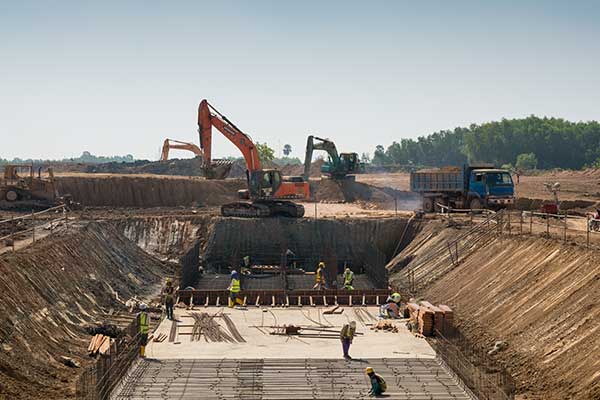
Site preparation is the work that decides whether everything built afterward sits level, drains properly, and stays that way. Hill Country Land Clearing prepares residential, commercial, and agricultural sites across San Antonio and Bexar County, taking raw or cleared land to a graded, compacted, buildable condition that a foundation crew can work on the day they show up.
San Antonio sits on a mix that catches out crews from elsewhere. Large parts of the south and east sides carry expansive clay that swells and shrinks dramatically between wet and dry seasons, which is exactly what cracks a slab that was not prepared for it. The north and west sides have shallow limestone and caliche, where the problem is not movement but excavation. Caliche compacts into an excellent base but takes real equipment to cut. Getting the pad right means knowing which of these you are standing on before you start moving dirt.
A pad is not just a flat spot. We remove organic material and root balls entirely, since anything left to decompose becomes a void and then a settlement crack. Fill goes in lifts and gets compacted rather than dumped and spread. The pad is built oversized past the foundation footprint so the edges do not slough, and it is crowned or sloped so water leaves rather than pools against the structure. If your engineer has specified a moisture conditioned or select fill pad, we build to that spec.
San Antonio gets long dry stretches broken by intense rainfall events, and flash flooding is a regional reality. Grading that ignores water is the most expensive mistake on a site. During prep we establish positive fall away from every building footprint, shape swales to route runoff to a controlled outlet, and set up silt fence and stabilized construction entrances where the project requires them. Getting drainage right at the prep stage costs a fraction of fixing it after a slab is poured.
We work directly with general contractors, custom home builders, and individuals building their own place on family land. That means reading a site plan and grading plan, hitting the elevations the civil drawings call for, coordinating with the surveyor, and staying out of the way of the trades stacked behind us. We also flag conflicts we see in the field, like a proposed pad sitting in a natural drainage path, before they become change orders.
Projects inside San Antonio city limits generally require land disturbance and tree permits through Development Services, and sites over the Edwards Aquifer Recharge Zone may require a TCEQ approved plan before construction begins. Larger disturbances can also trigger stormwater permitting. The owner or general contractor holds these, but we work within them and schedule around approval timelines rather than pretending they do not exist.
A large share of the site work we do around San Antonio is for people building on family acreage or a newly bought tract rather than in a subdivision. Those projects carry a different set of problems: no existing driveway, no utilities at the pad, a septic field that has to be sited and kept clear of traffic, and often a mile of ranch road between the county road and the build site. We sequence access first so that concrete trucks and delivery vehicles can actually reach the pad, because a pad nobody can get to is not progress.
Good site prep tries to balance cut and fill on the property so you are not paying to import dirt or export spoil. Topsoil stripped off the pad footprint gets stockpiled and reused for final landscaping instead of being hauled away and bought back later. Rock encountered during excavation is often crushable and usable as base for the driveway. On rocky north side sites this can offset a meaningful part of the material cost, which is one reason we walk the ground before quoting rather than pricing from a plan alone.
We prepare sites across San Antonio, Schertz, Cibolo, Selma, Converse, Universal City, Boerne, Bulverde, Helotes, New Braunfels, Fair Oaks Ranch, and throughout Bexar, Comal, Guadalupe, and Kendall counties.
Send us the site plan or just the address and the footprint you have in mind. Call 210-942-1961 to schedule a walkthrough.
It covers everything between raw land and a buildable surface: clearing vegetation, grubbing stumps and roots, stripping topsoil, cutting and filling to reach design elevation, building and compacting the pad, shaping drainage, and installing access. Some projects also need erosion control measures and a stabilized construction entrance. Scope depends on the site plan and the local requirements.
A cleared residential lot can be pad ready in a few days. Wooded acreage requiring clearing, grubbing, significant cut and fill, and a new access road can run several weeks. Rock excavation, wet weather, and permit timing are the usual causes of delay. We give a schedule with the quote and update it as conditions change.
Permits are held by the property owner or the general contractor, not the excavation contractor. We work within the approved permits, follow the conditions attached to them, and can tell you what your project is likely to need in San Antonio or Bexar County so you are not caught out. We do not submit applications on your behalf.
Clearing removes what is above ground: brush, trees, and vegetation. Grubbing removes what is below it: stumps, root balls, and buried organic material. For anything structural, grubbing is not optional. Organic material left in place decomposes, creates voids, and causes settlement under a foundation or a road base.
Yes, and it usually makes sense to. Equipment is already mobilized and the route often needs to exist anyway for construction traffic. We clear the corridor, cut the subgrade, and place and compact base material. Caliche is the common base material around San Antonio and performs well when properly compacted.
First by identifying them. On clay heavy sites the fix depends on the engineer's recommendation, which may involve select fill, moisture conditioning, over excavation and replacement, or a foundation design that accommodates movement. We build to that specification. What we will not do is place a pad on untreated expansive clay and call it finished.
We install the measures the project requires, such as silt fence, stabilized construction entrances, and inlet protection, and we shape the site so runoff is directed rather than sheeting across disturbed ground. Sites that disturb larger areas may have stormwater permit obligations with specific requirements, and we work to those.