
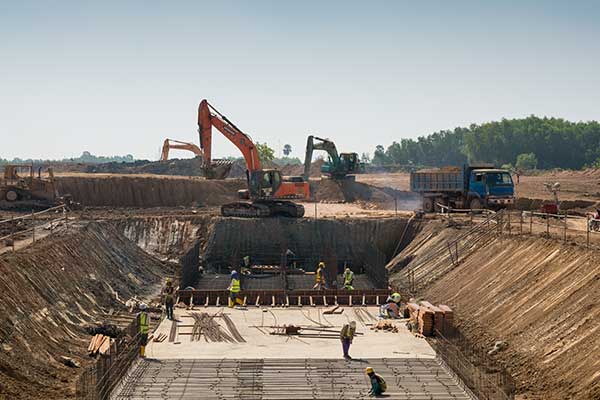
Site preparation around Seguin usually means building on land that has been farmed or grazed rather than developed. There is no driveway, utilities may be a long way off, the septic field has to be located before anything else, and the ground is deep soil with real shrink swell behaviour. Hill Country Land Clearing prepares homesites, barn pads, and access across Guadalupe County.
Deep soil is an advantage for almost everything except foundations. Much of this ground has meaningful shrink swell potential, taking on water in spring and giving it up through a hot summer with enough volume change to crack a slab that was not prepared for it. The remedy comes from your geotechnical report and your engineer, and can involve select fill, moisture conditioning, over excavation and replacement, or a foundation designed to tolerate movement. We build to that spec and do not shortcut it.
The Guadalupe and its tributaries carry substantial mapped floodplain through this county, and river bottom ground is exactly where people want to build. Floodplain development carries requirements that can affect fill, finished floor elevation, and whether a project works as designed. Establish your status before design rather than after. Check FEMA mapping and confirm with the City of Seguin or Guadalupe County depending on where the site sits.
Agricultural buildings deserve the same preparation a house pad gets, at a scale that matches. Organic material and roots come out entirely, since anything decomposing under a slab becomes a void. Fill goes in compacted lifts rather than being dumped. A barn pad has to shed water rather than pond against the structure, and an equipment yard has to carry loaded trucks and machinery rather than passenger cars, which means a different base than a residential driveway needs. Building these while equipment is already mobilized is far cheaper than a return trip.
Access on a rural tract is its own piece of work. We clear the corridor, cut subgrade, and place and compact base so the route carries concrete trucks during construction and equipment afterward. Where a draw or a drainage crosses the route, a culvert or a properly built crossing sized for actual storm flow is required rather than a token pipe. There is no rock here to excavate and crush, so base material has to be imported, which is a real cost line worth seeing up front.
On site sewage in Guadalupe County has to work with the soil you have, and the field location must be settled before pad grading rather than after. You cannot run construction traffic across a future drain field or place fill over an area the design depends on. Long electrical runs and water lines to a well also need routing before the pad is finished. We build to the layout your designer and the county specify and keep equipment off those areas from day one.
You cannot compact wet soil properly and equipment on saturated ground causes damage. That is real schedule risk here, more than on a rocky site that sheds water and dries fast. We build float into the program, say honestly when conditions are unworkable, and would rather lose several days than place fill at the wrong moisture content and fail compaction testing.
The topsoil here is genuinely good material and it is worth stripping and stockpiling rather than mixing it into fill or hauling it away. Reused at final grade it gives landscaping, pasture, or a garden a far better start than imported material, and it costs nothing beyond the handling. On a rural site where the pad is a small part of the property, stockpiling the strip is one of the easier savings available.
Flat sites do not drain themselves. Water sits, heavy soil absorbs very little of it, and the low spot becomes standing water that works against a foundation and kills grass. Any new structure changes how water crosses a property. We establish fall away from the building, shape the ground so runoff reaches an actual outlet rather than dying halfway, and consider where the water ends up rather than stopping at a property line.
Site preparation across Seguin, Marion, Cibolo, Schertz, New Braunfels, McQueeney, Geronimo, Kingsbury, Luling, and throughout Guadalupe, Comal, and Caldwell counties.
Send the plans and the geotechnical report if you have one, plus the address. Call 210-942-1961.
For anything structural on this soil it is money well spent and often required. Ground here varies in depth and plasticity across short distances, and the report tells your engineer what treatment the specific site needs. Building on soil with shrink swell potential without one means guessing at the variable most likely to cause a foundation problem.
Check FEMA mapping and confirm with the City of Seguin or Guadalupe County. The Guadalupe and its tributaries carry substantial mapped floodplain, and river bottom ground is exactly where people want to build. Establish this before design, since requirements can affect fill, finished floor elevation, and whether a project is viable as drawn.
Yes, and to the same standard as a house pad at a matching scale. Organic material and roots come out entirely, fill goes in compacted lifts, and the pad sheds water rather than ponding against the structure. An equipment yard needs a base that carries loaded trucks and machinery, which is different from a residential driveway.
Yes, and on a rural tract it is usually built first so deliveries can reach the site. We clear the corridor, cut subgrade, handle culverts or crossings where a drainage is in the way, and place and compact base. There is no local rock to excavate and crush here, so base material is imported, which is a real cost line.
First. The design comes from your on site sewage designer under Guadalupe County requirements, and the location must be settled before grading. Construction traffic across a future drain field compacts it and fill over it undermines the design, so we keep equipment off the area from day one once the layout is known.
More than on rocky ground. Soil cannot be compacted properly when wet and equipment on saturated ground causes damage, so wet stretches genuinely stop work rather than slowing it. We build float into the schedule and say when conditions are unworkable, since placing fill at the wrong moisture content fails testing and costs more than the delay.
Yes, and here it is fully achievable because there is no rock shelf. Root balls come out whole. That matters because organic material left underground decomposes into a void and produces settlement, and adding an avoidable settlement source to soil that already moves seasonally is asking for a foundation problem later.