
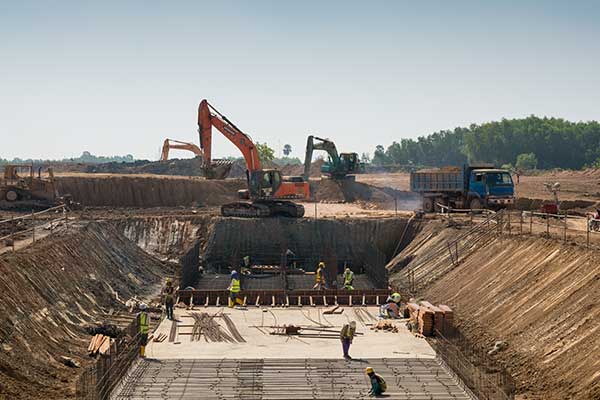
Site preparation in Universal City is small footprint work with consequences that show up years later if it is done badly. A shed, a shop, a pool, a patio, an addition. On soil that behaves in a way that catches people out, beside mature trees that predate the subdivision, on ground that may not be what you assume it is. Hill Country Land Clearing prepares these sites across the city.
The soil profile here is characteristic of this part of northeast Bexar County: a sandy loam surface over a denser clay subsoil. The sand digs easily and drains fast, which misleads people about how the ground behaves. Water moves down through the sand, reaches the clay, and stops, perching there with nowhere to go. That is why a yard can feel dry on the surface while the ground a few inches down stays saturated, why certain low spots never dry out, and why a pad has to account for what is under the sand rather than what is on top of it.
Because of the perching, drainage correction here is often about giving water somewhere to go rather than simply regrading a slope. We establish positive fall away from structures, shape the yard so runoff reaches an actual outlet instead of dying in the middle, and pay attention to where water sits after storms rather than only where it runs during them. On lots this close together we also check the fix does not push water over the fence, which converts a drainage detail into a neighbour problem.
Subdivisions built here from the sixties onward were graded during development, and the ground in a back yard is not always undisturbed soil. Imported fill placed to establish lot grades was not engineered to carry a structure, and it can contain construction debris buried during the original build. That matters the moment you put a slab on it. We find out what is actually there before placing a pad rather than grading over it and hoping.
Many lots here still carry live oaks and post oaks that were standing before the subdivision existed. Post oaks in particular do not tolerate root disturbance, and the damage does not appear immediately. Compaction, grade change over a root zone, or trenching through roots express themselves two or three seasons later as thinning crown and decline, long after anyone connects it to the work. Protection fencing goes up before work starts and stays up, and utility runs get bored under root zones rather than trenched through where feasible.
Organic material and roots come out of the footprint entirely, since anything left to decompose becomes a void and then a settlement crack. Fill goes in compacted lifts rather than being dumped and spread. The pad extends past the structure footprint so edges do not slough, and it is shaped to shed water rather than hold it against a slab. A shop or shed pad is built to the same standard as a house pad at a smaller size.
This is a separate incorporated city with its own building department, and requirements for structures, pools, driveways, and tree work are set locally rather than by San Antonio or by a neighbouring city. Setbacks, accessory structure rules, and impervious cover limits are worth confirming before the design is finalized. The owner or contractor holds the permits. We work within them and schedule around approval timelines rather than assuming.
Most of this happens at a home somebody is living in, so we plan the route in, protect the driveway and lawn where equipment crosses, keep the work area contained rather than spreading spoil across the yard, and tell you in advance which areas will be out of use and for roughly how long. Where the only access crosses grass or a root zone we lay protection instead of tracking straight over it.
Site preparation across Universal City, Selma, Live Oak, Schertz, Cibolo, Converse, Windcrest, Kirby, Garden Ridge, and neighbouring San Antonio areas.
Send the address with photos of the area, the access route, and the trees nearby. Call 210-942-1961.
Because the sandy loam surface sits over denser clay subsoil. Water moves down through the sand, hits the clay, and perches there with nowhere to go. The surface can feel dry while the ground a few inches down stays saturated. Drainage correction here is often about giving water an outlet rather than just regrading a slope.
Quite possibly, if the subdivision was graded during development, which most here were. Fill placed to establish lot grades was not engineered to carry a structure and can contain buried construction debris. It matters the moment you put a slab on it, so we find out what is there before placing a pad.
Yes, built to the same standard as a house pad at a smaller scale. Organic material and roots come out entirely, fill goes in compacted lifts, the pad extends past the footprint so edges hold, and it sheds water rather than ponding against the slab. On this soil, what is beneath the sand matters as much as what goes on top.
Protection fencing at the critical root zone before work starts, kept up throughout, with no equipment traffic or spoil inside that line, and utility runs bored under root zones rather than trenched through where feasible. Post oaks in particular do not tolerate root disturbance and show the damage two or three seasons later rather than immediately.
The City of Universal City, not San Antonio and not a neighbouring city. This is a separate incorporated municipality with its own building department, and setbacks, accessory structure rules, impervious cover limits, and tree requirements are set locally. Confirm before your design is finalized, since a change at permit stage costs far less than one in the field.
Often yes. Regrading to establish fall away from the house, reshaping the yard so runoff reaches an outlet, and correcting where a previous project sent water the wrong way handle most cases. The complication here is the perching, which sometimes means the answer involves giving water a route out rather than only changing surface slope.
It should not be. We plan the route in, protect the driveway and lawn where equipment crosses, keep the work area contained rather than spreading spoil, and clean up as we go. Some disturbance along the route is unavoidable, and we tell you in advance which areas will be affected so it is not a surprise.