
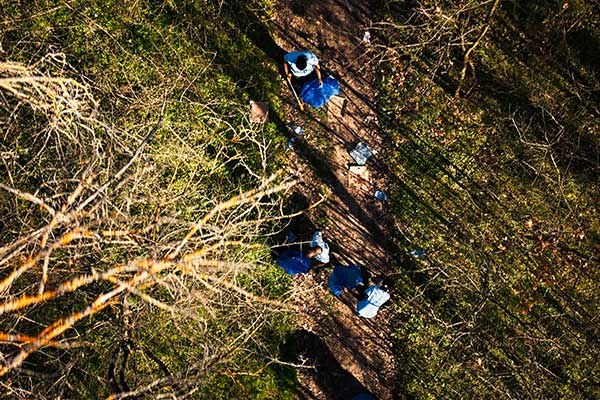
The trees worth keeping around Cibolo are not the ones people picture when they think of Texas clearing. Along Cibolo Creek and the smaller drainages there are pecans, big elms, and cottonwoods, and out on the tracts there are post oaks and live oaks that have been standing since this was all farm ground. Underbrush clearing takes out what has grown up beneath them and leaves those trees where they are.
Out goes chinaberry, hackberry saplings, young mesquite and huisache, retama, greenbriar, privet, poison ivy, and the volunteer growth crowding the base of better trees. Staying are pecans, live oaks, post oaks, cedar elms, and the mature bottomland trees along the drainages. We mark keepers with you before anything starts, and where something is a judgment call we ask rather than deciding for you. On tracts with good pecans, that conversation is worth having carefully.
The ground along Cibolo Creek and its tributaries grows differently from the open tracts. There is more moisture, more shade, deeper soil, and consequently a much heavier understory. Greenbriar, poison ivy, privet, and elm saplings fill in until the bottom is impassable, while the pecans and elms above them are exactly what makes that part of the property worth having. Clearing the understory here transforms the usability of a tract more than the same work does anywhere else on it.
A mature pecan with brush grown up around its base is competing for water and nutrients and is harder to work around, harvest under, or even walk near. Clearing beneath pecans improves airflow, makes the ground usable, and lets you actually see the condition of the trees. If your tract has a working orchard or even a handful of productive trees, understory clearing is one of the more worthwhile things you can do for them, and it is cheap compared with what a mature pecan is worth.
The species we are removing here nearly all resprout from the root crown. Chinaberry, hackberry, mesquite, huisache, and greenbriar will all come back unless the crown is removed or treated. On understory work close to trees you are keeping, full grubbing is often not appropriate because it disturbs root zones you want left alone. That means understory clearing here is usually a maintained condition rather than a permanent one, and a return visit every year or two is part of the plan rather than a sign something went wrong.
Mulching where a machine can work without disturbing the roots of keeper trees, and hand crews with saws close in around trunks, along fence lines, and in tight creek bottom ground. Material is generally mulched and left, or hauled where an owner wants clean ground. On clay we watch conditions closely, since equipment working near a mature tree on wet ground can compact the root zone in a way that shows up in the tree’s health years later.
Creek bottom understory around here reliably includes poison ivy, often climbing well up the trunks where nobody notices it until they are in it. Crews handle it with proper protection and it goes out with the debris rather than being chipped, since chipping disperses the oil. If you know it is present, tell us at the walkthrough so we plan for it rather than encountering it.
On larger tracts there is no need to open everything at once. Many owners start with the creek bottom or the area nearest the house, then work outward over a couple of seasons. That spreads the cost, lets you see how the ground responds, and gives you a chance to judge how much regrowth you are actually dealing with before committing to the rest of the property. It also makes the maintenance cycle easier to plan.
Underbrush clearing across Cibolo, Schertz, Universal City, Selma, Live Oak, Converse, Marion, Santa Clara, St. Hedwig, Seguin, New Braunfels, and throughout Guadalupe, Comal, and northeastern Bexar counties.
Tell us which trees matter to you and what you want to be able to reach. Call 210-942-1961.
Selective removal of what grows beneath the canopy, leaving mature trees, soil, and general contour alone. Around Cibolo that usually means taking out chinaberry, hackberry, greenbriar, privet, and young mesquite while keeping pecans, oaks, and the bottomland trees along the creeks. It is very different from clearing a tract to bare ground.
Most of it, yes, and that is the honest expectation here. Nearly everything in the understory on this soil resprouts from the root crown, and full grubbing is often inappropriate near trees you are keeping because it disturbs their root zones. Plan on a return visit every year or two. Understory clearing here is a maintained condition rather than a one time fix.
Generally yes, and it is inexpensive relative to what a mature pecan is worth. Removing brush from around the base reduces competition for water and nutrients, improves airflow, makes the ground usable and workable, and lets you actually assess the condition of the trees. On tracts with productive pecans it is one of the better investments available.
Yes, and creek bottoms are where this work makes the biggest difference, since the moisture and shade produce a much heavier understory than the open ground. Be aware that work near a creek may involve floodplain considerations depending on the scope, and it reliably involves poison ivy, so tell us what you know about the area beforehand.
It can, particularly on clay. Working a machine near a mature tree on wet ground compacts the root zone, and that damage shows up in the tree's health years later rather than immediately. We keep equipment out of root zones where possible, do close work by hand, and watch ground conditions carefully around trees that matter to you.
Yes. It is common in the creek bottoms here and often climbs the trunks where it goes unnoticed. Crews work with proper protection and it leaves with the debris rather than being chipped, since chipping disperses the oil into the air. Let us know at the walkthrough if you know it is present so we plan for it.
It is quoted by the acre or by the job depending on scale, and comes in below full clearing since there is no stump removal or grading. Drivers are understory density, how many trees have to be worked around, how much of the work must be done by hand, and access. Creek bottom ground generally takes longer per acre than open tracts.