
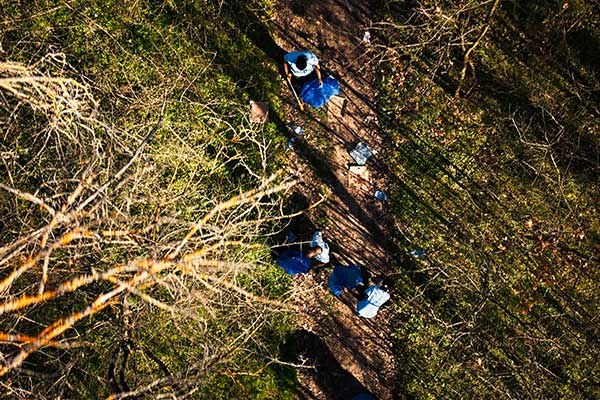
Underbrush clearing in Converse is about keeping the trees worth keeping and removing everything that has volunteered around them. On established lots that means clearing out hackberry and tallow saplings from under mature live oaks and pecans. On acreage it means opening the ground beneath post oaks that have been standing since this was farm country. Either way the trees stay and the mess goes.
Out goes hackberry and chinaberry saplings, Chinese tallow, privet, greenbriar, poison ivy, young mesquite and huisache, and the volunteer growth crowding the base of better trees. Staying are live oaks, post oaks, pecans, cedar elms, and anything planted deliberately that you want kept. We walk it with you and mark keepers before anything starts, and where something is ambiguous we ask instead of deciding for you.
Almost nothing we remove here was planted. Hackberry seeds itself into every unmaintained corner and grows fast into weak, brittle trees. Chinese tallow has spread across the wetter eastern parts of this area and reseeds heavily, particularly near drainages. Chinaberry does the same. All three reach a size where removal becomes a real job within a handful of years, which is why catching them as saplings is dramatically cheaper than catching them later.
The strip along a rear fence or a utility easement is where this problem starts on almost every Converse property. Nobody mows it, nobody looks at it, and within a few years there is a row of hackberry and tallow growing through the fence. Clearing that strip properly, including the stumps of resprouting species, is one of the most worthwhile maintenance jobs available and it protects the fence itself from being pushed apart.
The mature live oaks and pecans on these properties are worth real money in shade and in value, and they are usually the reason to do selective work rather than clearing. Removing competing understory reduces the draw on water and nutrients and improves airflow. The risks are mechanical damage and root zone compaction, both of which we manage by keeping equipment out of root zones, doing close work by hand, and watching ground conditions since working near a tree on wet clay compacts soil in a way that shows up years later.
Oak wilt is present in Bexar County and live oaks are root grafted, so the standard caution applies. Understory work should not be wounding oaks at all, but where a cut or scrape happens during the high risk window in late winter and spring it gets painted the same day. If your neighborhood has a known history, mention it at the walkthrough so we can plan the sequence around it.
The species we are removing here nearly all resprout from the crown, and the seed source is usually still present in the surrounding area regardless of what happens on your lot. That means understory clearing is a maintained condition rather than a permanent one. A short return visit every year or two costs a fraction of the first clearing and keeps the property from closing back in, which is the cheapest way to own a lot with trees on it here.
Open ground beneath the canopy, with the fence line visible and reachable again. On a small lot the usable area often increases noticeably once the back strip stops being a thicket, and owners regularly comment that the yard feels larger than they remembered. Where light now reaches the soil, turf and ground cover generally recover through the following season. Areas that stay deeply shaded become a straightforward decision about beds rather than a losing fight with grass.
There is no need to do everything in one visit. Starting with the fence line and the area nearest the house handles the most pressing problems, and the rest can follow in a later season. That spreads the cost and lets you see how much regrowth you are actually dealing with before committing to the whole property, which makes the maintenance cycle easier to plan realistically.
Underbrush clearing across Converse, Live Oak, Universal City, Selma, Schertz, Cibolo, Kirby, China Grove, St. Hedwig, Adkins, and neighboring San Antonio areas.
Tell us which trees matter and what you want to be able to reach. Call 210-942-1961.
Selective removal of what grows beneath the canopy, leaving mature trees and general landscape intact. Around Converse that usually means taking out hackberry, chinaberry, Chinese tallow, greenbriar, and privet while keeping live oaks, post oaks, and pecans. It is very different from clearing an area to bare ground, which is what land clearing does.
Because nobody mows it and it is where birds drop seed. Hackberry, chinaberry, and tallow all establish readily in that strip, and within a few years they are growing through the fence and pushing it apart. Clearing the strip and dealing with the stumps of resprouting species is one of the better maintenance investments on a property here.
Now, without question. Hackberry, tallow, and chinaberry reach removal size within a handful of years, and taking one out as a sapling costs a tiny fraction of removing it as a mature tree. Owners who stay ahead of volunteers spend far less over a decade than those who let them grow and then face several real removals at once.
Generally yes, by reducing competition for water and nutrients and improving airflow around the trunk. The risks are mechanical damage and root zone compaction, which is why close work is done by hand and equipment stays out of root zones. Working near a mature tree on wet clay compacts soil in ways that show up in the tree's health years later.
Some of it, and the honest expectation is a maintenance cycle rather than a permanent fix. The species here resprout from the crown, and the surrounding seed source usually remains regardless of what you do on your own lot. A short return visit every year or two costs far less than letting the property close in and clearing it fully a second time.
Yes, and it is worth keeping accessible for practical reasons as well as appearance. Easements filled with growth make it harder for crews to reach equipment and can generate complaints. Confirm what your easement documents permit and whether the utility has its own requirements before scheduling, since some easements carry conditions on what can be planted or built there.
It is quoted by the job on residential lots and by the acre on larger properties. Drivers are understory density, how many trees have to be worked around, how much has to be done by hand rather than by machine, and haul off volume. Fence line strips are usually quick and inexpensive compared with clearing a whole rear section.