
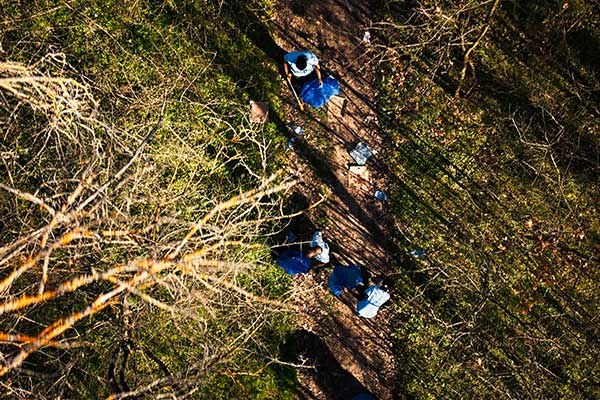
Underbrush clearing is the service that suits Garden Ridge best, for two reasons that happen to point the same direction. It gives owners what they actually want, which is an open wooded lot rather than bare ground. And it is the method that leaves the soil undisturbed, which on ground sitting over the recharge zone is exactly right.
Out goes Ashe juniper in the understory, persimmon, agarita, whitebrush, greenbriar, deadfall, prickly pear, and volunteer growth crowding the base of better trees. Staying are the live oaks, Spanish oaks, cedar elms, mountain laurel, and anything planted deliberately that you want kept. We mark keepers with you before anything starts, and where something is a judgment call we ask rather than deciding on your behalf.
Garden Ridge takes its trees seriously and the canopy is a large part of why people live here. A live oak with cedar grown up through and around it is competing for water on soil that is only inches deep over limestone. Thinning the juniper typically gives you healthier oaks, better structure as they respond to available light, and ground cover returning beneath within a season or two. It also removes the ladder fuel that lets a ground fire climb into a canopy nobody can replace.
This is the part that makes selective clearing the right method here rather than merely the preferred one. Removing understory with a mulching head or by hand leaves the root mat and soil completely intact and covers the ground with chip. No bare soil, no sediment, nothing exposed. Compare that with clearing a lot to dirt over ground that connects to the aquifer through features in the rock, and the choice makes itself.
Where the city’s tree code protects trees above a given size and deed restrictions cap how much of a lot may be cleared, selective understory work generally sits comfortably inside those limits, because the canopy is untouched and only ground level changes. It is frequently the approach that gets approved with the least difficulty. Bring your documents to the walkthrough so we design the scope around the actual thresholds.
This area sits inside the oak wilt region and live oaks here are root grafted, often across property lines. The disease travels through those connections and through beetles drawn to fresh wounds, which is why the standard guidance is to avoid wounding oaks during the high risk window in late winter and spring. Understory work should not wound oaks at all, but where a cut or scrape happens in that period it is painted the same day, and equipment stays clear of trunks and root flares.
Mulching where a machine can operate without disturbing root zones of keeper trees, and hand crews with saws close to trunks, landscaping, and structures. We also route the machine around any depressions or rock openings on the property rather than tracking over them. Material is generally left as chip in the wooded sections and hauled from areas near the house where owners want clean ground.
Open ground beneath a full canopy, with the trunk lines of the mature oaks visible for the first time in years. Owners regularly find the lot is considerably larger than they had come to think of it, because the usable area often doubles once the understory stops being a wall. The chip layer gives a finished, tended appearance rather than the scraped look full clearing leaves behind.
There is no need to open everything in one visit. Many owners start with the area around the house and the sight line they most want back, then work outward over a season or two. That spreads the cost, lets you judge how much light reaches the ground before deciding what to plant, and gives a realistic sense of the regrowth rate before committing to the rest of the property.
Underbrush clearing across Garden Ridge, Bulverde, Spring Branch, Schertz, Cibolo, Selma, Universal City, Bracken, New Braunfels, Timberwood Park, and throughout Comal, Guadalupe, and northern Bexar counties.
Tell us what you want to see and use when we are finished. Call 210-942-1961.
Underbrush clearing removes growth beneath the canopy and leaves mature trees, soil, and contour alone. Land clearing takes a defined area to bare workable ground including stumps. On a Garden Ridge lot, where the oaks are the point and the ground sits over the recharge zone, understory work is nearly always the appropriate service.
It avoids exposing soil, which is the main way clearing affects water quality here. Mulching and hand work leave the root mat intact and cover the ground with chip rather than creating bare surface that produces sediment. On terrain where features in the rock connect the surface to groundwater, that difference matters more than it would elsewhere.
Generally yes. Cedar growing through and around an oak competes directly for water on soil only inches deep over limestone, and it stacks ladder fuel against a tree you cannot replace. Removing it reduces competition and improves airflow. The caution is oak wilt, so any wound during the high risk season is painted the same day.
Usually more easily than full clearing. Where the code protects trees above a given size and restrictions cap clearing extent, selective understory work leaves the canopy untouched and tends to sit inside those limits. Confirm the specific thresholds with the City of Garden Ridge and bring your restrictions to the walkthrough so the scope is designed to fit.
Point them out at the walkthrough and we route equipment around them rather than tracking over them. On karst terrain those may be recharge features rather than simple low spots, and repeated machine traffic across one is not appropriate. If something looks like a genuine feature, we will say so rather than working through it.
Usually within a season or two where light reaches the soil and a seed bank remains. Cedar shade and water competition are what suppressed it. Areas that sat under closed canopy for decades sometimes need seeding, and the chip layer helps hold moisture on thin soil while that establishes.
Two to four years for a light maintenance pass on most lots, longer where the chip layer is suppressing seed. Cedar returns from seed rather than stumps, so the rate drops after the initial clearing but does not stop, since the surrounding seed source remains regardless of what you do on your own property.