
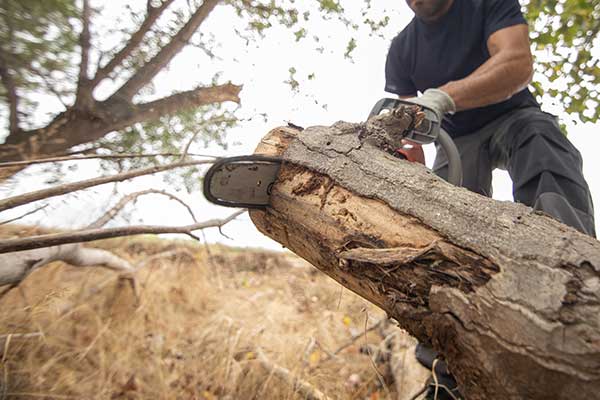
Tree removal at Canyon Lake is a slope problem before it is a tree problem. The tree is on a hillside, the house is below it, the driveway is too steep and narrow for a crane, and there is nowhere to drop anything. Hill Country Land Clearing removes trees across the Canyon Lake area with that reality planned for rather than discovered on the day.
On flat ground you fell a tree, cut it up, and carry it out. On a Canyon Lake lot a felled trunk does not necessarily stay where it lands, gravity is working against every piece you move, and the retrieval route is uphill. Add narrow switchback roads that a crane often cannot reach and short steep driveways with no turnaround, and the method usually ends up being sectional rigging with everything lowered under control. That takes longer and it is why access drives the price as much as the tree does.
Plenty of rough looking trees on these slopes are structurally fine and we will say so rather than quoting a removal. What generally justifies taking one out is extensive deadwood in the crown, conks or mushrooms at the base indicating root decay, a hollow or split trunk, a fresh lean with soil lifting on the uphill side, or storm damage that has compromised the structure. On slope, pay particular attention to soil movement at the base, since a tree on a hillside that starts to shift has a different failure pattern than one on level ground.
This county sits inside the oak wilt region and live oaks here are extensively root grafted, frequently across lot lines and sometimes down a whole hillside. The fungus travels through those connections and through beetles drawn to fresh wounds, which is why guidance across central Texas is to avoid cutting or pruning oaks during the high risk window in late winter and spring unless safety makes waiting impossible. When an oak must come out then, wounds are painted immediately. Containing an active infection center usually involves more than one tree.
Dry years leave standing dead juniper all over these lots, and it is among the most flammable material in Texas sitting on some of the most fire prone terrain in the state. Spanish oaks and post oaks also decline and die back after extended drought. On a lot where houses are close together and the road out is narrow, removing standing dead material near structures and along the access is some of the highest value work available.
There is a good argument for leaving stumps in place on steep ground, because the root system is still holding soil even after the tree is gone. Grinding below grade is usually enough for appearance and is the gentler option. Full grubbing pulls the root ball and is what you need under a foundation or a driveway, but on thin soil over limestone it can mean tearing into rock and leaving a hole that does not backfill cleanly. We tell you which outcome is realistic on your lot rather than promising clean ground and delivering a crater.
Canyon Lake is unincorporated, so there is no city tree ordinance and no municipal permit. What applies instead is your deed restrictions and property owners association, which in these subdivisions frequently protect trees above a certain trunk size, and the Corps of Engineers if the tree stands on the federal land around the reservoir rather than on your lot. Confirm your boundary and read your restrictions before scheduling.
After a storm the first job is making things safe rather than finishing a removal. That can mean taking down a hanging limb, relieving weight from a leaning trunk, or clearing a tree off a roof, a deck, or a driveway before the full removal is scheduled. If a tree or limb is on a power line, call your electric provider first, because energized conductors are their responsibility and not something to approach.
Tree removal across Canyon Lake, Startzville, Sattler, Fischer, Cranes Mill, Spring Branch, Bulverde, Smithson Valley, New Braunfels, and throughout Comal, Hays, Kendall, and Blanco counties.
Photos of the tree, the house, and the driveway approach get you an answer fast. Call 210-942-1961.
Because access and gravity do most of the work against you. A felled trunk on a hillside does not stay where it lands, every piece has to be moved uphill or lowered under control, and cranes often cannot reach these streets or fit these driveways. That usually means sectional rigging, which is slower and more labor intensive than felling a tree on open ground.
There is no city here, so no municipal tree permit. What applies is your deed restrictions and property owners association, which in these subdivisions commonly protect trees above a given trunk size. And if the tree stands on the federal land around the reservoir rather than on your lot, that is Corps of Engineers property. Confirm your boundary and read your restrictions.
Often not, and that is a genuine recommendation rather than us avoiding work. The root system continues holding soil after the tree is gone, which matters on this grade. Grinding below grade handles appearance while leaving the roots in place. Full grubbing is only necessary where a foundation, driveway, or pad is going over the location.
Get it properly diagnosed before acting, ideally by a certified arborist or the Texas A&M Forest Service, since oak wilt, drought stress, root decay, and hypoxylon can look similar. Comal County is inside the oak wilt region and the oaks here are heavily root grafted, so a confirmed case involves the surrounding trees rather than just the one that is declining.
That is what sectional rigging is for. Pieces come down from the top and are lowered under control rather than dropped, and equipment sits on protection where surfaces matter. On slope we also plan the retrieval route before the saw starts, because dragging material across a hillside can do more damage than the felling itself.
Yes, and it is common here after dry years. Standing dead juniper is extremely flammable and it tends to sit exactly where you least want it, near houses and along narrow access roads. Bulk removals get quoted by the area rather than per tree, and material can be mulched on site or hauled depending on access.
Your choice. It can be cut to firewood length and stacked on the lot, mulched, chipped, or hauled off. Haul off costs more here than in most places because every load goes out on narrow winding subdivision roads. Burning is generally a poor idea on a wooded slope and is often prohibited by restrictions or a county ban anyway.