
The most common tree problem in Converse is not disease or storm damage. It is a tree that was planted in the wrong place twenty years ago and has now grown into the size it was always going to be. Hill Country Land Clearing removes trees across Converse and the surrounding area, and a good share of the calls are exactly that situation.
When the newer subdivisions here went in, builders and early owners put trees where they looked right on a young lot rather than where a mature canopy would fit. Twenty years on, those trees are pressing against eaves, dropping limbs over roofs, lifting driveways and walks, and sending roots toward foundations and sewer laterals. It is not the tree’s fault and it is rarely a disease problem. It is a spacing problem that has finally arrived, and on lots this size it arrives sooner than it does elsewhere.
On clay soils a large tree close to a slab is a genuine consideration, because roots draw moisture out of the soil and clay shrinks as it dries, which can contribute to differential movement under a foundation. Roots also find their way into older sewer laterals through joints and cracks. Neither means every tree near a house has to come out, and we will say so when it does not. But if you are seeing foundation movement or recurring drain blockages on the side of the house where a large tree sits, it is worth having the tree considered as part of the picture.
Plenty of trees look worse than they are, and we would rather recommend pruning than sell a removal you do not need. What generally justifies taking one out is extensive deadwood in the crown, conks or mushrooms at the base indicating root decay, a hollow or split trunk, a new lean with soil lifting on one side, storm damage that has compromised the structure, or a location conflict that pruning cannot solve. On small lots the location question does a lot of the work.
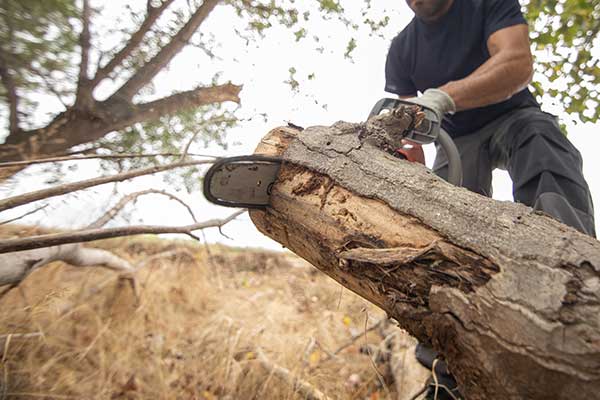
There is rarely room to fell a tree whole here. Most removals come down in sections from the top, with pieces rigged and lowered under control rather than dropped, working between a house, a fence, a neighbor’s roof, and often a pool. Where the street allows a crane, confined removals go faster and more safely. Equipment sits on protection where lawn and driveway condition matter, and the site is raked and blown before we leave.
Converse is an incorporated city with its own permitting, and in the newer subdivisions the HOA frequently protects trees independently of anything the city requires, sometimes including replacement obligations. That means two things to check rather than one. Confirm with the City of Converse and read your covenants before scheduling. The approval, where one is needed, belongs to the property owner.
After a storm the priority is making the situation safe rather than completing a removal, which can mean taking down a hanging limb, relieving weight from a leaning trunk, or clearing a tree off a structure or driveway before the full removal is scheduled. If a tree or limb is contacting a power line, call CPS Energy first, since energized conductors are their responsibility and not something for a homeowner or a crew to approach.
Grinding takes a stump below grade and suits turf or a bed. Full removal of the root ball is what you need if a pool, a pad, a driveway, or an addition is going over the location, and on these soils it is achievable rather than a fight with rock. If you are replanting, choose the species and the position for the tree it will become rather than the one you are planting, because the problem you are solving today started with exactly that decision.
On properties where multiple trees were planted at the same time in the wrong positions, it is worth looking at all of them together rather than one at a time. Mobilization is a fixed cost, so combining removals is more economical than separate visits. It also lets us tell you which trees genuinely need to go now, which can be pruned for clearance instead, and which are fine where they are, rather than quoting everything you point at.
Tree removal across Converse, Live Oak, Universal City, Selma, Schertz, Cibolo, Kirby, China Grove, St. Hedwig, Adkins, and neighboring San Antonio areas.
Photos of the tree, the house, and the access route get you an answer quickly. Call 210-942-1961.
Not always. Sometimes pruning for clearance solves it, particularly if the issue is limbs over the roof rather than the trunk position. Removal becomes the answer when the trunk is genuinely too close for the mature size, when roots are lifting hardscape, or when the crown cannot be reduced enough without ruining the tree. We will tell you which situation you are in.
On clay soils a large tree near a slab can contribute to foundation movement, because roots draw moisture from the soil and clay shrinks as it dries. That does not mean every nearby tree is a threat. If you are seeing movement or repeated drain blockages on the same side of the house as a large tree, it is worth having the tree assessed as part of the picture.
In many newer Converse subdivisions, yes, and it is separate from anything the city requires. Covenants sometimes protect specified trees and can include replacement obligations. Check your documents and confirm with the City of Converse before scheduling. Where approval is needed it is the property owner's responsibility rather than the contractor's.
Clearance drives it more than the tree does. A tree with room to be felled whole costs a fraction of the same tree that has to come down in rigged sections between a house, a fence, and a pool. Access for equipment and where debris can be staged both matter. Stump work is quoted as a separate line.
It depends what is going over the spot. Grinding several inches below grade is enough for turf or a planting bed. If a pool, a shed pad, a driveway, or an addition is going over the location, the root ball needs to come out entirely, which is achievable on these soils rather than being a fight with rock.
Something sized for the space it will occupy at maturity rather than the space available now. The problem most owners here are solving started exactly that way twenty years ago. Consider the mature canopy width, the distance to the foundation and the sewer line, and whether the position will conflict with a fence or a driveway once the tree is full size.
Yes. The first priority after a storm is making the situation safe, which may mean removing a hanging limb, relieving weight from a leaning trunk, or getting a tree off a structure or driveway before scheduling the full removal. If anything is contacting a power line, call CPS Energy first, because energized conductors are their responsibility.