
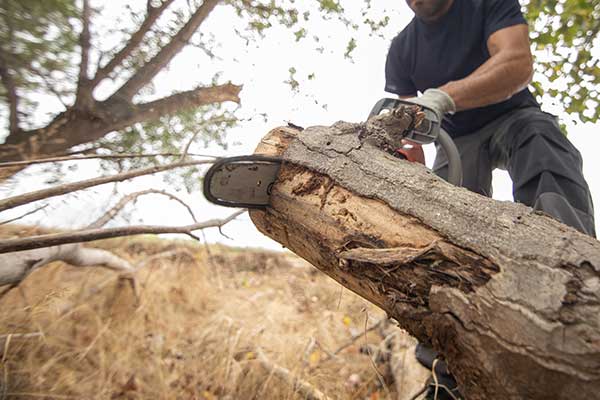
The live oaks are what make Fair Oaks Ranch look the way it does, and they are also the source of most of the tree work here. Oak wilt is present across this part of the Hill Country, the oaks on these lots are heavily root grafted, and a decision about one tree is frequently a decision about several. Hill Country Land Clearing removes trees across Fair Oaks Ranch with that context taken seriously.
Live oaks in this area are connected underground through root grafts, often across property lines and sometimes down an entire street. The fungus travels through those connections as well as through beetles drawn to fresh wounds. That is why the standing guidance across central Texas is to avoid cutting or pruning oaks during the high risk window in late winter and spring unless safety makes waiting impossible, and why any oak wound in that period gets painted immediately. Containing an active infection center generally involves more than removing the visibly affected tree, and severing root grafts by trenching is part of how that is done.
Several things look like oak wilt. Drought stress, root decay, hypoxylon on already stressed trees, and construction damage from years earlier all produce declining oaks. Removing a healthy tree helps nobody, and misreading a genuine oak wilt center costs you the trees around it. Get a proper diagnosis from a certified arborist or the Texas A&M Forest Service before making decisions, particularly where the answer will affect your neighbors’ trees as well as your own.
Plenty of trees look worse than they are, and we would rather recommend pruning or monitoring than sell a removal you do not need. What usually justifies taking one out is extensive deadwood in the crown, conks or mushrooms at the base indicating root decay, a hollow or split trunk, a new lean with soil lifting on one side, or storm damage that has compromised the structure. Location weighs heavily. The same defect is a monitoring item at the back of two acres and an urgent problem over a roof.
The city regulates tree removal through its code and the homeowners association covenants add their own protections, which can include protected tree definitions and replacement obligations. Both apply and satisfying one does not satisfy the other. Confirm current requirements with the City of Fair Oaks Ranch and read your covenants before scheduling. Where approval is required it belongs to the property owner, and we will not take down a protected tree that has not been cleared.
On the open parts of a larger lot, trees can often be felled directionally and processed on the ground, which is fast and safe. Near a custom home, a pool, or mature landscaping, the same tree comes down in sections from the top with pieces rigged and lowered under control. Where the driveway and street allow it, a crane makes confined removals faster and safer. Equipment sits on protection where lawn, driveway, and hardscape condition matter.
Grinding below grade is enough for lawn or a planting area and is the usual choice. Full grubbing removes the root ball and is necessary where a pool, a pad, or a driveway is going over the location. On thin soil over limestone, grubbing can mean tearing into rock and leaving a hole that does not backfill neatly, so we tell you which result is realistic on your lot rather than promising clean ground and delivering otherwise.
After a storm the first job is making the situation safe rather than finishing a removal, which may mean taking down a hanging limb, relieving weight from a leaning trunk, or clearing a tree off a structure or driveway before the full removal is scheduled. If a tree or limb is contacting a power line, call your electric provider first, since energized conductors are their responsibility and not something to approach.
If your removal comes with a replacement obligation, plan the new location before the stump is ground so the two decisions fit together. Given the deer pressure across this area, young plantings generally need protection to establish at all, which is worth budgeting for at the same time rather than discovering after the first winter.
Tree removal across Fair Oaks Ranch, Boerne, Leon Springs, Cross Mountain, Grey Forest, Helotes, Shavano Park, Bulverde, Timberwood Park, and throughout Bexar, Comal, and Kendall counties.
Photos of the tree and everything around it get you an answer quickly. Call 210-942-1961.
It might be, since this area is inside the affected region, but drought stress, root decay, hypoxylon on stressed trees, and old construction damage all look similar. Get a proper diagnosis from a certified arborist or the Texas A&M Forest Service before acting. Guessing wrong costs you either a healthy tree or the trees around a genuine infection center.
Both generally apply and they are separate. The city regulates tree removal through its code, and covenants add protections that can include protected tree definitions and replacement obligations. Satisfying one does not satisfy the other. Confirm with the City of Fair Oaks Ranch and read your covenants before scheduling, since approval is the owner's responsibility.
Outside the high risk window in late winter and spring, if the tree is not an immediate hazard. Fresh wounds in that period attract the beetles that carry the fungus, which matters enormously where oaks are as heavily root grafted as they are here. When removal cannot wait, immediate wound painting is the standard precaution and it is part of the work.
Severing root grafts by trenching between infected and healthy trees is a recognized containment measure, done to depths and distances a management plan specifies rather than by guesswork. It works best alongside a proper diagnosis and a plan covering the surrounding trees. Have an arborist or the Forest Service set the layout and we can carry out the work.
Possibly, depending on the tree and your covenants, since replacement obligations are common in restrictions here. Confirm at the approval stage rather than afterward, and plan the replacement location before the stump is ground so the decisions fit together. Budget for deer protection as well, since young plantings rarely establish here without it.
Height, diameter, species, lean, and above all clearance drive it. A tree with room to be felled whole costs a fraction of the same tree over a custom home and a pool requiring sectional rigging. Access here is generally good, with long driveways and wide gates, which tends to work in your favor. Stump work is a separate line.
Grinding below grade suits lawn or a planting area and is the usual choice. Full removal of the root ball is needed where a pool, pad, or driveway is going over the spot. On thin soil over limestone, grubbing can mean tearing into rock and leaving a hole that does not backfill cleanly, so we tell you what is realistic first.