
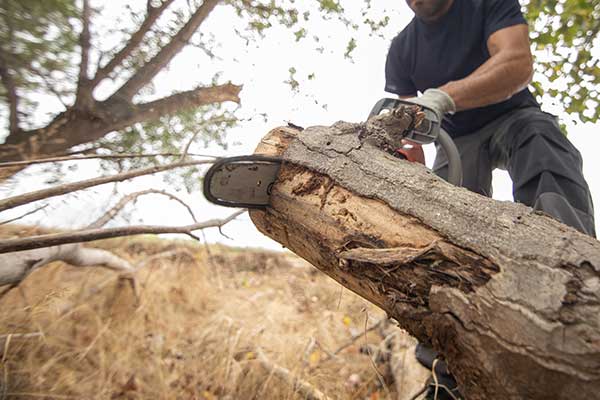
Tree removal in New Braunfels starts with the permit question, because this city protects its larger trees and the heritage tree rules have real teeth. Hill Country Land Clearing removes trees across the city and both counties it occupies, and we raise the approval issue at the first call rather than after the fact.
New Braunfels regulates tree removal through its code and gives specific protection to larger trees, with heritage designations attaching above certain trunk sizes depending on species. Removing one without approval is a serious matter rather than a paperwork oversight, and mitigation requirements can attach to approvals. Requirements inside city limits differ from unincorporated Comal or Guadalupe County. Confirm current thresholds with the City of New Braunfels before scheduling, since approval belongs to the property owner.
Trees along the Comal and the Guadalupe deserve separate consideration. Bald cypress on these banks are often very old, they are part of what defines this city, and their roots hold the bank in place. Removing one is rarely the right first answer and it may carry requirements beyond the standard tree code. If a bank tree is genuinely hazardous, get an arborist assessment and check with the city before assuming removal is the path.
Given the approval process here it is worth being certain before starting one. What generally justifies removal is extensive deadwood in the crown, conks or mushrooms at the base indicating root decay, a hollow or split trunk, a new lean with soil lifting on one side, or storm damage that has compromised the structure. Location weighs heavily, since the same defect is a monitoring item at the back of a tract and an urgent problem over a roof.
Comal County sits inside the oak wilt region and live oaks here are root grafted, often across property lines. Guidance is to avoid cutting or pruning oaks during the high risk window in late winter and spring unless safety makes waiting impossible, and to paint any wound immediately. That said, drought stress, root decay, and hypoxylon on already stressed trees all look similar. Get a proper diagnosis before making decisions, especially where the outcome affects neighboring trees.
This area has a genuine flood history and high water does damage that shows up later. Trees along the bottoms can be undermined, partially uprooted, or left with soil scoured from around the root plate, and they may look sound while being structurally compromised. After a major event, trees near the water are worth having looked at even where nothing appears obviously wrong. Immediately after a storm the priority is making things safe rather than completing removals.
On acreage there is room to fell directionally and process on the ground, which is fast and safe. In the older parts of town and in the newer subdivisions, trees near houses come down in sections from the top with pieces rigged and lowered under control. Where a street and driveway allow, a crane makes confined removals faster and safer. Equipment sits on protection where lawn and hardscape condition matters.
East and south, grubbing works cleanly because there is deep soil and no rock, so full root ball removal is realistic where a structure is going over the spot. West of the escarpment, grubbing can mean tearing into limestone and leaving a hole that does not backfill neatly, so grinding below grade is often the better outcome. We tell you which applies on your property rather than quoting one approach everywhere.
If a tree or limb is contacting a power line, call your electric provider before anyone approaches it. Energized conductors are their responsibility and not something for a homeowner or a crew to handle. Once clearances are established we can work safely around a line, but that assessment comes first rather than during the climb.
Where a property has multiple trees in question, looking at them in one visit is more economical than separate trips and gives a better picture of what is going on. It also lets us tell you which trees genuinely need to come out, which can be pruned instead, and which are fine. Given the approval process here, knowing that before you start filing paperwork on a heritage tree is worth something on its own.
Tree removal across New Braunfels, Gruene, Canyon Lake, Bulverde, Spring Branch, Garden Ridge, Schertz, Cibolo, Seguin, Marion, and throughout Comal and Guadalupe counties.
Photos of the tree and everything around it get you an answer quickly. Call 210-942-1961.
Inside city limits, very likely, and heritage designations attach to larger trees above certain trunk sizes depending on species. Removing a protected tree without approval is a serious matter and mitigation can attach to approvals. Requirements differ from unincorporated Comal or Guadalupe County. Confirm current thresholds with the city before scheduling.
Broadly, a tree the city protects at a higher standard because of its size and species, with thresholds set in the code. The practical effect is that removal requires approval and may carry mitigation requirements. Because the thresholds are specific and can change, confirm with the City of New Braunfels rather than relying on a general description or a neighbor's experience.
It is rarely the right first answer. Bald cypress on these banks are often very old, they hold the bank in place, and removal may carry requirements beyond the standard tree code. If a bank tree is genuinely hazardous, get an arborist assessment and check with the city before assuming removal is the path forward.
Possibly. High water undermines root plates, scours soil from around roots, and partially uproots trees that still look upright and leafed out. Structural damage from flooding often shows up well after the water goes down. Trees near the water are worth having assessed after a major event even when nothing looks obviously wrong.
It may be, since Comal County is inside the affected region and live oaks here are root grafted. But drought stress, root decay, and hypoxylon on stressed trees look similar. Get a proper diagnosis from a certified arborist or the Texas A&M Forest Service before acting, particularly where the answer affects neighboring trees as well as your own.
It depends on your side of the city and on what is going over the spot. East and south, deep soil with no rock makes full root ball removal realistic. West of the escarpment, grubbing can mean tearing into limestone and leaving a hole that will not backfill cleanly, so grinding below grade is usually better.
Height, diameter, species, lean, and above all clearance drive it. A tree with room to be felled whole costs a fraction of the same tree over a house requiring sectional rigging. Permit timing can also affect scheduling here more than in surrounding areas, so factor approval time into your planning as well as the work itself.