
Tree removal in Selma splits between two situations that look very different. On the commercial corridor there is a declining tree standing over a parking lot or a walkway where the public passes underneath all day. On the residential side there is the familiar failing hackberry over a driveway. Both need removing properly, and the first one carries a dimension the second does not.
A declining tree in a parking island or beside a walkway is a different problem from the same tree at the back of a lot. Cars are parked under it, people walk under it, and if a limb comes down the consequences are not confined to your property. For a commercial owner or manager, a tree showing clear signs of failure over an occupied area is worth acting on promptly rather than monitoring, and it is worth having documented that you did. We would rather tell you a tree is fine than remove it unnecessarily, but where it is not fine, the timeline matters.
Trees planted in parking islands rarely thrive, and it is not usually a mystery. Restricted root space in a small island, compacted soil, reflected heat off pavement, root damage from utility work, and irrigation that is either absent or excessive all contribute. A tree that has been struggling for a decade in a four foot island is not going to be saved by pruning. Understanding that helps when planning replacements, because putting the same species back in the same island produces the same result.
Selma regulates tree preservation through its code, and on a commercial site a tree may also be tied to an approved landscape plan or a mitigation obligation. Removing it can require both city approval and a plan revision. Confirm what applies before scheduling, since approval belongs to the owner rather than the contractor and unwinding an unauthorized removal on a commercial site is considerably harder than on a residential lot.
What generally justifies removal is extensive deadwood in the crown, conks or mushrooms at the base indicating root decay, a hollow or split trunk, a new lean with soil lifting on one side, or storm damage that has compromised the structure. Location weighs heavily. The same defect at the back of a vacant parcel is a monitoring item and over a customer entrance is not.
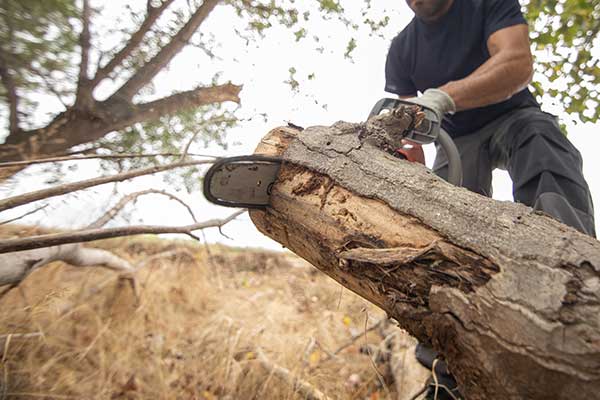
On open ground trees can be felled directionally and processed where they land. On a parking lot, beside a building, or on a residential lot with a fence and a neighbour, the tree comes down in sections from the top with pieces rigged and lowered under control. Commercial work usually means an early start, a lane or a section of parking coned off for the shortest possible time, and the area swept and reopened before the property gets busy.
On expansive clay, repeated wet and dry cycles work on root plates over time. A tree that develops a new lean with soil heaving or cracking on one side, particularly after a wet period following a long dry one, deserves prompt attention. That pattern differs from a tree that has always grown at an angle. If something has moved recently, have it assessed rather than waiting to see what happens.
Deep soil with no rock shelf means root balls come out whole rather than tearing into limestone. Grinding below grade suits turf or a landscape bed. Full removal is what you need where paving, a pad, or a new island is going over the location, and it matters on commercial work because a decomposing root ball under new paving produces exactly the settlement you were trying to avoid.
On a commercial property with a number of trees in landscape islands and perimeter areas, looking at all of them in one visit is more economical than separate calls and gives you a clearer picture of what you are managing. It also lets us tell you which trees genuinely need to come out, which can be pruned, and which are struggling but stable, which is useful information when planning a landscape budget rather than reacting to failures one at a time.
Tree removal across Selma, Schertz, Cibolo, Live Oak, Universal City, Converse, Garden Ridge, Kirby, Windcrest, and throughout Bexar, Comal, and Guadalupe counties.
Photos of the tree and what is around it get you an answer quickly. Call 210-942-1961.
More urgent than the same tree at the back of a property. Cars park under it and people walk under it all day, so a failure is not confined to your own property. Where a tree shows clear signs of structural failure over an occupied area, acting promptly and documenting that you did is worth more than continued monitoring.
Restricted root space in a small island, compacted soil, reflected heat off pavement, root damage from utility work, and irrigation that is absent or excessive all contribute. A tree struggling for a decade in a four foot island will not be saved by pruning. That matters for replacement planning, since the same species in the same island gives the same result.
Likely both city approval and possibly a landscape plan revision, since a tree on a commercial property may be tied to an approved plan or a mitigation obligation as well as the city's tree code. Confirm before scheduling. Unwinding an unauthorized removal on a commercial site is considerably harder than on a residential lot.
Usually we can work with a section coned off rather than a closure, and for the shortest time practical. Early starts are normal so the area is swept and reopened before the property gets busy. Tell us which hours matter and where customers and deliveries move, and we plan the work around that.
A new lean with soil heaving or cracking on one side deserves prompt attention, particularly after a wet period following a long dry one. On expansive clay, repeated cycles work on root plates over time. That differs from a tree that has always grown at an angle, so if it has moved recently, have it assessed rather than waiting.
Grinding below grade suits turf or a landscape bed. Full removal is needed where paving, a pad, or a new island is going over the location, and on commercial work it matters, since a decomposing root ball under new paving produces exactly the settlement you were trying to avoid. Deep soil here makes full removal practical.
Clearance drives it more than the tree does. A tree with room to be felled whole costs a fraction of the same tree requiring sectional rigging over parked cars or between a building and a walkway. Working hours and access restrictions on an operating property also factor in. Stump work is quoted as a separate line.