
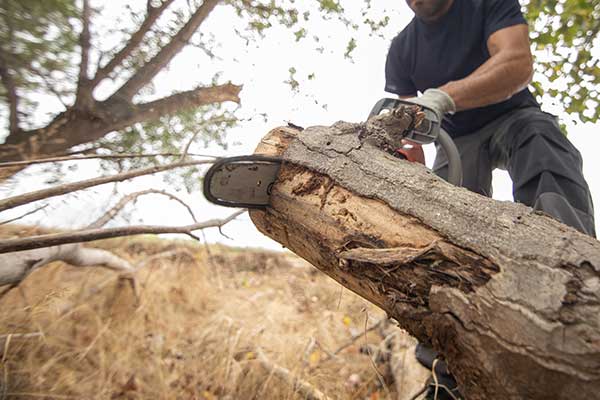
Removing a tree in Terrell Hills is rarely a simple decision. The tree is usually large, usually old, frequently planted deliberately by someone who knew what they were doing, and protected by city ordinance besides. Hill Country Land Clearing removes trees here with all of that taken seriously, and we would rather talk you out of an unnecessary removal than sell you one.
Terrell Hills is a separate incorporated city with its own government and its own tree requirements, and San Antonio’s rules do not apply to your lot. Protected trees generally require approval before removal and conditions can attach. Thresholds differ from neighbouring cities, so a friend’s experience a few blocks away is not a guide. Confirm current requirements with the City of Terrell Hills before scheduling. Approval belongs to the property owner, and we will not remove a protected tree that has not been cleared.
Here is a problem specific to designed landscapes of this era. Trees were placed for the effect they would give within a reasonable timeframe, not always for what they would be at eighty years. Two live oaks set thirty feet apart look correct for decades and then begin competing, with crowns growing into each other and one usually losing. At that point the choice is often between removing one to save the other or watching both decline. It is a real horticultural decision and worth an arborist’s opinion rather than a contractor’s.
Live oaks across 78209 are extensively root grafted, often across property lines and sometimes down an entire street. Oak wilt travels through those connections as well as through beetles drawn to fresh wounds, which is why the standing guidance is to avoid cutting or pruning oaks during the high risk window in late winter and spring unless safety makes waiting impossible. When an oak must come out then, wounds are painted immediately and equipment is cleaned between trees. Containing an active centre involves more than one tree.
Several conditions look like oak wilt, including drought stress, root decay, hypoxylon on already stressed trees, and construction damage from years earlier that is only now expressing itself. Removing a healthy tree helps nobody, and on these properties it also means an approval process you did not need. Get a proper diagnosis from a certified arborist or the Texas A&M Forest Service before deciding, particularly where the answer affects neighbours’ trees as well as your own.
What generally justifies removal is extensive deadwood in the crown, conks or mushrooms at the base indicating root decay, a hollow or split trunk, a new lean with soil lifting on one side, or storm damage that has compromised the structure. Location weighs heavily. The same defect at the back of a deep lot is a monitoring item and over a bedroom or a drive where cars park is not.
Few trees on these properties can be felled whole. Most come down in sections from the top with pieces rigged and lowered under control, working between a house, a wall, a pool, mature planting, and often a neighbour’s roof. Where the street and drive allow it, a crane makes confined removals faster and safer. Equipment sits on protection where lawn, drive, and hardscape condition matter, and the site is raked and blown before we leave.
On a property like this the removal itself is rarely the risk to the rest of the canopy. The equipment route is. Driving repeatedly across the root zones of oaks that are staying can put them into decline that appears two or three seasons later, which is a poor trade for taking out one tree. We plan machine routes around root zones and lay protection where crossing is unavoidable.
Grinding takes a stump below grade and suits lawn or a bed. Full removal of the root ball is needed where a pool, a pad, or paving is going over the location. If you are replanting, think about the mature size and the spacing rather than the effect next year, since the crowding problem on these properties began with exactly that decision made eighty years ago in good faith.
Tree removal across Terrell Hills, Alamo Heights, Olmos Park, Lincoln Heights, Mahncke Park, Northwood, Castle Hills, and neighbouring San Antonio blocks.
Photos of the tree and everything around it get you an answer quickly. Call 210-942-1961.
Very likely for protected trees. This is a separate incorporated city with its own tree requirements, and San Antonio's rules do not apply to your lot. Thresholds also differ from neighbouring cities, so a friend's experience a few blocks away is not a guide. Confirm with the City of Terrell Hills before scheduling.
That is a genuine horticultural decision and worth an arborist's opinion rather than a contractor's. Trees placed thirty feet apart looked correct for decades and are now competing, and often one is losing. The choice is frequently between removing one to save the other or watching both decline, which is not a call to make casually.
It may be, since oaks across 78209 are heavily root grafted and the disease is present. But drought stress, root decay, hypoxylon, and construction damage from years earlier all look similar. Get a proper diagnosis from a certified arborist or the Texas A&M Forest Service before deciding, particularly where neighbours' trees are involved.
Outside the high risk window in late winter and spring, if the tree is not an immediate hazard. Fresh wounds in that period attract the beetles that carry the fungus, which matters enormously where oaks are as connected as they are here. When removal cannot wait, immediate wound painting is standard and part of the work.
Not from the removal itself, but potentially from the equipment route. Driving repeatedly across the root zones of trees that are staying can put them into decline appearing two or three seasons later, which is a poor trade. We plan machine routes around root zones and lay protection where crossing cannot be avoided.
Clearance drives it more than the tree does. Few trees on these properties can be felled whole, so most come down in rigged sections between a house, a wall, a pool, and often a neighbour's roof, which takes considerably longer. Where a crane can be positioned it is often faster and safer. Stump work is a separate line.
Something chosen for its mature size and spacing rather than the effect next year. The crowding problem on properties here began with exactly that decision made eighty years ago in good faith by people who otherwise knew what they were doing. Plan the location before the stump is ground so both decisions work together.