
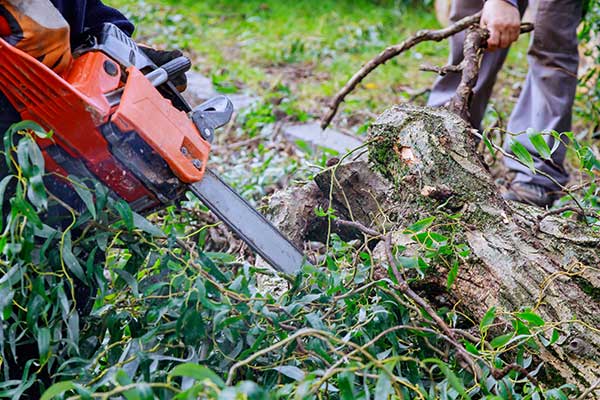
Back yards in Castle Hills are big enough that the far end can get away from you without anyone quite noticing. A few seasons of not going back there and the fence line disappears, the shed is swallowed, and the last thirty feet of the lot is a wall of ligustrum and hackberry. Hill Country Land Clearing clears overgrown yards, fence lines, and neglected lots across Castle Hills and the surrounding 78213 area.
The problem plants on these lots were nearly all planted deliberately or arrived by bird. Ligustrum is the worst of them, reseeding into every unmaintained corner and forming thickets that shade out anything underneath. Chinaberry, nandina, and privet fill in behind it. Hackberry seedlings come up everywhere and grow into weak trees that break in the first real wind. English ivy and Virginia creeper climb trunks and fences. Greenbriar and poison ivy take over the back line. Each behaves differently when cut, which is why one round of trimming buys about a season.
A large share of the calls we get here come from two situations: a property that has been rented for years while nobody looked at the back half, and a family home that has passed to adult children after a long period of the owner being unable to maintain it. Both usually mean a decade of accumulated growth, plus dumped material, plus fencing that has quietly failed under the weight of vines. It is a bigger job than a normal cleanup but it is a very common one, and there is nothing unusual about the condition.
Ligustrum, chinaberry, and hackberry all resprout hard from the stump. Cut them flush and you get five stems where there was one, often within a few months. Real removal means pulling the root crown where access allows, grinding the stump below grade, or pairing the cut with follow up treatment. We tell you at the quote which plants on your property will fight back, so you can choose between a one time clearing and a maintenance approach with your eyes open.
Castle Hills has its own city government and its own property maintenance standards, enforced locally rather than by San Antonio. Overgrown lots, encroaching vegetation, and unmaintained rental properties can draw notices. Getting ahead of it is far cheaper than responding to repeat citations, and if the property is going on the market a cleared lot shows enormously better in photographs and in person than one where a buyer cannot see the back fence.
Most brush work here touches a shared boundary. Before cutting on a fence line we confirm which side is yours and what is rooted where, since anything growing on their side is theirs to decide about. We let adjacent owners know when noisy work is happening, keep material from dropping over the line, and avoid staging where we block someone’s driveway. On lots where a failing fence is being held up mostly by vines, we say so before we remove them.
No burning, no piles left behind. Brush is cut, loaded, and taken to disposal, with the truck staged so it does not block the street. Heavy jobs get multiple trips rather than one overloaded load, and the work area is raked and blown before we leave. If you would rather have the material chipped and kept for beds somewhere on the property we can do that instead, though most owners here want it gone.
Winter is the best season for heavy brush work. Vines and understory are dormant, you can see the structure of what you are cutting, poison ivy is less active, and crews are not working blind into dense growth that hides wasps, snakes, and old fencing. Summer work is entirely possible, just slower and less pleasant for everyone involved.
Overgrown corners on these lots hold more than plants. Collapsed wooden fencing, old chain link swallowed years ago, garden edging, buried irrigation, forgotten planters and birdbaths, dumped building material from a remodel two owners ago, and occasionally a cleanout or a utility box nobody has seen in a decade. Metal and hardware are why we do not run a chipper blind into a thicket. We clear by hand into the material first, separate what is not vegetation, and price that handling rather than absorbing a surprise mid job.
Brush removal throughout Castle Hills, Shavano Park, Hollywood Park, Hill Country Village, Balcones Heights, Leon Valley, Olmos Park, Alamo Heights, and neighboring San Antonio blocks around West Avenue, Blanco Road, and NW Military Highway.
Photos of the back fence line are usually enough for a preliminary number. Call 210-942-1961.
Ligustrum, followed closely by hackberry seedlings. Ligustrum was planted widely as a hedge in this area decades ago and now reseeds into every unmaintained corner, forming thickets under the canopy. Hackberry comes up everywhere and grows into weak trees that break easily. Most brush work in Castle Hills is invasive removal rather than native brush control.
Yes, and it is a large share of what we do here. Long neglected rental and inherited properties usually combine a decade of growth with dumped material and failing fencing, which makes them a bigger job than a routine cleanup but a very familiar one. We assess it in person because photos rarely convey the volume accurately.
Yes. It is common along back fence lines here, often climbing the trunks where people do not notice it until they are already in it. Crews handle it with proper protection and it goes out with the debris rather than being chipped, since chipping disperses the oil. Tell us if you know it is present so we can plan for it in advance.
Usually. Where growth has grown into the wire or the pickets we work it off by hand, which is slower than machine work but avoids tearing the fence apart. Where a fence is already failing and the vines are effectively holding it upright, we will tell you honestly before we start that removing the brush may be what finally takes it down.
We notify adjacent owners on the day as a courtesy, but a heads up from you a few days ahead goes further, particularly where work is right on a shared boundary. If any of the vegetation is rooted on their side, that is their property and we would need their permission to cut it, so it is worth establishing beforehand.
It is quoted by the job, driven by material volume, the size of the woody stems, whether equipment can reach the area, and how many haul off loads result. A back corner cleanup is a very different scale from a full lot that has been unmanaged for a decade. Hand only access raises the price because the work moves considerably slower.
Some of it. Ligustrum, hackberry, chinaberry, and greenbriar all resprout from the root crown unless the crown is removed or treated, and ligustrum reseeds continually. After the initial clearing, a short maintenance visit every year or two holds the property for a fraction of the first cost. Left alone, most lots here close back in within three to five years.