
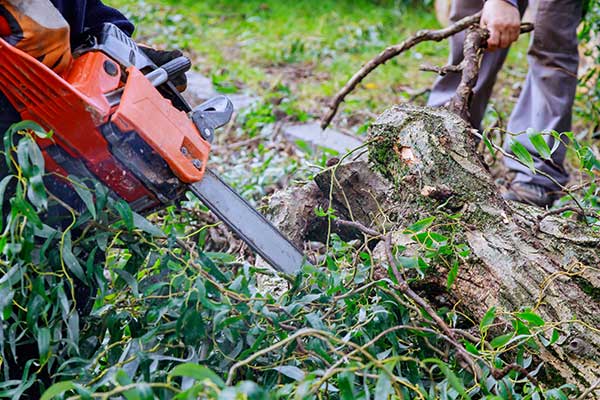
Brush here is cedar, and cedar does not need anyone’s permission to move in. Ashe juniper regenerates from seed across this whole area, and a wooded lot that was open beneath the oaks a decade ago fills in without anybody deciding to allow it. Hill Country Land Clearing removes brush across Garden Ridge on lots of every size, using methods that suit ground where what happens on the surface reaches the aquifer more directly than most places.
Ashe juniper dominates, filling in beneath the live oaks until the lot is impassable at ground level. Persimmon, agarita, whitebrush, and greenbriar follow it, with prickly pear on the more open sections. Cedar has one useful characteristic: cut below its lowest green growth it does not resprout from the stump. The others come back from the root crown, so a lot with a mixed population needs a mixed approach rather than one blanket treatment.
This is wildland urban interface with substantial houses in it. Cedar is among the most volatile fuels in Texas, and on wooded lots it forms continuous cover running from the boundary straight up to the structure. Clearing brush back from the house, the outbuildings, and the propane tank, and breaking up continuous fuel across the lot, is the highest value brush work available here. Clearing the driveway wide enough for a fire truck to get in and turn around belongs in the same conversation.
Something particular to this area: depressions in the ground are not always just low spots. On karst terrain a surface depression can be a recharge feature connected to the aquifer, and it is not somewhere to run equipment repeatedly, stack brush, or fill in. If there are depressions, exposed rock openings, or areas that swallow water after a storm on your property, point them out at the walkthrough. We work around them rather than through them, and if something looks like a genuine feature we will say so.
On most properties, how brush is removed is mainly a question of cost and appearance. Here it is also a question of what gets left exposed. Cutting and mulching leave the soil and root mat undisturbed, which on the recharge zone is the right instinct. Grubbing and blade work create exposed soil that can move, so we confine them to areas where a project genuinely requires it. This is not us being precious, it is the reason this area has rules that others do not.
Lots here are large but boundaries still matter. Before cutting on a line we confirm which side is yours and what is rooted where, since anything on the neighbor’s side is theirs to decide about. We let adjacent owners know when noisy work is happening and keep material from crossing a line. Where a property backs onto undeveloped land, we confirm where your ownership actually ends before anything is cut.
It is easy to assume rules only cover trees. Deed restrictions here can also govern how much of a lot may be cleared and whether material can be left on site, and the city’s tree code may capture more than you expect depending on stem size. Selective brush work usually sits comfortably inside those limits since the canopy is untouched, but bring your documents to the walkthrough so the scope is built to fit rather than around assumptions.
Sections of a lot left alone since the property was developed hold more than juniper. Old construction debris, abandoned irrigation, fencing remnants, dumped landscape material, and occasionally a wellhead or a cleanout nobody has seen in years. Metal is what damages a mulching head, so we work by hand into dense material first, separate what is not vegetation, and price that handling rather than absorbing a surprise partway through the job.
The first clearing on a lot that has closed in over fifteen years is the expensive one, because the cedar has gone from cuttable to needing real horsepower and the volume is high. Everything after that costs a fraction. Owners who bring us back on a light cycle never watch the fuel load rebuild against the house and never pay for a full reclaim twice, which on a wooded lot here is the most sensible habit available.
Brush removal across Garden Ridge, Bulverde, Spring Branch, Schertz, Cibolo, Selma, Universal City, Bracken, New Braunfels, Timberwood Park, and throughout Comal, Guadalupe, and northern Bexar counties.
Photos of the house, the driveway, and the area you want cleared are the most useful thing to send. Call 210-942-1961.
The area immediately around the structure gets the most attention, with cedar and brush pulled well back and nothing flammable stacked against walls or under decks. Beyond that the goal is breaking up continuous fuel rather than clearing everything. Keeping the canopy while removing the understory is usually the right outcome, since ladder fuel is what carries fire upward.
It regenerates from seed, and the seed source across this area is substantial regardless of what happens on your own property. Cut below its lowest green growth it does not resprout from the stump, which helps, but new seedlings continue to establish. That makes cedar control a maintenance cycle rather than a one time job, though a much slower one after the first clearing.
Not without finding out what they are first. On karst terrain a surface depression can be a recharge feature connected to the aquifer rather than a simple low spot, and filling or driving over one is not appropriate. Point them out at the walkthrough. We work around features rather than through them and will tell you if something warrants proper assessment.
Deed restrictions here can govern clearing extent and whether material may be left on site, and the city's tree code may capture stems larger than you would expect. Selective understory work usually sits within those limits, but it is worth confirming before scheduling rather than assuming brush is unregulated because it is not a mature tree.
If a fire truck cannot get up it and turn around, yes. Long driveways with cedar crowding both sides are common here and they genuinely limit whether a structure can be defended. Clearing the approach and providing a turnaround is inexpensive to add while equipment is already on the property and it matters more than clearing the back corner.
Not if the method is right. Cutting and mulching leave the soil and root mat undisturbed, which is the appropriate approach on the recharge zone. It is grubbing and blade work that create exposed soil, and we confine those to areas where a project actually requires them. That distinction matters more here than in most places.
Plan on revisiting defensible space every year or two, and the wider lot every two to four years. Cedar returns from seed rather than stumps, so the rate drops noticeably after the first clearing. Properties kept on a cycle cost a fraction of what it takes to reclaim one that has been allowed to close back in completely.