
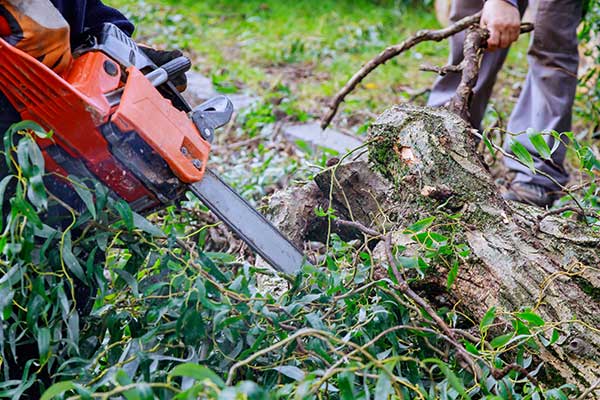
People have been cutting cedar in this part of the country for well over a century. The cedar choppers who worked these hills made a living at it because Ashe juniper grows here faster and thicker than almost anywhere, and nothing about that has changed. Hill Country Land Clearing removes brush across Helotes, on subdivision lots and on the acreage west of town.
Helotes carries some of the highest wildfire exposure in Bexar County, and the terrain is the reason. Fire moves uphill fast, faster on steep ground, and the draws between ridges act as chimneys that pull it through. Cedar is one of the most volatile fuels in Texas and here it forms continuous cover across property lines and up every slope. If you own a house in Helotes, brush removal is a fire decision before it is a landscaping one.
The standard advice about clearing around a structure needs adjusting on this terrain. Fire approaching from below reaches a house faster than fire approaching on the flat, which means the downhill side needs more clearance than the uphill side, not the same amount. Everything under decks and exterior stairs gets attention, since those collect litter and are where embers settle. The goal throughout is breaking up continuous fuel, not stripping the lot bare.
A long climbing driveway with cedar crowded against both sides is a real limitation on whether a structure can be defended. Fire apparatus needs width, vertical clearance, and somewhere to turn around, and so does an ambulance. Clearing the approach is unglamorous work that matters more than clearing the back of the lot, and it is worth adding while equipment is already on the property.
Ashe juniper dominates and regenerates from seed across the whole area. Persimmon, agarita, whitebrush, and greenbriar fill in underneath, with prickly pear on the more open ground. Cedar has one genuinely helpful trait: cut below its lowest green growth it does not resprout from the stump. The others come back from the root crown. A lot with a mixed population needs a mixed approach rather than one blanket treatment.
Method matters here beyond cost and appearance. This watershed drains toward Helotes Creek and contributes to the aquifer, and on steep ground bare soil moves. Cutting and mulching leave the root mat undisturbed and put chip on the surface, which is the right instinct. Grubbing and blade work create exposed soil, so we confine those to areas where a project genuinely requires it. Fuel reduction and soil retention are not in conflict if the method is chosen properly.
On continuous cover, one property’s fuel load is the neighborhood’s problem, which most people here already understand. Before cutting along a boundary we confirm which side is yours and what is rooted where. We let adjacent owners know when noisy work is happening and keep material from crossing a line. Where a property adjoins undeveloped or protected land, we confirm the boundary before anything is cut rather than assuming.
Sections of a property left alone for years hold more than juniper. Old fencing swallowed by regrowth, dumped material from a previous owner, abandoned irrigation, deadfall stacked by nobody in particular, and occasionally a wellhead or a cleanout. Metal is what damages a mulching head, and on a slope it is much better found by a person on foot than by a machine. We work by hand into dense material first and price debris handling rather than absorbing a surprise mid job.
The first clearing on a property that has closed in over fifteen years is the expensive one, because the cedar has gone from cuttable to needing real horsepower and the volume is high. Everything afterward costs a fraction. Given the fire exposure here, owners who bring us back on a light cycle every year or two are not just saving money, they are keeping the fuel load near the house from rebuilding to where it was.
Brush removal across Helotes, Grey Forest, Scenic Oaks, Cross Mountain, Fair Oaks Ranch, Leon Springs, Shavano Park, Rio Medina, Mico, and throughout northwest Bexar, Medina, and Kendall counties.
Photos of the house, the downhill side, and the driveway are the most useful thing to send. Call 210-942-1961.
More on the downhill side than the uphill side, because fire approaching from below moves faster on this terrain. The area immediately around the structure gets the most attention, including under decks and stairs where litter collects and embers settle. Beyond that the goal is breaking up continuous fuel rather than clearing everything to bare ground.
Terrain plus fuel. Fire moves uphill quickly and this is all slope, with draws between ridges acting as chimneys. Cedar is among the most volatile fuels in Texas and it grows here in continuous cover running across property lines. Add access limitations on narrow climbing roads and the exposure is genuinely higher than in flatter parts of the county.
If a fire truck cannot get up it and turn around, yes. Long climbing driveways with cedar crowding both sides are common here and they directly affect whether a structure can be defended or a person can be reached. Clearing the approach and providing a turnaround is inexpensive while equipment is already on the property.
Not if the method is right. Cutting and mulching leave the soil and root mat intact and leave chip on the surface. It is grubbing and blade work that expose soil, and on ground draining toward Helotes Creek that matters beyond your own property. We confine soil disturbing methods to areas where the project genuinely requires them.
It regenerates from seed and the seed source across this area is substantial regardless of what you do on your own lot. Cut below its lowest green growth it does not resprout from the stump, which helps considerably, but new seedlings continue to establish. That makes it a maintenance cycle, though a much slower one after the first clearing.
The city's tree code may capture stems larger than you would expect, and deed restrictions in many subdivisions address clearing extent. Selective understory and brush work usually sits within those limits since the canopy is untouched, but confirm before scheduling rather than assuming brush is unregulated because it is not a mature tree.
Revisit defensible space every year or two and the wider property every two to four years. Given the fire exposure here, staying ahead of regrowth near the house is worth more than any other maintenance you do on the lot, and it costs a fraction of reclaiming a property that has closed back in.