
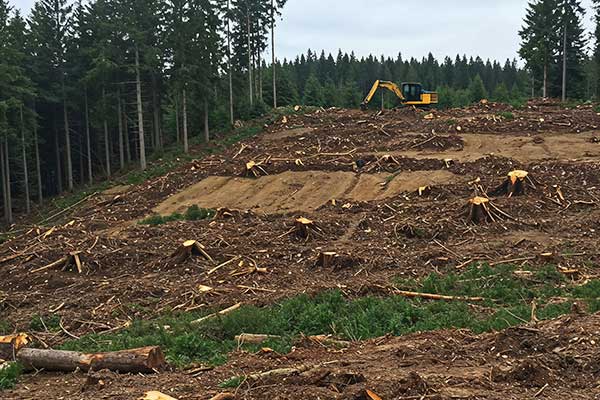
Forestry mulching grinds standing brush and small trees into chip in one pass and leaves it on the ground. On acreage it is the standard method. In a built out residential city like Castle Hills it is a specialist tool, right for certain properties and wrong for others. We would rather tell you which one you have before you pay for it.
A mulching head is a rotating drum with carbide teeth mounted on a compact track loader or an excavator arm. It cuts material from the top down and reduces it to chip where it stands. The machine tracks over its own mulch and never digs, so topsoil and root structure stay in place. There are no piles, no burning, and no trucks running material off the property, which on a job with real volume saves both time and disposal cost.
On a maintained residential lot, mulching usually is not the answer. It leaves a chip layer that looks correct on a wooded property and looks like a construction site on a landscaped one. The machine needs room to maneuver and overhead clearance, which many back yards do not have once you account for the gate, the patio, and mature planting. And it does not remove stumps, so it is no substitute for grubbing where a pool, a foundation, or a driveway is going in. If cutting and hauling is the right method for your lot, we will quote that instead.
The honest way to decide between mulching and haul off on a Castle Hills property is to estimate the volume. A back corner cleanup generates a couple of loads and hauling is simple. A half acre that has not been touched in fifteen years can generate ten or more, and at that point the disposal trips become the dominant cost of the job. Mulching removes that cost entirely. The trade is appearance, and whether that matters depends on whether the area is part of your usable yard or the back of the property.
The gate is usually the constraint rather than the vegetation. We run compact machines that fit standard residential openings, but a mulching head still needs swing room and clearance under a mature canopy. Before quoting we check gate width, turning space, whether the route to the back crosses anything that cannot take machine weight, and where the trailer can be parked to unload. On commercial parcels this is generally much easier.
It is ground cover rather than waste. It shades soil, slows runoff, suppresses some regrowth by blocking light to seed, and breaks down into organic matter over a few seasons. Depth depends on how much material was standing, and a heavy ligustrum thicket leaves more than scattered brush. If you plan to seed or plant soon after, we can thin the heaviest concentrations so seed reaches soil rather than sitting on chip.
Mulching cuts at grade but leaves the roots. Species that resprout from the root crown, which here means ligustrum, hackberry, chinaberry, and privet, will push back through the layer within a season or two. That is not a defect in the method, it is a reason to plan a follow up pass rather than expecting one visit to settle the property for good. On a maintained cycle it is a short and inexpensive return visit.
On a larger Castle Hills lot the right answer is frequently both methods rather than one. Mulch the back section where volume is high and appearance matters less, and cut and haul the areas closer to the house where you want clean ground and no chip layer. That splits the job along the line where the trade off actually changes, instead of applying one method to a property that has two different kinds of area on it. We lay that out on the quote so you can see where the boundary falls.
Mulching throughout Castle Hills, Shavano Park, Hollywood Park, Hill Country Village, Leon Valley, Balcones Heights, and surrounding San Antonio areas where lot size and access make it practical.
Send an address and we can usually assess density and access before scheduling a walkthrough. Call 210-942-1961.
Sometimes, and often not. The machine needs maneuvering room and overhead clearance, and the chip layer suits a wooded area rather than a landscaped yard. It makes sense here on larger lots, vacant parcels, commercial properties, and heavily overgrown rear sections. On a maintained back yard, cutting and hauling usually produces the result you actually want.
Estimate the volume. A couple of truckloads is easy to haul and mulching offers little advantage. Ten or more loads and the disposal trips become the biggest cost in the job, at which point mulching saves real money. The other question is appearance, which depends on whether the area is part of your usable yard or the back of the property.
No. The head grinds material to or slightly below grade and the root system stays in place. If you need stumps gone for a pool, a foundation, a casita pad, or a driveway, that is grubbing work with an excavator and it gets quoted separately. For areas going back to turf or planting, grinding is usually sufficient.
Wood chip on open ground is not a meaningful termite attractant by itself, but like any landscape mulch it should not be piled against the house, a wooden fence, or an outbuilding. We keep the layer back from structures. The same standard practice that applies to bagged mulch from a garden center applies here.
Yes, and access is usually far easier than on residential lots, which makes it efficient. Overgrown commercial and mixed use parcels on the arterials clear quickly once a machine can get on them. Commercial work may carry additional requirements from the city, so confirm what Castle Hills needs for your parcel before scheduling.
Roughly an inch to several inches depending on how much material was standing. Dense ligustrum leaves more than scattered brush. If depth is a concern for planting or appearance, we can spread it more evenly or pull the heaviest concentrations back during the same visit rather than leaving it uneven.
The species here that resprout from the root crown will return through the chip within a season or two. Cedar, which does not resprout, is a smaller part of the mix on these lots than it is on acreage further out. Plan on a maintenance pass every year or two, which is a short job compared with the initial clearing.