
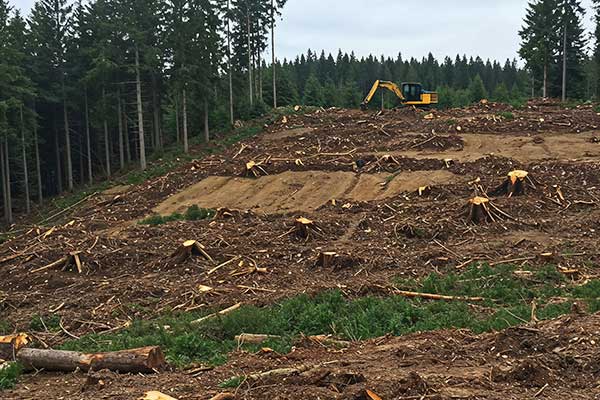
Forestry mulching suits Shavano Park better than it suits most residential areas, and lot size is the reason. On a quarter acre suburban lot the machine cannot fit and the chip looks wrong. On a wooded acre, there is room to work, cedar goes through a head efficiently, and the chip layer looks entirely appropriate under a canopy of live oaks.
A mulching head is a rotating drum with carbide teeth mounted on a compact tracked machine or an excavator arm. It cuts standing material from the top down and reduces it to chip where it stands. The machine tracks over its own mulch and never digs, so soil and root structure stay in place. No piles, no burning, no disposal trips down a private driveway. The back of a lot goes from impassable to walkable in a day or two.
Three things line up. Cedar is the dominant species and it mulches beautifully, feeding through a head quickly and breaking down into a stable cover. Soil is thin over limestone across much of the city, so anything that strips it takes something that will not come back, while mulching leaves it entirely alone. And on a wooded property the chip layer reads as ground cover rather than as construction debris, which is the objection that rules mulching out on maintained suburban lawns.
This matters and it is not true everywhere. Cedar cut below its lowest green growth does not resprout from the stump, so mulched juniper largely stays gone and returns only from new seed over a period of years. That means mulching produces a genuinely lasting result on a cedar dominated lot here, unlike on the east side of the region where the dominant species come back from the root crown within a season. Persimmon and whitebrush in the mix will resprout through the chip.
Close to the house the chip layer is usually not what an owner wants across maintained landscape, and around pools, patios, and beds the machine has neither the room nor any business working. Those areas get hand crews and haul off. Mulching also leaves stumps and roots, so it is no substitute for grubbing inside a structural footprint. Most properties here end up with both methods in different areas, which is the right answer rather than a compromise.
Mulching does not exempt work from the city’s tree requirements. The code may capture stems above a certain size regardless of the method used to remove them, so the question is what you are removing rather than what machine removes it. Confirm thresholds with the City of Shavano Park before scheduling, and if there is any doubt about a particular stem, we would rather ask than find out afterward.
Access here is generally better than in older neighbourhoods, but a few things still need confirming: gate width, whether the driveway will carry a lowboy, overhead clearance under mature canopy along the approach, and where equipment can stage without blocking your turnaround. On lots where the working area sits well behind the house, we also check the route in does not require crossing root zones we are trying to protect.
A dozer pushes material into piles and takes soil with it, and on ground carrying inches of soil over limestone that loss is permanent. Blade work is still correct where a project genuinely needs bare ground inside a defined footprint. Everywhere else on a wooded lot here, mulching gives you the cleared ground without the cost that scraping imposes on the soil itself, and without the appearance of a construction site.
A few details prevent most first day problems. Mark anything you want left standing, including young oaks that disappear inside dense cedar. Point out septic components, irrigation, low voltage lighting, buried metal, and old fencing. Confirm gate width, overhead clearance along the driveway, and where a lowboy can stop to unload. Ten minutes on this saves considerably more time than it costs.
Mulching throughout Shavano Park, Hollywood Park, Hill Country Village, Helotes, Leon Springs, Cross Mountain, Fair Oaks Ranch, Stone Oak, and neighbouring northwest San Antonio areas.
Send the address and photos of the area and the driveway approach. Call 210-942-1961.
Better than it suits most residential property. On a wooded acre there is room for the machine to work and the chip layer reads as ground cover rather than construction debris. On a quarter acre suburban lawn neither of those is true. Close to the house and around maintained landscape, cut and haul is still the right method here.
Cedar cut below its lowest green growth does not resprout from the stump, so mulched juniper largely stays down and returns only from new seed over a period of years. That is a genuinely lasting result. Persimmon, whitebrush, and other root crown sprouters in the mix will come back through the chip within a season or two.
No. The head grinds material to or slightly below grade and the root system stays in place, which here is helpful since intact roots hold thin soil over limestone. If you need stumps out for a pool, a foundation, a casita pad, or a driveway, that is grubbing work inside a defined footprint and it is quoted separately.
Possibly. The city's code may capture stems above a certain size regardless of the method used, so the question is what is being removed rather than which machine does it. Confirm thresholds with the City of Shavano Park before scheduling, and if a particular stem is in doubt we would rather ask than proceed.
An inch to several inches depending on how much material was standing, with heavy cedar leaving more. On thin soil over limestone the chip is genuinely beneficial, holding moisture and adding organic matter as it breaks down. If you are planting in the area we can thin the heaviest concentrations so material reaches the soil.
Usually, though we confirm the specifics first: gate width, whether the driveway carries a lowboy, overhead clearance under canopy along the approach, and where equipment can stage. Where the working area sits well behind the house we also check that the route in does not cross root zones we are trying to protect.
Usually, because disposal is a significant cost and mulching removes it entirely. On a property with a long private drive, every load hauled is a slow trip. The trade off is a chip layer rather than clean ground and stumps left in place, which is why most owners here use mulching in the back sections and haul off nearer the house.