
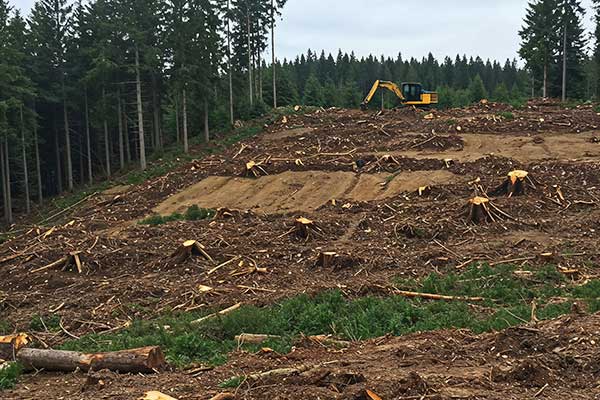
Forestry mulching is the default method on Spring Branch acreage and the reasons stack up quickly. The material never leaves the property, which matters enormously when the property is at the end of several miles of private road. The soil stays where it is, which matters on thin ground over limestone. And cedar, the dominant species here, mulches beautifully and stays down afterward.
A mulching head is a rotating drum with carbide teeth mounted on a tracked machine or an excavator arm. It cuts standing material from the top down and reduces it to chip where it stands. The machine tracks over its own mulch and never digs, so soil and root structure stay in place. There are no piles waiting on a burn ban to lift, no windrows, and no trucks running material out down a ranch road that would not enjoy the traffic.
On a suburban lot, haul off is a couple of truck trips. On a hundred acre tract twenty minutes off the county road, it is a serious logistical operation and often the single largest cost in the job. Mulching eliminates it completely. That alone makes it the right method on most properties here before you even get to the soil and erosion arguments, and it is why owners who priced haul off and then priced mulching rarely go back.
This is the fact that makes mulching produce lasting results on this side of the region. Cedar cut below its lowest green growth does not resprout from the stump, so mulched juniper stays gone and returns only from new seed over a period of years. That is genuinely different from the east side of the region where the dominant species come back from the root crown within a season. Persimmon and whitebrush in the mix will resprout through the chip.
Hill Country rainfall arrives in volume and this ground has little capacity to absorb it. Land cleared to bare dirt on any slope will move, and the soil you lose took a very long time to accumulate over that limestone. Mulching leaves the root mat intact and adds a chip layer that slows runoff, which means you can open a tract up without watching it wash into a draw the following spring and end up in the river.
Better to say before you pay. Mulching does not remove stumps or roots, so it is no substitute for grubbing where a foundation, a road base, a pond, or a septic field is going. It has practical diameter limits and large hardwoods are better felled and processed conventionally. And on genuinely severe slope there are limits to what a tracked machine can work safely, which we identify at the walkthrough rather than on the hillside.
This is the constraint that shapes scheduling on most Spring Branch jobs. The machine arrives on a lowboy, which needs a road it can navigate, a place to stop, and room to unload. Long unpaved private roads, cattle guards of uncertain capacity, and low water crossings all get checked before we commit to a date. On some tracts the answer is that the machine goes in and stays for the duration rather than coming and going.
A dozer pushes material into piles and takes soil with it, and on ground carrying a few inches over limestone that loss is permanent. Blade work remains correct when you genuinely need bare ground for a pad, a road, or a pond. Everywhere else on Spring Branch acreage, mulching leaves the soil in place and turns the vegetation into cover, and it finishes faster because there is no piling, burning, or hauling.
Little is needed from you, but a few details help. Mark anything you want left standing, including young oaks and madrones that vanish inside dense cedar. Point out well heads, septic components, buried lines, and any old fencing or metal. Confirm gate width, cattle guard capacity, and whether the ranch road will carry a lowboy in current conditions rather than in a dry August.
Mulching throughout Spring Branch, Bulverde, Canyon Lake, Startzville, Fischer, Blanco, Wimberley, Boerne, Comfort, New Braunfels, and across Comal, Kendall, Blanco, and Hays counties.
Send the address and we can assess density from imagery before scheduling a walkthrough. Call 210-942-1961.
Because the material never leaves the property, and on a tract at the end of several miles of private road, hauling is often the largest single cost in a clearing job. Add thin soil that should not be stripped and cedar that mulches well and stays down, and the arguments all point the same direction on most properties here.
Cedar cut below its lowest green growth does not resprout from the stump, so mulched juniper largely stays down and returns only from new seed over a period of years. That makes mulching genuinely lasting on a cedar dominated tract. Persimmon, whitebrush, and other root crown sprouters in the mix do come back through the chip.
No. The head grinds material to or slightly below grade and the root system stays in place, which here is a feature since intact roots hold thin soil on slope. If you need stumps out for a foundation, a road base, a pond, or a septic field, that is grubbing work and it gets quoted separately.
That gets settled before we commit to a date. The machine arrives on a lowboy needing a navigable road, somewhere to stop, and room to unload, and out here that means checking unpaved private roads, cattle guard capacity, and any low water crossing on the route. On some tracts the machine goes in and stays for the duration.
For most tracts here, yes. There is no waiting out a Comal County burn ban, no fire risk on a windy afternoon, no smoke drifting onto a neighbour, and no burn scars left in the pasture. Burning still has a place on very large tracts with enormous volume and a genuinely safe place to do it.
Light growth can run several acres in a day. Mature closed canopy cedar on slope can take a full day per acre or more. Rock, grade, and travel between working areas all factor in, and on a large remote tract so does the distance the machine covers between sections. We give a day count with the quote.
Generally help. The chip layer holds moisture in thin soil, moderates temperature, and protects against erosion while grass reestablishes. Very heavy concentrations can block seedlings, which is why we can thin the deepest areas if you are seeding right away. Most tracts see grass return within a season or two once cedar stops shading it.