
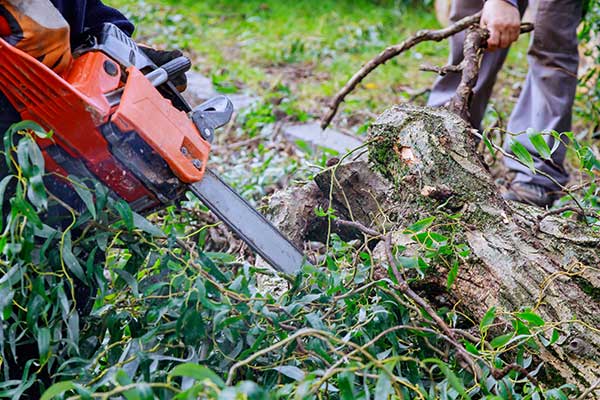
Brush in Alamo Heights does not creep in from open pasture. It comes from the fence line, the alley, and the creek, and it is mostly things that were planted on purpose decades ago and then escaped. Hill Country Land Clearing clears overgrown yards, side lots, rear alley frontage, and creek banks across 78209, hauling everything out and leaving a property that looks tended rather than stripped.
The problem plants in this part of San Antonio are almost all introduced. Ligustrum is the worst offender, forming dense thickets under the oaks and reseeding everywhere birds land. Nandina, chinaberry, and privet fill in behind it. English ivy and Boston ivy climb trunks and walls and get into mortar joints. Greenbriar and poison ivy take over the back fence line. Along the creeks you get elephant ear, giant cane, and hackberry saplings. Each of these behaves differently when cut, which is why blanket trimming buys you about one season.
Ligustrum, chinaberry, and hackberry all resprout hard from the stump. Cut them at ground level and you get five stems where there was one, usually within a few months. Real removal means pulling the root crown with a machine where access allows, grinding the stump below grade, or pairing the cut with follow up treatment. We tell you at the quote which plants on your property are going to come back so you can decide between a one time clearing and a maintenance approach.
On lots this size almost every brush job touches a shared boundary. Before cutting anything on a fence line we confirm which side is yours and what overhangs from where. We let adjacent homeowners know when noisy work is happening, keep material from being dropped over the line, and avoid staging equipment where it blocks a neighbor’s alley access. In a neighborhood where everybody knows everybody, that part of the job matters as much as the cutting.
Alamo Heights maintains its own property maintenance standards, and overgrown lots, encroaching vegetation, and obstructed alleys can draw notices. Vacant properties and rentals are the usual candidates. Getting ahead of it is far cheaper than responding to repeated citations, and a cleared lot is also much easier to show if the property is going on the market.
There is no burning and no mulch pile left behind. Brush is cut, loaded, and hauled to disposal, with the truck staged so it does not block the street. On heavy jobs we make multiple trips rather than overloading, and we rake and blow the work area before we leave. If you want the material chipped and kept for beds somewhere on the property, we can do that instead, but haul off is what most homeowners here want.
Winter is the best season for heavy brush work in Alamo Heights. Vines and understory are dormant, visibility is better, poison ivy is less active, and you can actually see the structure of what you are cutting. Summer work is entirely possible but slower, and dense growth hides wasps, snakes, and old fencing that nobody remembers installing.
Overgrown corners in this neighborhood usually contain more than plants. Old chain link that was swallowed years ago, sections of collapsed wooden fence, garden edging, buried irrigation, forgotten planters, and occasionally a well head or a cleanout. Metal and hardware are the reason we do not run a chipper blind into a thicket. We clear by hand into the material first, separate what is not vegetation, and price debris handling for it rather than absorbing a surprise mid job.
The first clearing on a long neglected lot is always the expensive one, because the stems have gone from cuttable to needing real equipment and the volume is high. After that, holding the property takes a fraction of the effort. Owners who bring us back on a light cycle every year or two never see the thicket return, and the annual cost is a small share of what a full reclaim would run. It is the single best way to own a wooded lot here without fighting it.
Brush removal throughout Alamo Heights, Terrell Hills, Olmos Park, Lincoln Heights, Mahncke Park, Northwood, and the neighboring San Antonio blocks along Broadway, Austin Highway, and Basse Road.
Photos of the fence line or the back corner are usually enough for a preliminary number. Call 210-942-1961.
Ligustrum, by a wide margin. It was planted as an ornamental across this part of San Antonio decades ago and now reseeds into every unmaintained corner, forming thickets under the oaks that shade out everything else. Nandina, chinaberry, privet, and English ivy follow the same pattern. Most brush jobs here are invasive removal rather than native brush control.
Yes. It is common along back fence lines and creek banks here, often climbing the oaks where people do not notice it until they are already in it. Crews handle it with proper protection and it goes out with the rest of the debris rather than being chipped, since chipping aerosolizes the oil. Tell us if you know it is present so we can plan for it.
In most cases yes. We work the vegetation off the fence by hand where the growth has grown into the wire or the pickets, which is slower than machine work but avoids damaging the fence. Where a fence is already failing under the weight of vines, we will tell you honestly that removing the brush may be what finally takes it down.
We do it as a courtesy on the day, but a heads up from you a few days ahead goes further. Where work is right on a shared boundary or where equipment needs to swing over a line, it is worth a conversation first. If any of the vegetation is rooted on the neighbor's side, that is their tree or shrub and we would need their approval to cut it.
It is quoted by the job, driven by the volume of material, the size of the woody stems, access for equipment, and how many haul off loads it generates. A back corner cleanup is a different scale from a full lot that has been unmanaged for a decade. Hand only access raises the price since the work moves slower.
Some of it will. Ligustrum, hackberry, chinaberry, and greenbriar all resprout from the root crown unless the crown is removed or treated. Once the initial clearing is done, a short maintenance visit every year or two holds the property in condition for a fraction of what the first clearing cost. Left alone, most lots here close back in within three to five years.
Yes, and it is one of the more common calls we get in 78209. Buyers cannot assess a lot they cannot walk. Clearing the rear yard, the fence lines, and the understory lets the property photograph properly and shows the actual lot size, the mature trees, and any structures that were hidden. It is usually a short job with a large effect on presentation.