
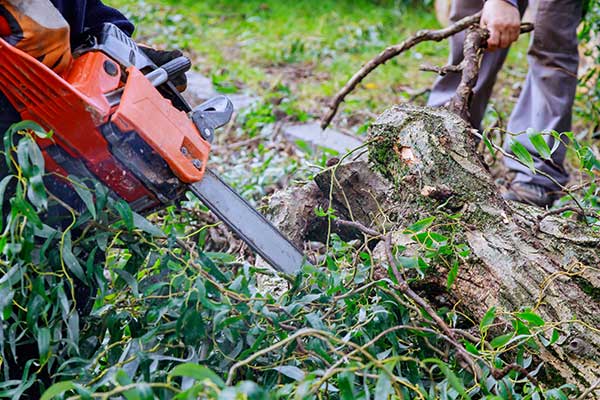
Brush around Cibolo behaves differently from brush in the Hill Country, and the difference decides whether your money is well spent. Out west, cedar cut below the green does not come back. Here, nearly everything comes back. Mesquite, huisache, retama, chinaberry, hackberry, and Macartney rose all resprout from the root crown, and a cut that does not deal with the crown produces a thicker thicket than the one you paid to remove.
A mature mesquite cut flush at ground level will typically push several new stems from the base within a season. Two years later you have a multi stemmed shrub where there was a single trunk, and it is harder to remove than the original was. Huisache does the same and faster. This is the single most important thing to understand before buying brush work in Guadalupe County, and it is why we talk about root crowns rather than about cutting.
Worth calling out on its own because it defeats a lot of owners. It forms dense thorny mounds across old pasture, spreads by both seed and by canes rooting where they touch ground, and shrugs off shredding entirely. Mowing it repeatedly tends to thicken it. Getting rid of it means mechanical removal that takes the crown out, usually with a grubbing attachment, and often a follow up on what regenerates. Treat it as a campaign rather than a single job.
Because the soil is deep clay with no rock, an excavator or a grubbing attachment can take the root crown out cleanly, which is not always possible further west. That makes real control achievable on a Cibolo tract rather than aspirational. It costs more per acre than shredding or mulching, and it is worth it, because shredding a mesquite pasture is an annual expense forever while grubbing is a job that largely stays done.
This was farm and ranch country until very recently and the wire proves it. Barbed and net wire swallowed by brush, t posts standing in the middle of nowhere, cross fencing from an era when the tract was divided differently, and gates hanging in fence lines that no longer exist. Wire wraps machine components and it is dangerous for anyone on foot. We look for it specifically, pull it as part of the work, and price it honestly rather than discovering it as a change order.
Plenty of tracts around Cibolo still carry agricultural valuation, and brush encroachment works against the grazing capacity that supports it. Brush control is standard practice for keeping pasture productive. If your valuation depends on a particular use or a management plan, work to that rather than clearing arbitrarily, and confirm requirements with the Guadalupe County Appraisal District. Tell us what your situation requires and we will clear to it.
Wet clay and heavy equipment do not mix. After significant rain, ground here needs real drying time before machines go on it, and working it too early leaves ruts that set hard and become a separate problem. We schedule around that, and on tracts where timing is tight we will tell you honestly if the window is a bad one rather than showing up and making a mess of your property.
Prickly pear spreads from dropped pads that root wherever they land, which is why shredding it makes the problem larger rather than smaller. Removal means picking it up and taking it out rather than cutting through it, and keeping it separate from material that is going to be mulched so pads are not redistributed across the tract. Heavy infestations usually need a second look the following season for whatever regenerated from pieces left behind.
Because nearly everything here resprouts, the honest question at the quote stage is whether you want a tract to look clear next month or to be clear in three years. Those are different jobs at different prices. A single mulching pass is inexpensive and temporary. Grubbing crowns costs more and largely holds. Neither is wrong, but choosing without knowing the difference is how owners end up paying twice and feeling misled.
Brush removal across Cibolo, Schertz, Universal City, Selma, Live Oak, Converse, Marion, Santa Clara, St. Hedwig, Seguin, New Braunfels, and throughout Guadalupe, Comal, and northeastern Bexar counties.
Tell us the acreage, the access, and whether the ground is going back to pasture. Call 210-942-1961.
Because cutting removes the top but leaves the root crown, and mesquite responds by pushing multiple new stems from the base. A single trunk becomes a multi stemmed shrub within a couple of seasons and it is harder to remove than the original. Real control requires taking the crown out or treating it, not just cutting at ground level.
Mechanically, by removing the crown, and expect to follow up. It spreads by seed and by canes rooting where they touch the ground, and shredding tends to thicken it rather than reduce it. Repeated mowing is what most owners try first and it rarely works. Treat it as a campaign over a couple of seasons rather than a single clearing job.
On this soil, usually yes. Deep clay with no rock means the crown can be removed cleanly, which makes real control achievable. Shredding a mesquite pasture is an expense you repeat every year or two forever. Grubbing costs more once and largely stays done, so the comparison should be lifetime cost rather than the price of a single pass.
It gets pulled and removed as part of the work, priced as its own line. Former farm and ranch tracts around Cibolo nearly always have more buried wire than the owner recalls, and it damages equipment and is hazardous to crews on foot. We look for it deliberately during the walkthrough rather than finding it with a machine.
Brush control is standard practice for maintaining grazing capacity, so it generally supports an agricultural use rather than working against it. What matters is that the work fits whatever your valuation is based on. Confirm the requirements with the Guadalupe County Appraisal District and tell us what your situation calls for so we clear to it.
Extended dry stretches, which usually means late summer or a dry winter spell. Black clay holds water and needs real drying time after rain before it will carry equipment. Working it too wet leaves ruts that set hard and become a separate repair problem. We would rather move a date than damage the ground.
Often more than expected. Mesquite and huisache canopy suppresses grass production well beyond the footprint of the individual plants, and Macartney rose takes ground out of use entirely. Recovery depends on whether grass is still present underneath and on rainfall afterward, but reclaimed pasture on this soil generally responds well once the competition is removed.