
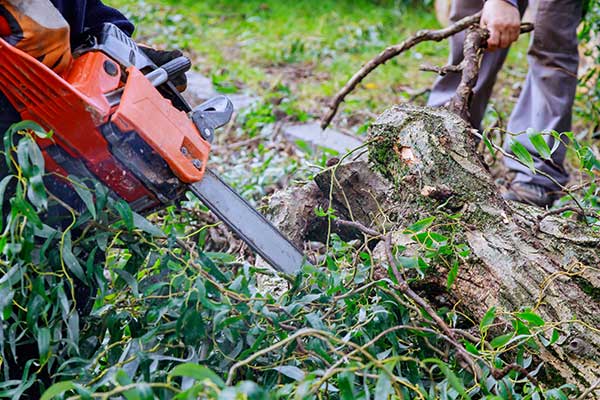
Brush on a Live Oak lot is mostly the savannah trying to reassert itself. Underneath the native oaks, yaupon and hackberry come up thick wherever nobody is mowing, and within a few years the back third of a yard is a wall. Hill Country Land Clearing clears overgrown yards, fence lines, and neglected parcels across Live Oak and the surrounding northeast Bexar area.
If you have a wooded lot here you almost certainly have yaupon holly. It is native, it is evergreen, and left alone it forms dense thickets under the oak canopy that nothing else grows through. It also resprouts vigorously from the base, so cutting it flush gives you a multi stemmed version of the same shrub within a season. Owners are often surprised how much lot they get back when it comes out, because a yaupon thicket hides more space than almost anything else in this area.
Hackberry seeds itself into every unmaintained corner and grows into weak, brittle trees. Chinaberry and ligustrum do the same. Chinese tallow has spread through the wetter parts of northeast Bexar and reseeds heavily. American beautyberry shows up in the understory and is worth keeping where you have it, since it is native and well behaved. Greenbriar and poison ivy take over back fence lines. Almost everything except beautyberry resprouts from the crown.
Yaupon, hackberry, chinaberry, ligustrum, and tallow all come back from the root crown. Cut them at ground level and they return with more stems than they had. Real removal means pulling the crown where access allows, grinding the stump below grade, or pairing the cut with follow up treatment. The sandy surface soil here actually helps, since crowns pull more easily than they would in heavy clay. We tell you at the quote which plants on your lot will fight back.
The reason brush removal here needs care is that the thicket you are clearing sits directly on the root zone of trees you want to keep. Post oaks especially do not tolerate compaction, and running a machine repeatedly across their roots to get at yaupon can cost you the tree over the following few years. On lots with good native oaks, more of this work gets done by hand than an owner might expect, and that is a deliberate choice rather than an inefficiency.
Live Oak enforces its own property maintenance standards through the city rather than through San Antonio. Overgrown lots, encroaching vegetation, and accumulated debris can generate notices, and vacant properties and rentals are the usual candidates. Staying ahead of it is cheaper than responding to repeat citations, and a cleared lot shows far better if the property is going on the market or being leased.
No burning, no piles left behind. Material is cut, loaded, and taken to disposal, with multiple trips on heavy jobs rather than one overloaded load. The work area is raked and blown before we leave. If you would rather have material chipped and kept for beds on the property we can do that, though most owners here want it gone entirely.
Yaupon hides more than open ground. Behind a thicket that has stood for fifteen years we routinely find collapsed fence panels, old chain link swallowed by growth, dumped building material from a previous remodel, play equipment nobody removed, and occasionally a cleanout or utility box unseen in years. Metal is why we do not run equipment blind into dense growth. We work by hand into it first, separate what is not vegetation, and price that handling honestly.
For a property that is selling, one visit usually covers it. For a home you intend to keep, a short maintenance visit every year or two is far cheaper than clearing a thicket every five years, and it keeps the ground under your oaks in a condition where you can actually see what is happening to the trees. Owners who get on a cycle rarely go back to the full reclaim.
Brush removal across Live Oak, Universal City, Selma, Converse, Schertz, Cibolo, Windcrest, Kirby, and neighboring San Antonio areas along Pat Booker Road, I-35, and Loop 1604.
Photos of the back fence line and the area under the oaks are usually enough for a preliminary number. Call 210-942-1961.
Yaupon holly is a native evergreen shrub that thrives under oak canopy in this area. Left unmanaged it forms dense thickets that nothing grows through, and it resprouts vigorously from the base, so cutting alone produces a multi stemmed version of the same plant. Removing it typically gives owners back far more usable yard than they expected.
Most of it. Yaupon, hackberry, chinaberry, ligustrum, and tallow all resprout from the root crown unless the crown is removed or treated. The sandy surface soil here helps, since crowns pull more easily than they would in heavy clay. A short maintenance visit every year or two costs a fraction of the first clearing.
Not if it is done carefully, and this is the main reason we hand work more of these lots than you might expect. The thicket sits directly on the root zones of the trees you are keeping, and post oaks in particular do not tolerate compaction. Repeatedly running a machine over those roots can cost you the tree within a few years.
American beautyberry is worth keeping where you have it, since it is native, well behaved, and produces fruit birds use. Some cover away from the house is genuinely valuable. What is worth removing is the dense yaupon and the invasive hackberry, chinaberry, ligustrum, and tallow that crowd out everything else and offer far less in return.
Live Oak enforces its own property maintenance standards, and overgrown lots, encroaching vegetation, and accumulated debris can all generate notices. Vacant properties and rentals are the usual candidates. Scheduled clearing is generally cheaper than responding to repeat citations, particularly for owners who are not local to the property.
Yes. It is common along back fence lines here and often climbs the oaks where nobody notices it until they are in it. Crews handle it with proper protection and it goes out with the debris rather than being chipped, since chipping disperses the oil. Let us know at the walkthrough if you know it is present.
It is quoted by the job, driven by material volume, stem size, whether equipment can reach the area, and how many haul off loads it produces. A back corner cleanup is a very different scale from a full lot that has been unmanaged for a decade. Where hand work is needed to protect oak roots, that raises the price and is worth it.