
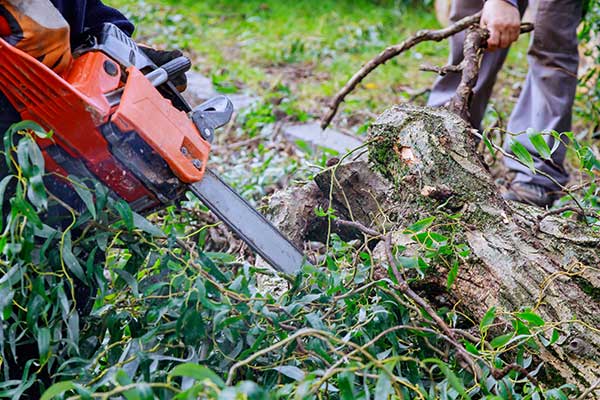
Some of the most useful brush work we do in Schertz is on ground nobody thinks of as landscaping: detention basins, drainage easements, and the common areas behind master planned subdivisions. Those features have to keep working, and when they fill with mesquite and hackberry they stop working. Hill Country Land Clearing handles that alongside the ordinary business of overgrown yards and vacant parcels.
Every subdivision and commercial site built here in the last two decades has detention, and those basins were sized and shaped to hold and release a specific volume of water. When they grow up in brush, capacity is reduced, outlet structures get blocked, and the inspection that was supposed to confirm they work becomes impossible. Clearing them is maintenance of a functioning system rather than tidying. We clear the basin, the side slopes, and around the outlet without damaging the grading that makes it work.
The easement strip behind a row of houses is nobody’s favorite ground to mow, so it is usually the first place brush establishes. Within a few years there is a line of hackberry and tallow growing through the fence, the swale no longer carries water where it was designed to, and the utility that holds the easement cannot get access. Clearing that strip properly, including stumps of the resprouting species, solves three problems at once.
Mesquite and huisache dominate open ground, with hackberry, chinaberry, retama, and Chinese tallow filling in and prickly pear on grazed or disturbed areas. In the residential areas add ligustrum, greenbriar, and poison ivy along fence lines. Nearly all of it resprouts from the root crown, so cutting alone produces a thicker stand within a season. The good news is that Schertz soil is deep enough to grub crowns cleanly, which makes lasting control genuinely achievable rather than aspirational.
A mowed or shredded detention basin looks maintained for a few months and then comes back heavier than before, because shredding a mesquite or huisache stem encourages it to push several more. If a feature needs to stay clear long term, the crowns need to come out. That costs more the first time and less every year afterward, which is the calculation worth putting in front of a board or an owner rather than just quoting the cheapest pass.
Schertz enforces its own property maintenance standards, and overgrown lots, encroaching vegetation, and obstructed easements can all generate notices. Vacant parcels and absentee owned properties are the usual candidates. Scheduled clearing is cheaper than responding to repeat citations, and for owners who are not local a maintenance interval removes the need to judge a property’s condition from a distance.
Soils here hold water and release it slowly, and machines on saturated ground leave ruts that set hard. In a detention basin that is worse than cosmetic, since rutting changes the grading the basin depends on. We schedule around wet stretches rather than working through them, and on basin work in particular we would rather move a date than damage the feature we were hired to maintain.
Parcels and easements that have been left for years hold more than plants. Old fencing swallowed by regrowth, t posts, dumped construction material, tires, and occasionally a cleanout, valve box, or survey pin nobody has seen in a decade. Metal is what damages equipment and buried infrastructure is much better found by a person on foot. We walk the ground first, flag what is there, and price debris handling separately rather than absorbing a surprise partway through.
The first clearing on a feature that has been left for years is always the expensive one, because stems have gone from cuttable to needing real horsepower. Everything after that costs a fraction. For associations and property managers in particular, a scheduled interval is easier to budget, avoids complaints and notices, and keeps detention and easement features working the way they were designed to rather than being reclaimed every five years.
Brush removal across Schertz, Cibolo, Selma, Universal City, Live Oak, Converse, Garden Ridge, New Braunfels, Marion, Santa Clara, and throughout Guadalupe, Comal, and Bexar counties.
Send the address, and for common area work, the plat or basin location if you have it. Call 210-942-1961.
Yes, and it is regular work for associations and property managers here. Basins were sized to hold and release a specific volume, and brush reduces capacity and blocks outlet structures. We clear the basin floor, side slopes, and around the outlet without disturbing the grading the feature depends on, which matters more than it does on ordinary ground.
Because nobody mows it. The easement strip is the least convenient ground on any lot, so hackberry, tallow, and mesquite establish there first, then grow through the fence. Within a few years the swale stops carrying water where it was designed to and the utility holding the easement cannot get access. Clearing it solves several problems at once.
For a few months, then it comes back heavier. Shredding a mesquite or huisache stem encourages it to push several more from the crown, so repeated mowing thickens the stand rather than reducing it. If a feature needs to stay clear long term, the crowns have to come out. That costs more once and less every year after.
Yes, and it is a good share of what we do in Schertz. Common areas, greenbelts, detention basins, and easement strips all need periodic clearing, and boards generally prefer a scheduled interval to reacting when it becomes a complaint. We can quote both a reclaim of an overgrown feature and an ongoing maintenance cycle.
Schertz enforces its own property maintenance standards, and overgrown lots, encroaching vegetation, and obstructed easements can generate notices. Vacant and absentee owned properties are the usual candidates. Scheduled clearing is generally cheaper than responding to repeat citations, particularly for owners who are not local to the property.
Yes, and on basin work particularly. These soils hold water and machines on saturated ground leave ruts that set hard, which in a detention basin changes the grading the feature depends on. We schedule around wet stretches rather than working through them and damaging what we were hired to maintain.
It is hauled to disposal on residential and common area work. On larger parcels mulching in place is an option where appearance permits and volume is high enough that disposal trips would dominate the cost. Burning is generally not practical here given how close development now sits to most of the remaining open ground.