
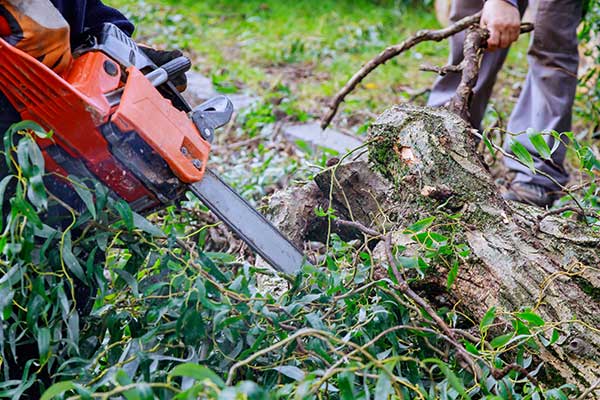
Most of the brush we remove in Terrell Hills started life as a hedge. Ligustrum and privet were planted across this area as screening decades ago, and left long enough, a hedge stops being a hedge and becomes a row of thirty foot trees with bare legs, a hollow interior, and a canopy shading out everything beneath it. Hill Country Land Clearing clears that and the rest of it across Terrell Hills.
This is the characteristic Terrell Hills problem. A privet or ligustrum hedge planted in the fifties and trimmed for thirty years, then not trimmed for thirty more, is now a line of multi trunked trees. It no longer screens at eye level because the foliage has all gone to the top, it has killed everything below it, and its roots have gone under the fence and the walk. Cutting it back does not restore it. At that point the honest options are removing it and starting again or removing it and doing something else with the space.
Behind the failed hedging comes the volunteer growth: hackberry and chinaberry seeding into every unmaintained corner, nandina spreading out of old beds, English ivy and Virginia creeper climbing trunks and walls, greenbriar and poison ivy along the back line. Some of these were also planted originally, which is worth remembering. Nandina and ivy were both standard choices in the era these gardens were made, and they have simply done what they do given seventy years.
Deep lots here frequently have a rear portion that was originally a working part of the property: a service yard, a cutting garden, a compost area, a place for the help to park. Those areas stopped being used at some point and nobody has looked at them since. They are now the densest growth on the lot and usually contain the most buried material. Reclaiming that ground is often the single largest gain available on a property here.
Worth handling separately. Ivy on a masonry wall works into mortar joints and holds moisture against the surface. Ivy on an oak or a pecan adds weight and wind load, holds moisture against the bark, and hides structural defects from anyone trying to assess the tree. We cut it at the base and remove what pulls free cleanly, then leave the upper material to die back over the following months rather than ripping it off and taking bark or mortar with it.
Ligustrum, privet, chinaberry, hackberry, and nandina all resprout hard from the base. Cut them flush and you get a multi stemmed version of the same problem by spring. Real removal means taking the root crown out where access allows, grinding below grade, or pairing the cut with follow up treatment. We tell you at the quote which plants on your property will come back, so the choice between a single job and a maintenance approach is yours to make knowingly.
Everyone here can hear everything and most of the boundaries are shared. Before cutting on a line we confirm which side is yours and what is rooted where, since anything on the neighbour’s side is theirs to decide about. We let adjacent owners know when noisy work is happening, keep material from crossing a line, and avoid staging where we block a drive. Material is hauled out rather than left, and the route is swept before we leave.
Behind an overgrown boundary on a property like this we routinely find collapsed fence panels, old chain link swallowed decades ago, brick and stone from hardscape that was replaced rather than removed, garden edging, buried irrigation, birdbaths and planters, and occasionally a cleanout or valve box unseen in years. Metal and masonry are why we work by hand into dense material first, separate what is not vegetation, and price that handling honestly.
The first clearing on a property that has been left for twenty or thirty years is the expensive one, because hedging has become tree sized and the volume is high. Everything after that costs a fraction. Owners who bring us back on a light interval never watch the boundary close in again and never pay for a full reclaim twice, which on a garden with this much invested in it is the sensible way to hold it.
Brush removal across Terrell Hills, Alamo Heights, Olmos Park, Lincoln Heights, Mahncke Park, Northwood, Castle Hills, and neighbouring San Antonio blocks.
Photos of the hedge line or the back of the lot are usually enough for a preliminary number. Call 210-942-1961.
Usually not successfully once it has gone this far. A privet or ligustrum hedge that has become a row of thirty foot trees has all its foliage at the top and bare legs below, and cutting it back hard leaves you with bare stems that may or may not break dormant buds. At that point removal and replacement is generally the honest recommendation.
Time, mostly. Hedging planted in the mid century and maintained for decades will hold its form indefinitely, but once trimming stops the plants revert to what they naturally are, which for ligustrum and privet is a tree. Thirty years of that produces the situation most owners here are looking at, and it is not a sign anything was done wrong originally.
Yes, and carefully. We cut it at the base and remove what comes free without damaging masonry or bark, then leave the upper growth to die back over the following months. Pulling established ivy directly off a wall takes mortar with it and off a trunk takes bark, either of which does more harm than the ivy was doing.
Some of it. Ligustrum, privet, chinaberry, hackberry, and nandina all resprout from the base unless the crown is removed or treated. We tell you at the quote which plants on your property will fight back so the choice between a single clearing and a maintenance approach is made knowingly rather than discovered next spring.
Yes. It is common along back fence lines here and often climbs the oaks where nobody notices it until they are in it. Crews handle it with proper protection and it goes out with the debris rather than being chipped, since chipping disperses the oil. Tell us at the walkthrough if you know it is present.
That is usually the largest gain available on a property here. Deep lots frequently have a rear portion that was a service yard or working garden originally and stopped being used decades ago. It is the densest growth on the lot and usually holds the most buried material, and reclaiming it often adds noticeably to usable space.
We notify adjacent owners on the day as a courtesy, but a few days' notice from you goes further, particularly where work is on a shared boundary. If any of the vegetation is rooted on their side, that is their property and we would need their permission, so it is worth establishing beforehand rather than at the fence.