
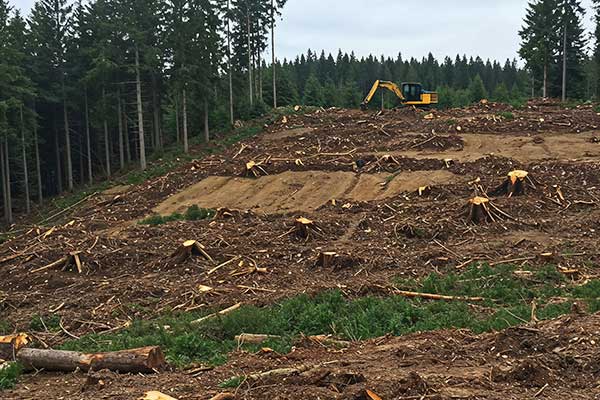
Forestry mulching is the default clearing method around Boerne and the reason is simple: it is the method this terrain was made for. Steep ground, shallow soil, limestone close to the surface, and cedar as the dominant species add up to a situation where blade clearing does real damage and mulching does not. One machine, one pass, material stays on the property as ground cover.
A mulching head is a rotating drum with carbide teeth mounted on a tracked machine or an excavator arm. It cuts standing material from the top down and reduces it to chip where it stands. Because the machine tracks over its own mulch and never digs, soil and root structure stay in place. There are no burn piles waiting on a ban to lift, no windrows to deal with, and no convoy of trucks hauling material down a county road.
Three local realities make it the right tool. Rock is the first: mulching works from the top down and never fights limestone, while grubbing on this ground is slow and often not fully achievable. Slope is the second: leaving the root mat intact is what keeps a hillside above Cibolo Creek from moving after the first big rain. Cedar is the third, and it happens to mulch beautifully. It feeds through a head fast and the chip breaks down into a stable cover.
There is a long running case in the Hill Country that thinning cedar improves water yield, on the reasoning that a dense juniper canopy intercepts a meaningful share of rainfall in the foliage where it evaporates before ever reaching the ground. How much reaches the aquifer versus the grass varies with the site and the science is not as tidy as either side of the argument suggests. What owners here reliably see is grass returning under thinned canopy and draws holding moisture longer, which is worth the work regardless of how the recharge question resolves.
We would rather set this out before you pay. Mulching does not remove stumps or roots, so it is no substitute for grubbing where a foundation, a road base, a pond, or a septic field is going. It has practical diameter limits, and large hardwoods are better felled and processed conventionally. Species that resprout from the root crown will come back through the chip. And on genuinely severe slope or loose rock there are limits to what a tracked machine can work safely. When your project needs blade work, we will tell you.
Slope is the governing factor on most Boerne tracts. Tracked machines with low ground pressure handle grades that wheeled equipment cannot touch, and operator experience on this ground matters as much as the machine. We assess slope, rock, soil depth, and access before quoting, and where a section of a property is beyond safe working limits we exclude it rather than pretending otherwise. Hillside work is where cutting corners gets someone hurt.
The chip left behind is doing work. It shades soil, slows runoff on grade, suppresses some regrowth by keeping light off seed, and breaks down into organic matter over several seasons, which on thin Hill Country soil is genuinely valuable. Depth depends on how much material was standing, and heavy cedar can leave several inches. If you are broadcasting grass seed soon after, we can thin the heaviest concentrations so seed reaches soil.
A dozer pushes material into piles and takes soil with it, which on land that has a few inches of soil over limestone is a permanent loss rather than a temporary mess. It is still the right tool when you need bare ground for a pad, a road, or a pond. Mulching leaves soil where it is and converts the vegetation into cover. On typical Boerne acreage, mulching also finishes faster because there is no piling, no burning, and no hauling. Choose on what the land has to do next, not on the per acre number alone.
Very little is needed from you, but three things help. Mark or point out anything you want left standing, including young oaks and madrones that vanish in dense cedar. Identify well heads, buried lines, old fencing, and anything metal, since that is the one thing a mulching head cannot handle. Confirm gate width, cattle guard capacity, and whether the access road will carry a lowboy delivering the machine. Those details prevent nearly every delay that happens on day one.
Mulching throughout Boerne, Comfort, Sisterdale, Welfare, Waring, Kendalia, Bergheim, Fair Oaks Ranch, Spring Branch, Bulverde, Pipe Creek, and across Kendall, Kerr, Bandera, and Comal counties.
Mulching is priced per acre on stem density and average trunk size. Send the address and we can assess density from imagery before scheduling a walkthrough. Call 210-942-1961.
Density and stem diameter drive it more than acreage does. Scattered light cedar goes quickly. A closed canopy of mature juniper can take several times longer for the same acre. Slope, rock, and access from the county road all add to it. Send an address and we can estimate density from aerial imagery before we ever set foot on the property.
It is one of the few methods that does. Tracked machines handle grades that wheeled equipment cannot, and because mulching never digs, it leaves the root structure that holds a hillside together. There are still limits, and severe grades or loose rock faces are excluded from the scope rather than attempted. We assess slope on the ground before quoting.
Largely, yes. Cedar cut below its lowest green growth does not resprout from the stump, so mulched juniper stays down and only returns from new seed blowing or being carried in. That makes cedar unusually satisfying to clear compared to mesquite or persimmon, which come back from the root crown regardless of how cleanly they were cut.
For most Boerne tracts, yes. There is no waiting out a Kendall County burn ban, no fire risk on a windy Hill Country afternoon, no smoke drifting onto a neighbor, and no burn scars left in the pasture. Burning still has a place on very large tracts with enormous material volume and a safe place to do it, but mulching is faster and simpler for most acreage.
Generally the opposite. The chip layer holds moisture in thin soil, moderates temperature, and protects against erosion while grass reestablishes. Very heavy concentrations can block seedlings, which is why we can thin the deepest areas if you are seeding right away. On most tracts grass returns within a season or two once cedar stops shading it.
Yes, and that is how most Boerne mulching jobs are set up. We mark the oaks and mottes you want kept, work the cedar and understory out from around them, and keep the head and the machine clear of root flares and low limbs. During the high risk oak wilt window in late winter and spring, any wound to an oak gets painted the same day.
Light growth can run several acres in a day. Mature closed canopy cedar on slope can take a full day per acre or more. Rock, grade, and how far the machine has to travel between working areas all affect it. We give an estimated day count with the quote and tell you promptly if field conditions turn out heavier than the imagery suggested.