
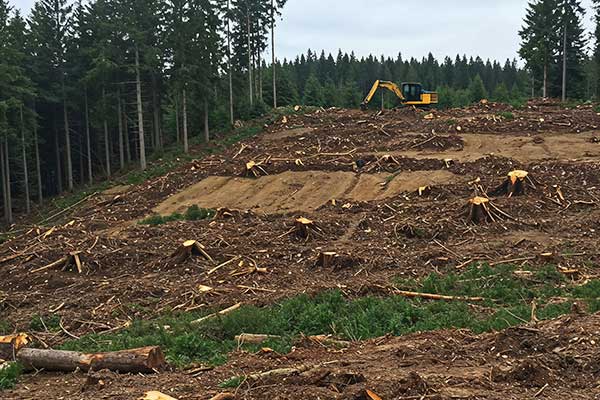
Forestry mulching grinds standing cedar and brush into chip in a single pass and leaves it on the ground. No burn pile sitting through a county ban, no windrows, no line of trucks running material down 281. On most Bulverde acreage it is the method that makes the most sense, and on tracts inside a subdivision it is frequently the only method that fits the restrictions.
A mulching head is a rotating drum with carbide teeth mounted on a tracked machine or an excavator arm. It cuts standing material from the top down and reduces it to chip where it stands. The machine tracks over its own mulch and never digs, so the soil and root mat stay in place. What you get is a walkable, drivable property covered in wood chip rather than a scraped surface waiting on the next storm.
Three local conditions push in the same direction. Soil here is thin over limestone, so anything that strips it is taking something that does not come back in a lifetime. The Bulverde area sits over the contributing and recharge zones of the Edwards Aquifer depending on location, where minimizing exposed soil and runoff is the right instinct regardless of what any particular rule requires. And cedar, which is the dominant nuisance species across the corridor, mulches extremely well. It feeds through a head fast and the chip settles into a stable ground cover.
This is an underrated advantage on subdivided acreage. Burning brush next to a subdivision generates complaints, sits at the mercy of Comal County burn bans, and is prohibited outright by many recorded restrictions. Haul off means repeated truck trips down a county road and through a neighborhood entrance. Mulching produces neither. The material never leaves the tract, there is no fire, and the property looks finished the day the machine leaves rather than after a cleanup phase.
Better to say this before you pay for it. Mulching does not remove stumps or root systems, so it is no substitute for grubbing where a foundation, a driveway base, an arena pad, or a septic field is going. It has practical diameter limits, and large hardwoods are better felled and processed conventionally. Species that resprout from the root crown will push back through the chip. If your project needs blade work or grubbing, we will tell you that rather than selling you a method that will not deliver.
The chip left behind holds moisture in thin soil, shades the ground, slows runoff on grade, suppresses some regrowth by keeping light off seed, and breaks down into organic matter over several seasons. Depth depends on how much material was standing, and heavy cedar can leave several inches. If you are broadcasting grass seed or putting animals on the ground soon after, we can thin the heaviest concentrations so seed reaches soil.
On acreage tracts the practical constraints are usually getting the machine in rather than the work itself. Gate width, cattle guard capacity, whether a lowboy can make the turn off the county road, and whether the driveway will carry the weight all get checked before we schedule. On tracts inside a subdivision we also confirm where equipment can stage without blocking a neighbor or a shared entrance.
A dozer pushes material into piles and takes topsoil with it, which on ground carrying a few inches of soil over limestone is a permanent loss rather than a temporary mess. It is still the correct tool when you need bare ground for a house pad, a driveway, or a pond. Mulching leaves soil in place and turns the vegetation into cover. On typical Bulverde acreage mulching also finishes faster, since there is no piling, no burning, and no hauling. Choose on what the ground has to do next rather than on the per acre number alone.
Very little is needed from you, but a few details prevent most day one problems. Mark anything you want left standing, including young oaks that disappear inside dense cedar. Point out well heads, buried lines, old fencing, and anything metal. Confirm gate width, cattle guard capacity, and whether the driveway will carry a lowboy delivering the machine. On tracts inside a subdivision, check where equipment can stage without blocking a shared entrance.
Mulching throughout Bulverde, Spring Branch, Canyon Lake, Smithson Valley, Garden Ridge, Timberwood Park, Bracken, Fair Oaks Ranch, Boerne, New Braunfels, and across Comal, Kendall, and northern Bexar counties.
Mulching is priced per acre on stem density and average trunk size. Send an address and we can assess density from imagery before a walkthrough. Call 210-942-1961.
Density and stem diameter drive the price more than acreage does. Scattered light cedar moves quickly. A closed canopy of mature juniper can take several times longer for the same acre. Slope, rock, and access from the county road all add to it. Send an address and we can estimate density from aerial imagery before scheduling a walkthrough.
Usually it is the method restrictions are most comfortable with, since nothing burns and nothing leaves the property. What restrictions more often limit is how much of a tract can be cleared and which trees are protected, and those limits apply to mulching the same as any other method. Read your documents and tell us the caps so we can work within them.
No. The head grinds material to or slightly below grade and the root system stays where it is, which is intentional since intact roots hold thin soil in place. If you need stumps gone for a house pad, a driveway, an arena, or a septic field, that is grubbing work with an excavator or dozer and it gets quoted separately.
Cedar cut below its lowest green growth does not resprout from the stump, so mulched juniper largely stays down and returns only from new seed. That makes it unusually rewarding to clear. Mesquite, persimmon, and whitebrush do resprout from the root crown and will push back through the chip layer within a season or two.
It is generally the gentler option, since it leaves soil and root structure in place and does not create the exposed ground that generates runoff and sediment. That said, construction activity over the recharge zone can carry state requirements of its own depending on the project and the acreage disturbed. If your work is tied to a build, confirm what applies before starting.
Yes, with a couple of considerations. We finish at a cut height appropriate for animals rather than leaving stobs, and prickly pear gets removed rather than scattered. A heavy chip layer is fine underfoot but can be thinned where you want grass to establish quickly. Tell us animals are going on it and we will finish accordingly.
Light growth can run several acres in a day. Mature closed canopy cedar can take a full day per acre or more. Slope, rock, and travel between working areas all factor in. We give an estimated day count with the quote and tell you promptly if conditions on the ground turn out heavier than the imagery suggested.