
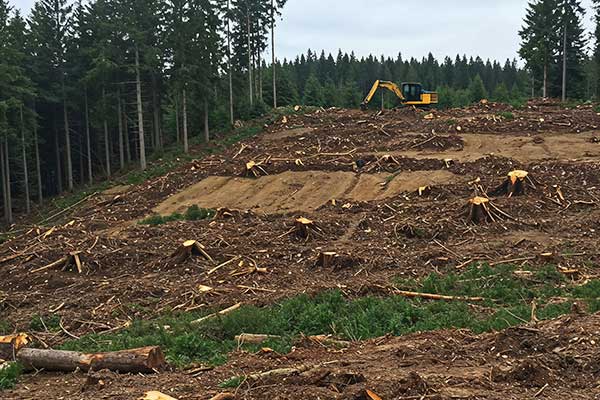
On Canyon Lake terrain, forestry mulching is not one option among several. It is usually the only method that clears a slope without setting up an erosion problem, and it is the only one that does not require hauling material out on roads that were never built for repeat truck traffic. One machine, one pass, material stays where it falls.
A mulching head is a rotating drum with carbide teeth mounted on a tracked machine or an excavator arm. It cuts standing material from the top down and reduces it to chip on the spot. The machine tracks over its own mulch and never digs, so soil and root structure stay in place. You end up with a walkable property under a layer of wood chip rather than a scraped hillside waiting for the next storm to rearrange it.
Soil on these slopes is a few inches deep over limestone and it took a very long time to get there. Blade clearing removes the root mat holding it, and on a fifteen or twenty percent grade the first heavy rain takes the rest. It moves downhill into a drainage, and from a drainage in this watershed it ends up in the reservoir. Mulching leaves the root structure intact and adds a chip layer that slows runoff, which means you can open a lot up without watching it wash.
Every load hauled off a Canyon Lake lot goes out on a narrow winding subdivision road, often with switchbacks and no turnaround. That is slow, it is hard on the roads, and it makes for a lot of truck movements past your neighbors. Burning is worse on a wooded slope and county bans frequently take it off the table anyway. Mulching produces neither problem. Nothing leaves the lot and nothing burns.
Better said before you pay for it. Mulching does not remove stumps or roots, so it is no substitute for grubbing where a foundation, a driveway base, or a septic field is going. It has practical diameter limits and large hardwoods are better felled and processed conventionally. Resprouting species will push back through the chip. And on genuinely severe grade there are limits to what a tracked machine can safely work, which we identify on the walkthrough rather than discovering on the hill.
This is the real constraint on most Canyon Lake jobs. A mulching machine arrives on a lowboy, and a lowboy needs a road it can navigate, somewhere to stop, and room to unload. Steep short driveways, switchbacks, and no turnaround are the norm here. Before quoting we work out delivery, unload point, and whether the lot can be worked from the top, from the bottom, or only partly. Sometimes the answer is that hand crews do part of the job.
It holds moisture in thin soil, shades the ground, slows water on grade, suppresses some regrowth by keeping light off seed, and breaks down into organic matter over several seasons. Depth depends on how much material was standing. Heavy cedar leaves several inches, which is generally welcome on a slope but can be thinned in areas where you want to establish grass or plant.
A dozer pushes material into piles and takes soil with it, and on ground carrying a few inches over limestone that soil does not come back in a lifetime. Blade work is still correct when you genuinely need bare ground for a pad or a driveway. Everywhere else on a Canyon Lake lot, mulching leaves the soil in place and converts the vegetation into cover. It also finishes faster, since there is no piling, no burning, and nothing to haul out.
A few details prevent most first day problems. Mark anything you want left standing, including young oaks that vanish inside dense cedar. Point out septic components, buried lines, old fencing, and anything metal. Confirm where a lowboy can stop and unload, and whether the driveway will carry the weight. On lots inside a subdivision, check with the association about where equipment may stage without blocking a shared road.
Mulching throughout Canyon Lake, Startzville, Sattler, Fischer, Cranes Mill, Spring Branch, Bulverde, Smithson Valley, New Braunfels, Wimberley, and across Comal, Hays, Kendall, and Blanco counties.
Send the address and photos of the driveway and the grade. Call 210-942-1961.
Tracked machines handle grades that wheeled equipment cannot touch, and much of Canyon Lake is workable. Severe grades, loose rock faces, and areas with no safe approach are excluded from the scope rather than attempted, and we identify those on the walkthrough. Where a section cannot be machine worked, hand crews handle it or it stays as it is.
That is the question we answer first. The machine arrives on a lowboy, which needs a navigable road, a place to stop, and room to unload. Short steep driveways and switchback roads are normal here, so delivery and unload point get worked out before anything is scheduled. Photos of your driveway and street approach help enormously.
On most Canyon Lake lots, yes. Haul off means repeated truck trips on narrow winding roads, which is slow and expensive and hard on both the road and your neighbors' patience. Mulching keeps everything on the lot. The trade off is that you get a chip layer rather than clean ground, and stumps stay in place.
Not readily. Chip settles and knits together, and it is doing the opposite job of loose soil by slowing water rather than moving with it. In concentrated drainage paths some material can shift during a heavy event, which is why we do not rely on chip alone where water is genuinely channelized. On general slope it stays put and helps.
It avoids the main way clearing hurts water quality, which is sediment. Bare soil on a slope in this watershed ends up in a drainage and then in the reservoir. Leaving the root mat intact and covering the ground with chip keeps soil where it is. It is the responsible default on any lot draining toward the water.
Cedar cut below its lowest green growth does not resprout from the stump, so mulched juniper largely stays down and returns only from new seed carried in. Persimmon, whitebrush, and other root crown sprouters will come back through the chip within a season or two, so a maintenance pass keeps the property in the condition you paid for.
Most Canyon Lake lots are under an acre and many are a day or less of machine time once equipment is on site. Dense mature cedar on severe grade takes longer, and delivery and setup consume real time on difficult access. We give an estimate with the quote and flag it promptly if conditions are heavier than the photos suggested.