
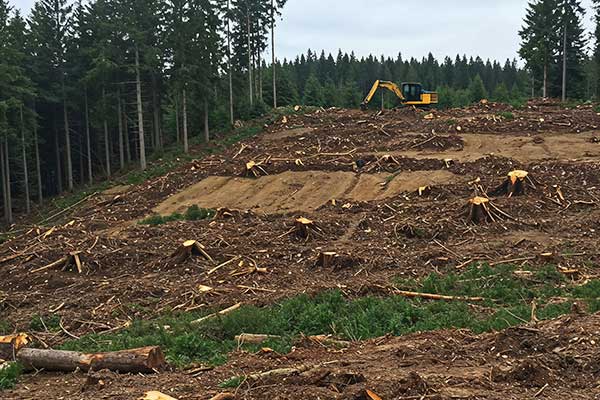
Forestry mulching grinds standing brush and small trees into chip in one pass and leaves it on the ground. In New Braunfels the honest answer about what it achieves depends on where your property sits, and the difference is large enough that a single blanket recommendation would be misleading.
A mulching head is a rotating drum with carbide teeth mounted on a tracked machine or an excavator arm. It cuts standing material from the top down and reduces it to chip where it stands. The machine tracks over its own mulch and never digs, so soil and root structure stay intact. Nothing is piled, burned, or trucked away, which on a job with real volume saves both time and a substantial disposal cost.
On the limestone side, cedar is the dominant species and cedar does not resprout when cut below its lowest green growth. That means mulched juniper stays down, and return comes from new seed over years rather than from stumps within a season. Add the fact that soil is only inches deep over rock, that slope is common, and that grubbing fights limestone anyway, and mulching becomes not just effective but clearly the correct method for most work on that side.
On the deep soil side, mesquite, huisache, retama, hackberry, and Chinese tallow dominate, and all of them come back from the root crown. Mulch a tract over there and it looks excellent for a season, then pushes new stems through the chip. That is the plant, not the machine. On that side mulching works best as step one: knock everything down, expose the ground, then grub the crowns or treat the regrowth once you can see and reach what you are dealing with.
Per acre, mulching is the least expensive clearing method available anywhere in this city. Over five years on an east side mesquite tract, that ranking often reverses, because mulching alone means repeat visits while grubbing largely stays done. West of the escarpment the calculation holds up much better, since cedar does not fight back the same way. We quote both methods side by side so the comparison is in front of you rather than buried in a headline number.
West of town the limiting factor is slope and rock, and tracked machines handle both reasonably. East and south the limiting factor is moisture, because deep clay holds water and machines rut it badly when it is wet. Mulching disturbs less than blade work since it is not digging or dragging, but no machine belongs on saturated clay. We schedule around wet conditions on that side rather than working through them.
Material left behind shades the soil, slows runoff, suppresses some regrowth by keeping light off seed, and breaks down over several seasons. On thin western soils that organic matter is genuinely valuable. On deep eastern clay it incorporates more slowly and stays visible longer. Either way, if you are seeding grass soon after we can thin the heaviest concentrations so seed reaches soil.
Before scheduling we confirm the practical questions: gate width, cattle guard capacity, whether the access road will carry a lowboy delivering the machine, and where equipment can stage. West of town, slope and driveway grade matter as well. On tracts being surrounded by new subdivisions, the route in sometimes runs through a residential street, which affects staging and timing. Ten minutes on these details prevents most first day delays.
There is little for you to do beforehand, but three things help. Mark anything you want left standing, including young trees that vanish in dense growth. Point out well heads, septic components, buried lines, and any old fencing, since metal is the one material a mulching head cannot handle. Confirm where the boundaries actually run if the fences are old or missing.
Mulching throughout New Braunfels, Gruene, Canyon Lake, Startzville, Bulverde, Spring Branch, Garden Ridge, Schertz, Cibolo, Seguin, Marion, and across Comal and Guadalupe counties.
Send the address and we will tell you honestly what mulching will and will not achieve on your ground. Call 210-942-1961.
West of the escarpment, largely yes, because cedar does not resprout when cut below its lowest green growth. East and south, no, because mesquite, huisache, retama, hackberry, and tallow all come back from the root crown within a season or two. The same machine produces genuinely different long term results depending on your location.
Often because they work mostly on one side of the escarpment and are describing that experience accurately. Someone who clears cedar west of town will tell you mulching is permanent, and for their tracts it effectively is. Someone working east will tell you it is temporary, and on that ground they are also right. Ask about your specific address.
No, on either side. The head grinds material to or slightly below grade and the root system stays in place. West of town that is a feature, since intact roots hold thin soil on slope. East of town it is the limitation, since those roots will resprout. If you need stumps out for a foundation or driveway, that is grubbing and it is quoted separately.
Per acre, yes, everywhere in this area, because disposal is a significant cost and mulching eliminates it. Over five years on an east side mesquite tract the ranking can reverse, since repeat visits add up while grubbing largely stays done. We quote both so the lifetime comparison is visible rather than hidden in a single number.
Yes, and it is the appropriate method there. Tracked machines handle grades wheeled equipment cannot, and because mulching never digs it leaves the root structure holding thin soil in place. Severe grades and areas with no safe approach get excluded from the scope and identified at the walkthrough rather than attempted.
East and south, often yes, because deep clay holds water and machines rut it badly, leaving ruts that set hard. West of town the ground sheds water and dries faster, so the window is wider. This is one more way the same service behaves differently depending on which part of the city your property is in.
An inch to several inches depending on volume. On thin western soils it breaks down into valuable organic matter over a few seasons. On deep eastern clay it incorporates more slowly and remains visible longer than owners expect. If you are seeding soon after, we can thin the heaviest areas so seed reaches soil rather than sitting on chip.