
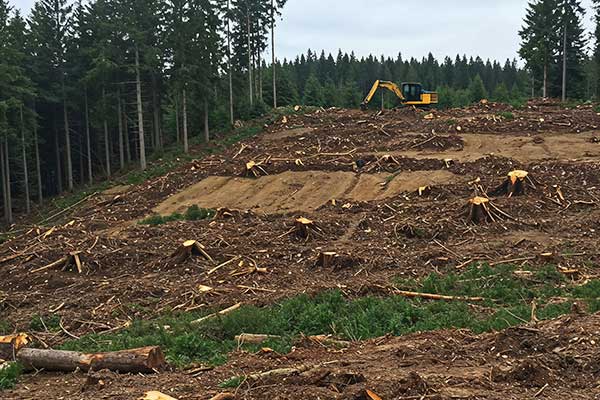
Forestry mulching grinds standing brush and small trees into chip and leaves it on the ground in one pass. No burn pile, no dump trailer, no convoy of trucks running material off the property. For a lot of San Antonio landowners it is the cleanest way to take back overgrown land, and on ground where erosion or the aquifer is a concern it is often the only sensible method.
A mulching head is a rotating drum with carbide teeth mounted on a skid steer, a compact track loader, or an excavator arm. It cuts standing material from the top down and reduces it to chip on the spot. Because the machine tracks over its own mulch and never digs, the topsoil and root mat stay in place. The result is a clean, walkable property covered in a layer of wood chip instead of a scraped surface waiting for the next rain to move it.
Three local conditions make mulching the practical default here. First, shallow limestone and caliche across the north and west sides make grubbing slow and expensive, and mulching does not fight rock. Second, a large share of Bexar and Comal county land sits over the Edwards Aquifer Recharge Zone, where minimizing exposed soil matters. Third, cedar is the dominant nuisance species, and cedar mulches beautifully. It goes through the head fast and the chip breaks down into a stable ground cover.
We would rather tell you this before you pay for it. Mulching does not remove stumps or root systems, so it is not a substitute for grubbing when you are building a foundation, a road base, or a pond. It also has practical size limits. Large diameter hardwoods are better felled and processed conventionally. Species that resprout from the root crown will come back through the mulch layer, so mesquite heavy tracts need either follow up or a different method. If your property needs blade work, we will say so.
The chip left behind does real work. It shades the soil, slows runoff on slope, suppresses some regrowth by blocking light to seed, and breaks down into organic matter over a few seasons. Thickness depends on how much material was standing. Heavy cedar can leave several inches, which is fine for most uses but is worth thinning if you are seeding grass right away.
A dozer pushes material into piles and takes topsoil with it. That is the right tool when you need bare ground, a pad, or a pond. Mulching leaves soil in place and turns the vegetation into cover. On a typical San Antonio acreage job, mulching finishes faster because there is no piling, no burning, and no hauling, and it leaves a property that looks finished rather than scraped. The trade off is that stumps and roots stay. Choose based on what the land needs to do next, not on which method sounds cheaper per acre.
Owners are usually surprised by the difference. Where there was an impassable wall of cedar, there is open ground under the remaining canopy that you can walk or drive across the same day. Boundaries and fence lines become visible again, often for the first time in years. The chip layer gives the ground an even, tended appearance without the raw dirt and burn scars that come with conventional clearing. It also means no cleanup phase, since there is nothing left standing in piles waiting for a match or a truck.
There is very little for you to do beforehand, but three things help. Mark or point out anything you want left standing, including young trees that are easy to miss in dense growth. Identify well heads, septic components, buried lines, and any old fencing, since metal is the one thing a mulching head cannot handle. Confirm gate width and where we can stage equipment. Ten minutes on these details before the crew arrives prevents nearly every problem that comes up mid job.
We mulch throughout San Antonio, Boerne, Helotes, Bulverde, Spring Branch, Fair Oaks Ranch, Timberwood Park, Grey Forest, Garden Ridge, and across Bexar, Comal, and Kendall counties.
Mulching is typically priced per acre based on stem density and average trunk diameter. Send us the address and we can usually assess density from aerial imagery before scheduling a walkthrough. Call 210-942-1961.
Price tracks density and stem size more than acreage. Light understory with scattered small cedar goes quickly and costs the least per acre. A solid cedar thicket with mature trunks can take several times longer for the same acre. Terrain and access matter too. Send an address and we can estimate density before we ever set foot on the property.
No. The head grinds material to or slightly below ground level but the root system stays in place. That is intentional, since intact roots hold soil on slope. If you need stumps gone for a foundation, a road, or a pond, that is grubbing work with an excavator or dozer and we quote it separately.
Some will. Cedar largely does not resprout from the stump, so mulched cedar mostly stays down and returns only from new seed. Mesquite, huisache, and several understory species do resprout from the root crown and will push through the mulch layer within a season or two. A maintenance pass or follow up treatment keeps the property in the condition you paid for.
For most San Antonio properties, yes. There is no burn ban to wait out, no smoke complaints from neighbors, no fire risk, and no bare burn scars left behind. Burning still makes sense on large rural tracts with enormous volumes of material and a safe place to do it, but for the average lot or small acreage mulching is faster and simpler.
Yes, within reason. Tracked machines handle Hill Country slope and shallow limestone far better than wheeled equipment, and because mulching does not dig, rock is much less of an obstacle than it is for grubbing. Very severe grades and loose rock faces have limits, and we will tell you honestly when a slope is beyond what we can work safely.
Anywhere from an inch to several inches depending on how much material was standing. Heavier stands leave more. If you are planting grass soon after, we can spread the material more evenly or thin the heaviest areas so seed reaches soil. Left alone, the layer breaks down over a few seasons.
Light work can run several acres in a day. Dense mature cedar can take a full day per acre or more. Weather has less effect than it does on blade clearing since mulching does not require dry ground the same way, though we still avoid working saturated soil to prevent rutting.