
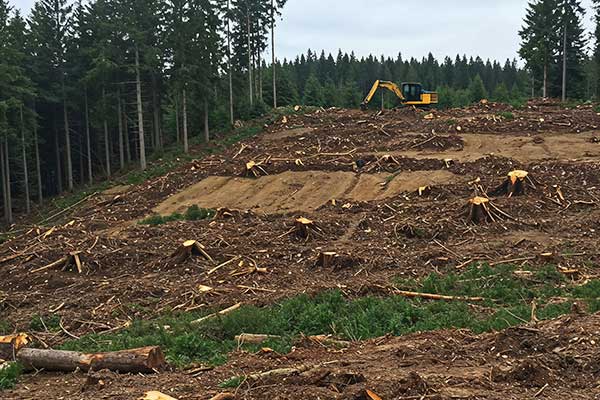
Forestry mulching grinds standing brush and small trees into chip in one pass and leaves it on the ground. On Guadalupe County acreage it is fast and cheap per acre and there is nothing to haul or burn. It also comes with a caveat on this soil and with these species that matters a great deal, and we would rather set it out plainly than let you find out next spring.
A mulching head is a rotating drum with carbide teeth mounted on a tracked machine or an excavator arm. It cuts standing material from the top down and reduces it to chip where it stands. The machine tracks over its own mulch rather than digging, so soil structure stays intact and there is no windrow, no burn pile, and no disposal trip. On a large tract the time saved compared with cut and haul is considerable.
Mulching cuts at grade and leaves the root system. Around Seguin the dominant species are mesquite, huisache, retama, chinaberry, hackberry, Chinese tallow, and Macartney rose, and every one of them comes back from the root crown. Mulch a pasture here and it looks excellent for a season, then pushes new stems through the chip and comes back multi stemmed. That is the plant, not the machine, and any quote calling mulching permanent clearing on this ground is describing somewhere else.
This is the practical way to use it on this ground. Mulch to knock everything down and expose the soil, then bring an excavator or grubbing attachment through to take the crowns out once you can actually see and reach them. On a dense tract that sequence is frequently faster and cheaper overall than trying to grub blind through a wall of mesquite and Macartney rose, and it lets you decide how much of the property genuinely warrants the full treatment.
If you want a pasture to stay clear and you are not planning to come back, mulching alone will disappoint you. Building sites need grubbing regardless, because roots left underground rot and cause settlement. And on ground you intend to plant or cultivate, the chip layer and the intact root systems are both complications rather than benefits. We will tell you which category your project is in, and it is often the more expensive one.
Mulching has one real advantage on these soils: because the machine is not digging or dragging, it disturbs the surface less than blade clearing does, which matters on ground that ruts easily. It still needs reasonably dry conditions. Tracked machines spread weight better than wheeled equipment, but no machine belongs on saturated ground here, and we schedule around wet stretches rather than pushing through them.
Material left behind shades soil, slows evaporation, and breaks down over a few seasons, incorporating more slowly on heavy soil than on lighter ground. Depth depends on volume standing. On ground going back to grass we can thin the heaviest areas so seed reaches soil. If the tract is heading into cultivation, the chip needs to be accounted for rather than simply disked in.
Per acre, mulching is the cheapest clearing method available and grubbing is among the most expensive. Over five years on a mesquite pasture that ranking usually reverses, because mulching alone means repeat visits while grubbing largely stays done. We put both numbers on the quote so the comparison is in front of you rather than buried in a headline price. On some tracts mulching genuinely is the right answer, and on others it is the expensive one.
Before scheduling we confirm the practical questions: gate width, cattle guard capacity, whether the county road and the farm road will carry a lowboy delivering the machine, and where it can be unloaded. On working ground we also confirm where equipment can stage without blocking your own access, since you still need to get to the rest of the property while we are there.
Mulching throughout Seguin, Marion, Cibolo, Schertz, New Braunfels, McQueeney, Geronimo, Kingsbury, Luling, Gonzales, and across Guadalupe, Comal, and Caldwell counties.
Tell us what you want the tract to look like in three years, not just next month. Call 210-942-1961.
No, and that is the honest answer here. Mesquite, huisache, retama, chinaberry, hackberry, tallow, and Macartney rose all resprout from the root crown, so the tract looks excellent for a season and then pushes new stems through the chip. Lasting control requires grubbing the crowns or following up with treatment.
Because it is fast, inexpensive per acre, and requires no hauling or burning. It also works very well as a first pass exposing the ground so crowns can be grubbed or treated afterward, which on a dense tract is often cheaper overall than grubbing blind through heavy brush. And on fence lines and farm roads you maintain anyway, regrowth is not a problem.
It knocks it down but does not control it. Macartney rose spreads by seed and by canes rooting where they touch ground, and mechanical cutting tends to thicken stands rather than reduce them. Mulching is useful to expose the ground for follow up work, but on its own it is not a treatment for it.
Not straightforwardly. The chip layer and the intact root systems are both complications for cultivated ground, and the roots will resprout regardless. If a tract is heading into crop production, grubbing rather than mulching is the appropriate method, and the chip has to be accounted for rather than simply disked into the soil.
Less badly than blade clearing, since the machine is not digging or dragging, and tracked equipment spreads weight better than wheels. But saturated ground here is still no place for a machine and ruts set hard. We schedule around wet stretches rather than working through them, because the repair cost lands on your ground.
Density and stem diameter drive it more than acreage, and it is the least expensive clearing method per acre available. That is exactly why the regrowth question matters, since the cheapest pass is not the cheapest outcome if you are paying again in two years. We quote mulching and grubbing side by side so the comparison is visible.
An inch to several inches depending on how much material was standing. On heavier soil it incorporates more slowly than on lighter ground, so it stays visible longer than owners sometimes expect. If you are seeding grass soon after, we can thin the heaviest concentrations so seed reaches soil rather than sitting on chip.