
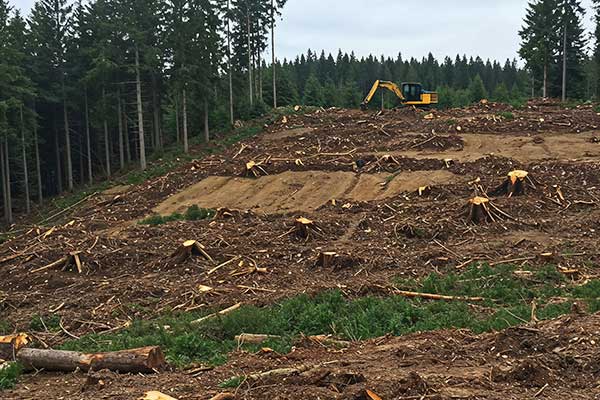
Forestry mulching grinds standing brush and small trees into chip in one pass and leaves it on the ground. In Selma it fits a specific set of properties, mostly the undeveloped parcels held along the corridor waiting on a tenant or a phase. On finished commercial landscape and on small residential lots it is the wrong tool, and we will say so rather than sell it.
A mulching head is a rotating drum with carbide teeth mounted on a tracked machine or an excavator arm. It cuts standing material from the top down and reduces it to chip where it stands. The machine tracks over its own mulch rather than digging. Nothing is piled, burned, or trucked away, which on a parcel with real volume saves both time and a substantial disposal cost.
This is one of the genuinely good uses for it around here. A parcel that has gone to brush cannot be walked, staked, or properly assessed, and a surveyor working through mesquite is slow and expensive. A mulching pass opens the ground in a day or two and lets everyone see the topography, the drainage, and the existing trees, which makes both the survey and the design work far more efficient. If construction follows within the year, regrowth is irrelevant.
Mulching cuts at grade and leaves the root system. The species here, mesquite, huisache, retama, hackberry, chinaberry, and Chinese tallow, all come back from the root crown. Mulch a parcel and it looks excellent for a season, then pushes new stems through the chip. That is the plant rather than the machine, and it means mulching is a timing decision here rather than a permanent solution. If you are holding a parcel long term and want it presentable, plan on repeat visits or grub the crowns.
On finished commercial landscape, in parking islands, and along buffer strips, mulching is inappropriate. The machine has no room and the chip layer is not what those areas need. On a standard residential lot it usually cannot fit through the gate with room to work, and the chip looks wrong on a maintained yard. And building pads need grubbing regardless, because roots left underground rot and cause settlement. Those jobs get hand crews and haul off instead.
If the parcel is going to be graded shortly after clearing, the chip has to be accounted for in the earthwork, since organic material cannot simply be buried under a building pad. That is worth coordinating with your civil contractor before the mulching rather than discovering it when the pad is going in. On a parcel being held rather than built on, the chip is simply ground cover and no complication at all.
Soils here hold water and release it slowly, so machines and wet ground do not mix. Mulching disturbs less than blade clearing since it is not digging or dragging, and tracked equipment spreads weight better than wheels, but saturated ground is still saturated ground and ruts set hard. We schedule around wet stretches rather than pushing through, particularly where grading follows.
Per acre, mulching is the least expensive clearing method and grubbing is among the most expensive. On a parcel being held for several years that ranking often reverses, because mulching alone means repeat visits while grubbing largely stays done. We put both numbers on the quote so the comparison is visible rather than buried in one headline price. Which is right depends entirely on how long you are holding the ground.
Before scheduling we confirm where a lowboy can stop and unload without blocking a drive aisle, a business entrance, or a public road. On corridor parcels the approach often runs past operating property, which affects timing as much as logistics. On parcels behind existing development we also confirm whether access runs through someone else’s lot and whether that has been arranged.
Mulching throughout Selma, Schertz, Cibolo, Live Oak, Universal City, Converse, Garden Ridge, New Braunfels, and across Bexar, Comal, and Guadalupe counties.
Tell us the acreage and what happens on the parcel next. That determines whether mulching is right. Call 210-942-1961.
For undeveloped parcels and rear areas, often yes. For finished landscape, parking islands, and buffer strips, no. The machine has no room in those areas and the chip layer is not what they need. We look at which parts of a property suit which method rather than applying one approach across the whole site.
For a season, then the species here push new stems through the chip. Mesquite, huisache, retama, hackberry, chinaberry, and tallow all resprout from the root crown. If you are holding a parcel long term and want it presentable, plan on repeat visits or grub the crowns. If construction follows within the year, regrowth is irrelevant.
It is one of the better uses for it here. A parcel gone to brush cannot be walked or staked properly, and a surveyor working through mesquite is slow and expensive. A mulching pass opens the ground quickly and lets everyone see topography, drainage, and existing trees, making both the survey and the design work more efficient.
It can if nobody plans for it, since organic material cannot simply be buried under a building pad. If grading follows shortly after clearing, coordinate that with your civil contractor beforehand. On a parcel being held rather than built on, the chip is just ground cover and creates no complication at all.
Density and stem size drive it more than acreage, and per acre it is the least expensive clearing method available. That is exactly why the regrowth question matters, since the cheapest pass is not the cheapest outcome if you are paying again in two years. We quote mulching and grubbing side by side so the comparison is visible.
Often, yes. These soils hold water and machines on saturated ground leave ruts that set hard. Mulching is gentler than blade clearing since it is not digging, but saturated ground is still no place for a machine. We schedule around wet stretches, particularly where grading follows and the surface condition matters.
Yes, and on a mixed property that is usually right. Mulch the open sections where volume is high and appearance matters less, and cut and haul the areas near frontage or finished landscape where clean ground is needed. We show that split on the quote so you can see where the line falls and why.