
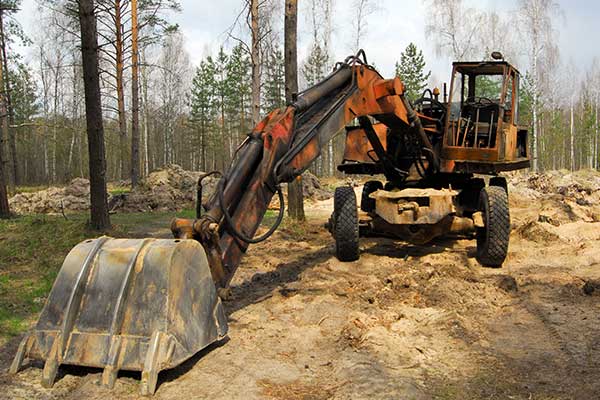
Canyon Lake lots are some of the steepest residential ground in Texas. A quarter acre in Canyon Lake Hills can drop forty feet from the road to the back corner, and it is covered in cedar the whole way down. Hill Country Land Clearing works these lots across the Canyon Lake area, from Startzville and Sattler through Cranes Mill, Fischer, and the subdivisions on both sides of the water.
This is the first thing to settle on any lot near the water. The land immediately around the reservoir is federal property managed by the U.S. Army Corps of Engineers, and vegetation removal on Corps land requires their authorization. Plenty of lakefront owners assume their lot runs to the waterline when it stops well short of it. Clearing across that boundary is not a minor paperwork issue. Get your survey out, and if there is any doubt about where your line sits or what you are allowed to do near it, contact the Corps before anyone starts cutting.
Canyon Lake is unincorporated. There is no city hall, no municipal tree ordinance, and no city permit office, which surprises owners who moved from somewhere that had all three. What governs instead is a combination of Comal County, which handles on site sewage, platting, and floodplain rather than zoning, your recorded deed restrictions and property owners association, and the Corps where the lake is involved. On most Canyon Lake lots the POA is the practical authority on what you can clear.
On grade this steep, clearing method is not a preference, it is a risk assessment. Land taken to bare dirt on a Canyon Lake hillside will move, and the soil is only a few inches deep over limestone to begin with. Once it moves it ends up in a drainage, then in the lake. That is why we push almost every owner here toward methods that leave root structure in the ground, and why we exclude sections of a lot from the scope when the grade is beyond what a machine can work safely rather than attempting it anyway.
Access is the constraint that decides most Canyon Lake quotes. Roads through these subdivisions are narrow and winding with switchbacks, driveways are short and steep with awkward approaches, and there is frequently nowhere to turn a trailer around. Before we price anything we work out whether a lowboy can deliver a machine, where it can be unloaded, and whether the lot itself can be worked from above, below, or only by hand. Two lots on the same street can price very differently on access alone.
Burning is a poor idea on a wooded slope with houses close together, and county bans often remove the option anyway. That leaves mulching in place or haul off, and haul off means repeated truck trips up and down roads that were not built for it. On most Canyon Lake lots mulching wins on both cost and practicality, with haul off reserved for areas around the house where an owner wants genuinely clean ground.
Slope, access, cedar density, trunk size, stump work, and disposal method. Slope and access are usually the two biggest, which is the opposite of open acreage where density dominates. A gently sloped lot with a wide driveway costs a fraction of a comparable lot with a fifteen percent grade and no turnaround. We price from the ground here rather than from imagery, because aerials completely hide grade.
On a wooded Canyon Lake lot it is worth opening sight lines before the homesite is finalized. Grade, rock outcrops, natural benches, and where the view actually is are all hidden under cedar until something comes out. More than one owner here has moved a planned house location after seeing the lot properly for the first time. If a build is in the plan, a limited clearing pass early is cheap information compared with committing a pad to the wrong spot.
Late fall and winter are the best window for larger jobs. Vegetation is dormant so the ground and the grade are visible, crews on foot are not dealing with snakes and wasps in dense cover, and the soil is generally firm. Spring rain makes slope work slow and risky. Summer brings heat, county burn bans, and real fire risk from machine work in dry fuel on this terrain. If the clearing is tied to a build, get it scheduled early.
We clear throughout Canyon Lake, Startzville, Sattler, Fischer, Cranes Mill, Spring Branch, Bulverde, Smithson Valley, New Braunfels, Wimberley, and across Comal, Hays, Kendall, and Blanco counties.
Send the address and photos showing the driveway and the slope. Those two things tell us most of what we need. Call 210-942-1961.
Usually your property owners association, since Canyon Lake is unincorporated and there is no city permit office. Comal County regulates on site sewage, platting, and floodplain rather than zoning. If your lot touches the reservoir, the Corps of Engineers controls the federal land around the water. Check your deed restrictions first, since they are enforceable regardless of what the county requires.
Often well short of the waterline. The land immediately around the reservoir is federal property managed by the Corps of Engineers, and it is a common surprise for lakefront owners. Pull your survey before any work near the water. Removing vegetation on Corps land without authorization is a serious matter, not a paperwork technicality, so confirm the line first.
Usually a good portion of it, and honestly not always all of it. Tracked machines handle grades that wheeled equipment cannot, and hand crews reach what machines should not. Where a section is beyond safe working limits we exclude it from the scope and say so rather than improvising on a hillside. Photos showing the slope let us assess it before we come out.
It can if it is done wrong, which is the main reason we avoid scraping ground here. Soil on these slopes is only inches deep over limestone, and once it is loose it moves downhill into a drainage and then into the water. Methods that leave the root mat intact and a mulch layer on the surface are the right default on Canyon Lake grade.
It is quoted by the lot rather than by the acre, since most Canyon Lake properties are well under an acre. Slope and access drive the price more than vegetation density does, which is the reverse of open acreage. A gently sloped lot with a workable driveway is far cheaper than a steep one with no room to unload equipment.
It is a bad idea on a wooded slope with houses nearby, and Comal County burn bans frequently remove the option anyway. Many deed restrictions here prohibit it outright. Mulching on site or hauling off are the practical choices, and on most lots mulching wins because the roads make repeated truck trips slow and expensive.
Yes, and it is common work here. Owners preparing a property for short term rental usually want parking sorted, the approach and entry opened up, brush pulled back from decks and outdoor areas, and the view improved. Check your deed restrictions on both the rental use and the clearing limits before planning the work.