
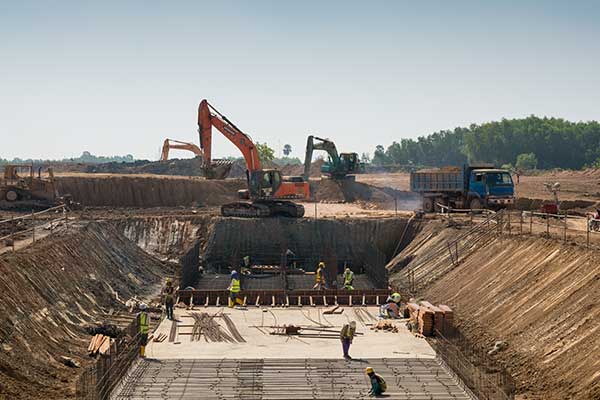
Site preparation in Fair Oaks Ranch usually means adding something substantial to a property that already has a house on it. A pool and outdoor living area, a casita, a workshop, a garage, an extended driveway. On rolling ground with limestone close to the surface and mature oaks that have to be protected, that is real excavation work rather than a landscaping job.
Soil depth varies widely across the city and the limestone is often not far down. Excavating a pool or a pad frequently means ripping or hammering rather than digging, and that is the line item most likely to move a budget. The offset is that excavated limestone, processed and compacted, makes excellent base for a driveway extension or a parking area, so material coming out can reduce material you would otherwise buy. We assess soil depth on site rather than pricing a pad from a plan.
This is the constraint that separates good site work here from bad. The live oaks on these lots are the reason the property looks the way it does, and they are protected by covenants and city requirements as well as by common sense. Protection fencing goes up at the critical root zone before work starts and stays up. No equipment traffic, spoil storage, or material staging inside that line. Where a utility or plumbing run has to cross a root zone, boring under it beats trenching through it. Damage done during construction shows up in the tree two or three seasons later, long after everyone has forgotten what caused it.
Lots here fall rather than sit flat, and rainfall arrives in volume that thin soil over rock cannot absorb. Adding a pool deck, a pad, and a driveway extension changes how water crosses the property, usually by increasing what runs off and concentrating where it goes. We establish positive fall away from every structure, shape the ground so runoff reaches a controlled outlet, and pay attention to what happens downhill, because on lots this size water pushed to a boundary still ends up somewhere.
Organic material and root balls come out of the footprint entirely, since anything left to decompose becomes a void and then a settlement crack. Fill goes in compacted lifts rather than being dumped and spread. The pad extends past the structure footprint so edges do not slough, and it is shaped to shed water rather than hold it against a slab. A casita or shop pad gets built to the same standard as a house pad, at a smaller size.
The homeowners association reviews structures, pools, driveways, and often tree removal, and the city has its own permitting on top of that. Setbacks, allowable structure size, materials, and clearing limits commonly appear in covenants. Get approval before the design is finalized rather than after, because changes at the review stage are inexpensive and changes in the field are not. These are two separate processes and both are the owner’s responsibility.
Many properties here have a long approach, and it has to carry concrete trucks, delivery vehicles, and equipment without failing. Where an extension or a turnaround is part of the project, building it early makes every trade behind us more efficient. Where the existing driveway is doing the work, we protect it and plan the route rather than assuming it will hold up to weeks of construction traffic.
Pools, casitas, and outdoor kitchens all need service brought to them, and on a large lot those runs can be long. Rock makes trenching expensive, so route selection genuinely matters. Where a line would otherwise cross the root zone of an oak you are protecting, boring under it is worth the extra cost rather than trenching straight through and hoping the tree recovers. We look at those routes during site prep, when changing them is still cheap.
Spoil from a pool excavation has to go somewhere, and on a wooded lot there is often nowhere convenient. Options are hauling it off, using it elsewhere on the property where grade allows, or processing rock into base for a driveway extension. We plan that during the quote rather than leaving a mound behind the house for the landscaper to deal with, since disposal is a real cost and it should be visible up front.
Site preparation across Fair Oaks Ranch, Boerne, Leon Springs, Cross Mountain, Grey Forest, Helotes, Shavano Park, Bulverde, Timberwood Park, and throughout Bexar, Comal, and Kendall counties.
Send the plan or the address with photos, plus your covenant requirements. Call 210-942-1961.
It is the largest variable on most projects here and depends on how deep the soil is and how hard the rock is. Rippable material moves far more cheaply than material needing a hammer. The offset is that excavated limestone makes excellent driveway or parking base once processed, so some of the excavation cost returns as material you do not have to buy.
Protection fencing at the critical root zone before work starts, kept up throughout. No equipment traffic, spoil, or material storage inside that line. Utility and plumbing runs get bored under root zones rather than trenched through where that is feasible. Damage done during construction typically shows in the tree two or three seasons later, so prevention is the only real option.
Yes, and they are separate. The association reviews structures, pools, driveways, and often tree removal, with covenants covering setbacks, size, materials, and clearing limits. The city has its own permitting. Get both settled before the design is final, since changes at review stage cost far less than changes once work has started.
Yes, built to the same standard as a house pad at a smaller scale. Organic material and roots come out entirely, fill goes in compacted lifts, the pad extends past the footprint so edges do not slough, and it sheds water rather than holding it against the slab. Rock excavation is usually the significant variable on the price.
Almost certainly. A pool, its decking, and any associated paving all reduce the ground available to absorb water and concentrate where runoff goes. On rolling ground that matters. We establish fall away from structures, shape the site so runoff reaches a controlled outlet, and consider what happens downhill rather than just moving the problem to a boundary.
Yes, and where it is part of a larger project it is usually worth building early so every trade behind us benefits. We clear the corridor, cut subgrade, and place and compact base. Excavated limestone from elsewhere on the site frequently supplies part of that base material, which reduces what has to be imported.
Typically a week or so for a pool or casita footprint, longer where significant rock excavation, drainage work, or a driveway extension is involved. Rock is the usual reason a schedule extends. Approval timing on the HOA and city side is often the longer variable overall. We provide a schedule with the quote and update it as conditions become clear.