
Schertz sits at the centre of one of the busiest development corridors in the region, and site preparation here runs from a backyard shed pad to a multi acre industrial building. Both matter and both go wrong in the same way if the soil is not respected. Hill Country Land Clearing prepares sites across Schertz and the three counties it occupies.
Most of this ground is clay with meaningful shrink swell potential. It takes on water through spring and gives it up through a hot summer, and the volume change is enough to crack a slab that was not built for it. The remedies come from the geotechnical report and the engineer: select fill, moisture conditioning, over excavation and replacement, or a foundation designed to tolerate movement. We build to that specification and do not shortcut it, because this is the one thing on a Schertz site you cannot fix afterward.
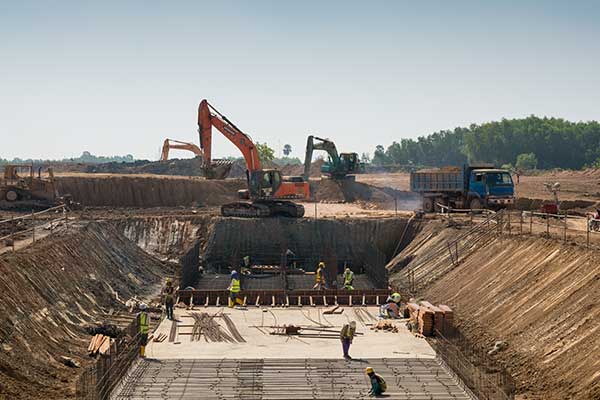
Large building pads carry requirements a house pad does not. Compaction testing at specified intervals and densities, moisture control across a much larger area, tighter elevation tolerances, and truck court and paving subgrade that has to carry loaded vehicles rather than passenger cars. Sequencing matters too, because on a large site the earthwork, the utilities, and the paving contractor are all working against the same schedule. We work to the geotechnical specification and the civil drawings rather than to a general standard.
Nearly every commercial and subdivision project here includes detention, and building a basin properly is more exacting than it looks. It has to hold the design volume, release at the designed rate through a correctly built outlet, and hold its side slopes without eroding. Get the grading wrong and it either does not detain what it was supposed to or it becomes a maintenance problem from the first year. It is also the feature most likely to be inspected, so it is worth building right the first time.
Construction disturbing an acre or more generally falls under stormwater permitting requirements, which means a plan, documented controls, and inspections. Silt fence, stabilized construction entrances, inlet protection, and stabilization of disturbed areas all have to be in place and maintained rather than installed and forgotten. We build to what the plan specifies and keep it functional through the work, because a failed control on a wet week becomes an enforcement problem quickly.
The advantage of this soil is that grubbing works. There is no rock shelf, so root balls come out whole and the footprint can be genuinely cleaned. That matters because organic material left under a pad decomposes, creates a void, and produces settlement that shows up as a crack after occupancy. On clay already prone to seasonal movement, adding an avoidable settlement source is the last thing anyone needs.
You cannot compact wet clay properly and equipment on saturated ground causes damage. That is real schedule risk on this ground, more than on a rocky site that sheds water and dries quickly. We build float into the program and say honestly when conditions are unworkable, because placing fill at the wrong moisture content to save three days fails compaction testing and costs considerably more than the delay would have.
Good site prep tries to balance cut and fill so you are not paying to import dirt and export spoil at the same time. Topsoil stripped from the footprint gets stockpiled and reused at final grade rather than hauled off and bought back later. There is no rock here to crush into base, so base material has to be imported, which is a real cost line worth seeing up front rather than discovering when the driveway or truck court is being built.
Not every job here is a commercial building. Shed pads, pool footprints, and patio slabs on residential lots get the same treatment at a smaller scale: organic material and roots out entirely, fill in compacted lifts, the pad extended past the footprint so edges hold, and shaped to shed water. On flat lots with clay soil, drainage correction is frequently the more valuable half of the job.
Site preparation across Schertz, Cibolo, Selma, Universal City, Live Oak, Converse, Garden Ridge, New Braunfels, Marion, Seguin, and throughout Guadalupe, Comal, and Bexar counties.
Send the civil drawings and the geotechnical report if you have them. Call 210-942-1961.
Yes, and it is a significant share of what we do in Schertz given the development along the I-35 corridor. Large pads carry requirements a house pad does not, including compaction testing at specified densities, tighter elevation tolerances, moisture control across a larger area, and subgrade built to carry loaded trucks rather than cars.
For anything structural on this soil it is money well spent and usually required. Clay here varies in depth and plasticity across short distances, and the report tells your engineer what treatment the specific site needs. Building on expansive clay without one means guessing at the variable most likely to cause a problem later.
To the specification in the geotechnical report, which is not optional. Depending on the recommendation that means select fill, moisture conditioning, over excavation and replacement, or a foundation designed to tolerate movement. What we will not do is place a slab on untreated clay, because the shrink swell cycle here will crack it and it cannot be fixed afterward.
Yes, and it is more exacting work than it appears. A basin has to hold the design volume, release at the designed rate through a correctly built outlet, and hold its side slopes without eroding. Grading errors mean it either does not detain what it should or becomes a maintenance problem immediately. It is also the feature most likely to be inspected.
Construction disturbing an acre or more generally falls under stormwater permitting, which means a plan, documented controls, and inspections. Silt fence, stabilized entrances, inlet protection, and stabilization of disturbed areas have to be installed and maintained rather than put in and forgotten. We build to the plan and keep the controls functional through the work.
More than on rocky ground. Clay cannot be compacted properly when wet and equipment on saturated ground causes damage, so wet stretches genuinely stop work rather than slowing it. We build float into the schedule and say when conditions are unworkable, since placing fill at the wrong moisture content fails testing and costs more than the delay.
Yes, and here it is fully achievable because there is no rock shelf. Root balls come out whole. That matters on clay, since organic material left underground decomposes into a void and produces settlement, and adding an avoidable settlement source to soil that already moves seasonally is asking for a foundation problem later.