
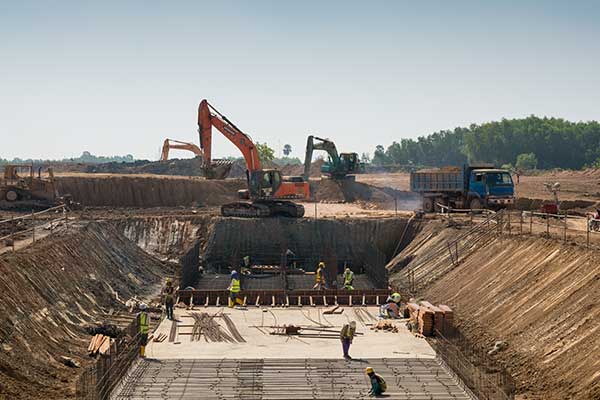
Site preparation in Selma is mostly commercial: an outparcel going in beside an existing centre, a pad site for a new tenant, a parking expansion, a drive reconfiguration. All of it happens on expansive clay, on a tight schedule, and usually next to a property that is open for business. Hill Country Land Clearing prepares these sites across Selma and the surrounding corridor.
This ground has meaningful shrink swell potential. It takes on water through spring and gives it up through a hot summer, and the volume change is enough to crack a slab that was not built for it. The remedy comes from the geotechnical report and the engineer: select fill, moisture conditioning, over excavation and replacement, or a foundation designed to tolerate movement. We build to that specification. This is the one item on a Selma site you cannot fix afterward.
On retail work the paving is as important as the building, and it fails more often. Subgrade under a drive aisle has to carry loaded delivery trucks and refuse vehicles rather than passenger cars, and clay that was not properly prepared and compacted produces the rutting and cracking you see across half the parking lots on any corridor. We prepare subgrade to the specification rather than to whatever gets the paving contractor on site fastest, because rework on a parking lot means closing part of an operating property.
An outparcel almost never drains in isolation. It has to tie into the existing storm system and the existing detention, at the rate the original design assumed, without pushing water onto the neighbouring pad or backing it up in a shared inlet. That means understanding what is already there before you change grades. We work from the civil drawings and confirm conditions in the field, because an assumption about an existing invert is the kind of error that surfaces during the first heavy rain.
The logistics matter as much as the earthwork. Construction traffic has to keep clear of customer traffic, staging cannot consume a neighbouring tenant’s parking, and the street and shared lots need sweeping because tracked mud generates complaints faster than noise does. Erosion control on a commercial site is also a requirement rather than a courtesy, with construction disturbing an acre or more generally falling under stormwater permitting. We install to the plan and keep controls functional through the work.
The advantage of this soil is that grubbing works. There is no rock shelf, so root balls come out whole and the footprint can be genuinely cleaned. That matters because organic material left under a pad or under paving decomposes, creates a void, and produces settlement. On clay already prone to seasonal movement, adding an avoidable settlement source under a slab or a drive aisle is asking for a problem that will be expensive to fix later.
You cannot compact wet clay properly and equipment on saturated ground causes damage. On a commercial schedule with a tenant opening date attached, that risk needs to be in the program rather than absorbed at the end. We build float in, say honestly when conditions are unworkable, and would rather lose days than place fill at the wrong moisture content and fail compaction testing on a site with a lease deadline.
There is rarely anywhere to put spoil on a commercial pad site, which means export rather than balance. Topsoil worth keeping gets stockpiled where the site allows and reused at final grade, and everything else is hauled. Base material has to be imported since there is no rock here to excavate and crush. Those truck movements need scheduling around the operating property next door rather than run whenever a load is ready.
Outparcels sit inside developments that already have services running through them, and those lines are not always where the record drawings say. Before excavating we get utilities located and ask what previous work has been done on the site. Where a new run has to cross an existing one or pass near a preserved tree, sorting the route during prep is far cheaper than after a trench is open.
Site preparation across Selma, Schertz, Cibolo, Live Oak, Universal City, Converse, Garden Ridge, Windcrest, New Braunfels, and throughout Bexar, Comal, and Guadalupe counties.
Send the civil drawings and the geotechnical report if you have them. Call 210-942-1961.
Yes, and it is the bulk of the site work here. Those jobs come with tight schedules and operating neighbours, so alongside the earthwork we plan construction traffic, staging that does not consume a tenant's parking, and sweeping to keep tracked material off shared lots and public roads.
For anything structural on this soil it is money well spent and usually required. Clay here varies in depth and plasticity across short distances, and the report tells your engineer what treatment the specific site needs. Building on expansive clay without one means guessing at the variable most likely to cause a problem.
Because drive aisles carry loaded delivery trucks and refuse vehicles rather than passenger cars, and clay that was not properly prepared and compacted produces the rutting and cracking visible across half the parking lots on any corridor. Rework means closing part of an operating property, which costs far more than doing the subgrade correctly the first time.
At the rate the original design assumed, into the existing storm system and detention, without pushing water onto a neighbouring pad or backing up a shared inlet. That requires understanding what is already there before changing grades. We work from the civil drawings and confirm conditions in the field rather than assuming an existing invert.
Construction disturbing an acre or more generally falls under stormwater permitting, which means a plan, documented controls, and inspections. Silt fence, stabilized entrances, and inlet protection have to be installed and maintained rather than put in and forgotten. On a shared commercial property, a failed control on a wet week becomes everyone's problem quickly.
Enough that it belongs in the program rather than being absorbed at the end. Clay cannot be compacted when wet and equipment on saturated ground causes damage, so wet stretches stop work rather than slowing it. Placing fill at the wrong moisture content to protect a date fails testing and costs more than the delay would have.
Yes. Shed and shop pads, pool footprints, patio slabs, and drainage correction on residential lots all get the same standards at a smaller scale: organic material and roots out entirely, fill in compacted lifts, and the pad shaped to shed water rather than hold it against a slab.