
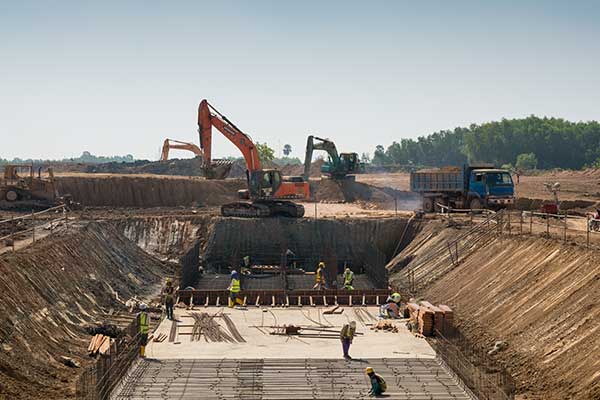
Site preparation in Shavano Park almost always means adding something substantial to a property that already has a house on it. A pool and outdoor living area, a casita, a workshop, a garage, a driveway extension. On limestone, under mature oaks, with a tree code that has real teeth, that is genuine excavation work rather than a landscaping exercise.
Soil depth varies widely across the city and limestone is often not far down. Excavating a pool or benching a pad frequently means ripping or hammering rather than digging, and that is the line item most likely to move a budget. The offset is that excavated limestone, processed and compacted, makes excellent base for a driveway extension or a parking area, so material coming out can reduce material you would otherwise buy. We assess soil depth on site rather than pricing a pad from a plan.
This is the constraint that separates good site work in Shavano Park from bad. The live oaks on these lots are protected by the city’s code as well as by common sense, and damage to them during construction is both a regulatory problem and an irreversible one. Protection fencing goes up at the critical root zone before work starts and stays up. No equipment traffic, spoil storage, or material staging inside that line. Where a utility or plumbing run has to cross a root zone, boring under beats trenching through.
A tree damaged during construction usually looks fine when the project finishes. Compaction, root severance, and grade change over a root zone express themselves two or three seasons later as thinning crown and decline, long after anyone connects it to the work. That is why protection is planned before mobilization rather than added when someone notices a problem. If a project as designed cannot be built without significantly disturbing a protected tree’s roots, we say so at the quote.
Adding a pool deck, a pad, and a driveway extension changes how water crosses a property, generally by increasing runoff and concentrating where it goes. Thin soil over rock absorbs very little of it. We establish positive fall away from every structure, shape the ground so runoff reaches a controlled outlet, and pay attention to where it ends up, because on lots this size water pushed toward a boundary still arrives somewhere and usually on a neighbour who will notice.
Where a property is on on site sewage, the field location has to be established and protected before any grading. You cannot run construction traffic across it or place fill over an area the design depends on. Long service runs to a pool, casita, or outdoor kitchen also need routing before the pad is finished, and rock makes trenching expensive enough that route selection genuinely matters rather than being an afterthought.
Organic material and root balls come out of the footprint entirely, since anything left to decompose becomes a void and then a settlement crack. Fill goes in compacted lifts rather than being dumped and spread. The pad extends past the structure footprint so edges do not slough, and it is shaped to shed water rather than hold it against a slab. A casita or shop pad is built to the same standard as a house pad, at a smaller size.
Excavated material from a pool or a pad has to go somewhere, and on a wooded lot there is often nowhere convenient that is not a root zone. Options are hauling it off, using it elsewhere on the property where grade allows, or processing rock into base for a driveway. We plan that during the quote rather than leaving a mound behind the house for the landscaper to inherit, since disposal is a genuine cost and it belongs in the number you see up front.
Concrete, base material, and equipment all have to reach a working area that may sit well behind the house, down a long private drive, under mature canopy. Turning radius, driveway grade, overhead clearance, and where a truck can stop all matter, and every trade behind us faces the same constraints. Sorting the access route early saves money on every delivery that follows rather than just on ours.
Site preparation across Shavano Park, Hollywood Park, Hill Country Village, Castle Hills, Helotes, Leon Springs, Cross Mountain, Fair Oaks Ranch, Stone Oak, and neighbouring San Antonio areas.
Send the plan or the address with photos, and tell us which trees you are protecting. Call 210-942-1961.
It is usually the largest variable and depends on soil depth and rock hardness, both of which change across short distances here. Rippable material moves far more cheaply than material needing a hammer. The offset is that excavated limestone makes excellent driveway or parking base once processed, so part of the cost returns as material you do not buy.
Protection fencing at the critical root zone before work starts, kept up throughout, with no equipment traffic, spoil, or material storage inside that line. Utility and plumbing runs get bored under root zones rather than trenched through where feasible. Given the city's code and the value of these oaks, this is planned before mobilization rather than added later.
Because compaction, root severance, and grade change over a root zone express themselves as thinning crown and decline two or three seasons after the work, long after anyone connects it to the cause. That delay is exactly why protection has to be planned upfront. By the time the symptom shows, the damage cannot be reversed.
Almost certainly, and the tree requirements will apply alongside the building permit. Setbacks, structure rules, and impervious cover limits are all worth confirming with the City of Shavano Park before the design is finalized, since a change at the approval stage costs far less than a change in the field.
Almost certainly. A pool, its decking, and associated paving all reduce the ground available to absorb water and concentrate where runoff goes, and thin soil over rock absorbs very little to begin with. We establish fall away from structures, route runoff to a controlled outlet, and consider where it ends up rather than pushing it to a boundary.
It has to be located and protected before any grading begins. Construction traffic across a drain field compacts it and fill placed over it undermines the design. Tell us where the system, the tanks, and the field are at the walkthrough, along with anything you know about earlier work on the property.
Typically a week or so for a pool or casita footprint, longer where significant rock excavation, drainage work, or a driveway extension is involved. Rock is the usual reason a schedule extends. Approval timing on the city side is often the larger variable overall, so factor that into planning alongside the work itself.