
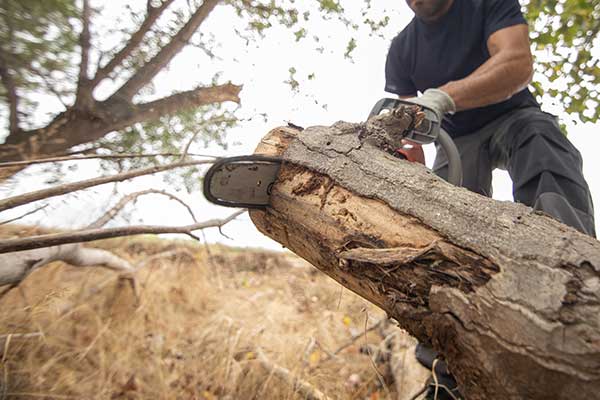
Removing a tree in Alamo Heights is a different exercise from removing one on open land. The tree is usually large, usually old, usually surrounded by a house, a garage, a pool, a wall, and a neighbor’s roof, and usually protected by city ordinance. Hill Country Land Clearing removes trees across 78209 with the rigging, the access planning, and the permit awareness that this neighborhood requires.
Alamo Heights is its own city with its own tree preservation code, so what applies in San Antonio does not govern your lot. Removal of protected trees generally requires city approval before the work happens, and approvals can come with replacement or mitigation conditions. Dead and demonstrably hazardous trees are typically treated differently from healthy ones. Thresholds are based on species and trunk size and they do change, so confirm current requirements with the City of Alamo Heights. The permit belongs to the property owner, and we do not take down a protected tree that has not been cleared.
The mature live oak canopy that makes Alamo Heights what it is also makes it vulnerable. These trees are extensively root grafted, often across property lines and sometimes down an entire block, and oak wilt moves through those connections as well as through beetles drawn to fresh wounds. That is why the standing guidance is to avoid cutting or pruning oaks during the high risk window in late winter and spring unless there is a safety reason not to wait. When an oak must come out in that period, wounds get painted immediately and equipment is cleaned between trees.
Not every declining tree needs removal, and we will say so when pruning or a cabling system is the better answer. The situations that generally justify removal are extensive deadwood in the crown, conks or mushrooms at the base indicating root decay, a hollow or split trunk, a new lean with soil lifting on one side, or storm damage that has compromised the structure. Location weighs heavily. The same defect is a monitoring item at the back fence and an urgent problem over a child’s bedroom.
Very few Alamo Heights trees can simply be felled. Most come down in sections from the top, with each piece rigged and lowered under control rather than dropped. Where a crane can be positioned and the street can accommodate it, sectional crane removal is faster and safer over a structure. Where it cannot, the work is climbed and rigged. Equipment sits on protection where lawn, driveway, or hardscape condition matters, and the site is raked and blown before we leave.
Access planning is half the quote. Narrow streets with no shoulder, mature canopy overhead limiting boom height, rear alleys that may or may not be usable, and neighbors who need driveway access all shape how the job runs. Where a crane or a chipper has to occupy the street, that gets coordinated in advance rather than discovered on the morning. We notify adjacent homeowners as a matter of course.
Live oak leads by a wide margin, usually from oak wilt, root decay, or structural failure in an aging specimen. Pecans drop major limbs as they decline and are common removals. Cedar elms and hackberries break easily and often end up in the wrong place. Arizona ash planted decades ago is now reaching the end of its life across this area. Ligustrum grown to tree size gets removed as part of understory work.
What you do with the stump depends on the plan for the ground. Grinding takes it several inches below grade and is enough for turf or a planting bed. Full grubbing removes the root ball and is what you need if a foundation, an addition, a pool, or a driveway is going over the spot. If your removal came with a replacement requirement from the city, plan the new planting location before the stump is ground so the two decisions fit together.
After a storm the first priority is making the situation safe rather than completing a full removal. That may mean taking down a hanging limb, relieving weight from a leaning trunk, or clearing a tree off a roof, a car, or a driveway before the rest of the work is scheduled. If a tree or limb is on a power line, call CPS Energy first, because energized conductors are their responsibility and not something for a homeowner or a tree crew to approach.
Tree removal across Alamo Heights, Terrell Hills, Olmos Park, Lincoln Heights, Mahncke Park, Northwood, and neighboring San Antonio blocks.
Photos showing the tree and everything around it get you an answer quickly. Call 210-942-1961.
In most cases yes for protected trees. Alamo Heights administers its own tree preservation code through the city, separate from San Antonio, and approval is generally required before a protected tree comes down. Removals may carry replacement or mitigation conditions. Dead and hazardous trees are handled differently. Confirm current thresholds with the city, since the permit is the owner's responsibility.
More than the same tree on open land, and access is why. A large oak between a house and a power line has to come down in rigged sections rather than being felled, which takes far longer. Height, diameter, species, lean, crane feasibility, and where debris can be staged all move the price. Stump grinding is normally a separate line item.
Get it diagnosed properly before acting, ideally by a certified arborist, because several conditions look similar. If it is confirmed, the response usually involves more than removing one tree, since these oaks are root grafted to their neighbors and the disease travels through those connections. Trenching to sever root grafts and treating adjacent trees are part of how it gets contained.
Outside the high risk window in late winter and spring, if the tree is not an immediate hazard. Fresh wounds during that period attract the beetles that carry the fungus between trees, which matters enormously in a neighborhood with this much connected live oak. When a removal cannot wait, immediate wound painting and cleaning equipment between trees are the standard precautions.
Yes. It comes down in sections from the top, with pieces rigged and lowered rather than dropped, and where the street allows it a crane makes confined removals both faster and safer. Clearance, not the tree, usually determines the method and the price. Photos showing the tree, the structure, and the street let us assess it quickly.
Sometimes, particularly for crane work or chipper positioning on blocks with no shoulder. Where that is necessary we coordinate it in advance and let neighbors know so driveway access is maintained as far as possible. On lots with usable alley access we often work from the rear instead, which keeps the street clear entirely.
Possibly. Alamo Heights ties replacement or mitigation obligations to certain removals as part of its tree code, with the specifics depending on the tree and the circumstances. This is worth confirming with the city at the permit stage rather than after the fact, and it is a good reason to plan replacement planting locations before the stump is ground out.