
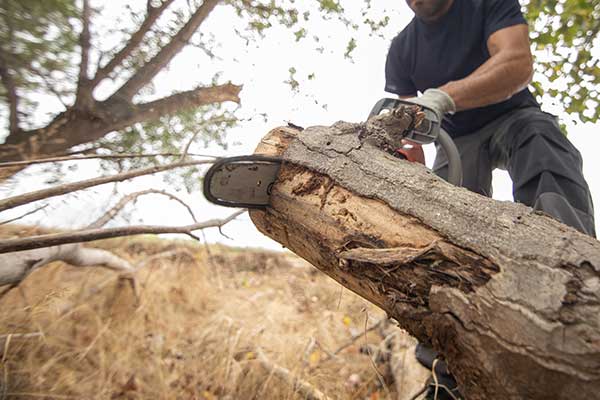
Tree work around Bulverde ranges from one dead live oak leaning toward a new house in a subdivision to a fence line of drought killed juniper on forty acres. Hill Country Land Clearing handles both across Comal County. The tree itself is often the easy part. Access, slope, rock, and whatever the deed restrictions say are usually what actually shape the job.
Comal County sits well inside the oak wilt region, and live oaks here are extensively root grafted, frequently across property lines and sometimes down an entire hillside. The fungus moves through those root connections and through beetles drawn to fresh wounds, which is why guidance across central Texas is to avoid cutting or pruning oaks during the high risk window in late winter and spring unless safety makes waiting impossible. When an oak must come out then, wounds are painted immediately and equipment is cleaned between trees. Containing an active infection center normally involves more than removing one tree, and severing root grafts by trenching is part of how that gets done.
Plenty of rough looking Hill Country trees are structurally sound and we will say so rather than quoting a removal. What generally justifies taking one out is extensive deadwood in the crown, conks or mushrooms at the base indicating root decay, a hollow or split trunk, a fresh lean with soil lifting on the uphill side, or storm damage that has compromised the structure. Location weighs heavily. The same defect is a monitoring item at the back of ten acres and an urgent problem over a bedroom or a barn.
Dry years leave their mark on this landscape long after the rain returns. Spanish oaks and post oaks decline and die back, and stands of drought killed juniper are left standing as some of the most flammable material in Texas, usually right along a fence line or a driveway. On the 281 corridor, where houses sit close enough that one property’s fuel is everyone’s problem, clearing standing dead cedar around structures and access routes is straightforward work with an enormous payoff in a bad fire year.
On open acreage most trees are felled directionally and processed on the ground, which is fast and safe when there is room. On a two acre lot with a house, a septic field, a fence, and a neighbor thirty feet away, the same tree comes down in sections from the top with pieces rigged and lowered rather than dropped. Slope adds its own considerations, since a felled trunk on a grade does not always stay where it lands. We plan the drop, the rigging, and the retrieval route before the saw starts.
What happens to the stump depends on the ground and your plans. Grinding takes it below grade and is enough for pasture, lawn, or planting. Full grubbing pulls the root ball and is what you need under a foundation, a driveway, or a pad. On thin soil over limestone, grubbing sometimes means tearing into rock and leaving a hole that does not backfill neatly, so we tell you which outcome is realistic on your site rather than promising a clean result and delivering a crater.
Whether anything governs your removal depends on where the tract sits. Inside Bulverde city limits the city has its own requirements. In unincorporated Comal County there is no zoning in the way a city does it. But recorded deed restrictions on subdivided acreage frequently protect trees above a given trunk size regardless of what any government requires, and those are enforceable. Check your documents, and confirm city or ETJ status if you are unsure which applies.
After a storm the first job is making the situation safe rather than completing a removal. That might mean taking down a hanging limb, relieving weight from a leaning trunk, or clearing a tree off a roof, a fence, or a driveway before the full removal is scheduled. If a tree or limb is on a power line, call your electric provider first, because energized conductors are their responsibility and not something to approach.
Tree removal across Bulverde, Spring Branch, Canyon Lake, Smithson Valley, Garden Ridge, Timberwood Park, Bracken, Fair Oaks Ranch, New Braunfels, and throughout Comal, Kendall, and northern Bexar counties.
Photos of the tree and everything around it get you an answer quickly. Call 210-942-1961.
It may be, since Comal County is well inside the affected region, but drought stress, root decay, and hypoxylon can look similar. Get a proper diagnosis before acting, ideally from a certified arborist or the Texas A&M Forest Service. The response to confirmed oak wilt involves the surrounding trees rather than just the one that is visibly declining.
Outside the high risk window in late winter and spring, whenever the tree is not an immediate hazard. Fresh wounds in that period attract the beetles that carry the fungus between trees, which matters a great deal where oaks are as heavily root grafted as they are here. If a removal cannot wait, immediate wound painting is the standard precaution and it is part of the work.
It depends on where the tract sits and what your deed says. Inside city limits the city has its own requirements, and unincorporated Comal County does not zone the way a city does. But recorded restrictions on subdivided acreage often protect trees above a certain trunk size regardless, and those are enforceable. Check your documents and confirm your jurisdiction.
Severing root grafts by trenching between infected and healthy trees is a recognized containment step, done to depths and distances that a management plan specifies rather than by guesswork. It works best alongside a proper diagnosis and a plan covering the surrounding trees. Get an arborist or the Forest Service to set the layout and we can carry out the work.
Yes, and it is common after dry years. Standing dead juniper is among the most flammable material on a Comal County property and it tends to concentrate exactly where you least want it, along fence lines and driveways. Bulk removals like this are quoted by the acre or the run rather than per tree, and material can be mulched, piled, or hauled.
Your choice. It can be cut to firewood length and stacked, mulched, chipped, piled for burning when Comal County has no ban in place, or hauled off. Plenty of acreage owners keep oak and mesquite for firewood and cooking wood. Haul off is the most expensive option because of trucking and disposal fees, so we settle the plan when we quote.
Yes. Where clearance is tight the tree comes down in sections from the top with pieces rigged and lowered under control rather than felled whole. That takes longer than an open acreage removal and costs more, which is why access and clearance drive the price as much as the tree does. Photos showing the surroundings let us assess it quickly.