
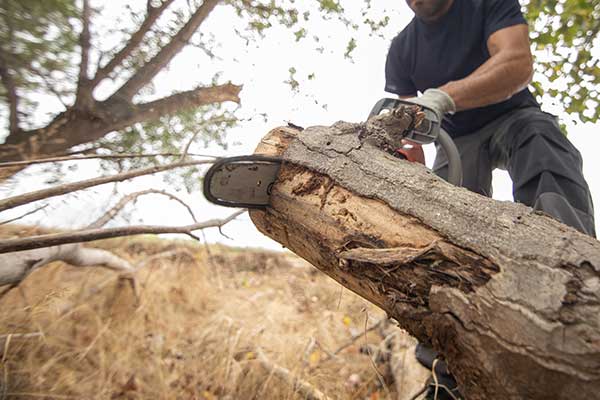
Castle Hills has a tree problem that is specific to how the neighborhood was built. The houses went up over a couple of decades, the trees went in at the same time, and a great many of them are now reaching the end of their span together. Hill Country Land Clearing removes trees across Castle Hills and the surrounding area, from a single failing ash over a driveway to several removals on one property.
When these lots were developed, the species chosen were often the ones that gave shade fastest. Arizona ash is the clearest example, planted heavily across San Antonio in that era and known for growing quickly, forming weak wood, and declining after a few decades. Mulberry, chinaberry, and fast growing hackberry followed the same pattern. Sixty years on, those trees are failing at similar times across whole streets. That is why owners here often need more than one removal, and why looking at the whole property at once is worth doing.
Not every declining tree needs removing and we will say so when pruning or cabling is the better answer. What usually justifies removal is extensive deadwood in the crown, conks or mushrooms at the base indicating root decay, a hollow or split trunk, a fresh lean with soil lifting on one side, or storm damage that has compromised the structure. Location weighs heavily. The same defect is a monitoring item at the back fence and an urgent problem over a bedroom or a car.
Live oaks in this area are root grafted, frequently across property lines, and oak wilt travels through those connections as well as through beetles drawn to fresh wounds. Guidance across central Texas is to avoid cutting or pruning oaks during the high risk window in late winter and spring unless safety makes waiting impossible. When an oak has to come out then, wounds are painted immediately and equipment is cleaned between trees. If oak wilt is suspected rather than confirmed, get a proper diagnosis before making decisions about the surrounding trees.
Some Castle Hills trees can be felled whole because the lots have room, which is a real advantage over the tighter older neighborhoods. Where a tree stands over a house, a pool, a fence, or a neighbor’s roof, it comes down in sections from the top with pieces rigged and lowered under control rather than dropped. Where the street and driveway allow, a crane makes confined removals faster and safer. Equipment sits on protection where lawn and driveway condition matters, and the site is raked and blown before we leave.
Service drops run to every house here and mature trees have grown around them over decades. Any removal near an energized line needs planning rather than improvisation. If a tree or limb is contacting a power line, call CPS Energy first, since energized conductors are their responsibility and not something for a homeowner or a crew to approach. We work out clearances before the climb rather than during it.
This is a separate incorporated city with its own government, so San Antonio’s tree rules do not govern your property. Requirements are set locally and can differ from what applies a block outside the city limits. Confirm current requirements with the City of Castle Hills before scheduling. The approval, where one is needed, is the property owner’s responsibility, and we would rather raise the question early than find it afterward.
Removal leaves a stump and what to do with it depends on your plans. Grinding takes it several inches below grade and is enough for lawn or a planting bed. Full grubbing pulls the root ball and is what you need under a foundation, a driveway, a pool, or a casita. We quote both so you can decide rather than finding out later that grinding was not enough for what you had in mind.
If you are taking out an aging fast growing tree, it is worth thinking about the replacement before the stump is ground, since location and species are easier to plan together. The lesson from the original planting is worth learning: species chosen for fast shade tend to give you fifty years and then a removal bill. Slower growing, longer lived choices cost patience and save the next owner the same problem.
Tree removal across Castle Hills, Shavano Park, Hollywood Park, Hill Country Village, Balcones Heights, Leon Valley, Olmos Park, Alamo Heights, and neighboring San Antonio blocks.
Photos showing the tree and everything around it get you an answer quickly. Call 210-942-1961.
Because they were planted at once. When these lots were developed the popular choices were fast growing shade species, particularly Arizona ash, which grows quickly, forms weak wood, and declines after a few decades. Sixty years later those trees are reaching the end of their span across whole streets at similar times. It is a pattern rather than a coincidence.
Requirements come from the City of Castle Hills rather than San Antonio, since this is a separate incorporated municipality with its own government. What applies here is not necessarily what applies a block outside the city limits. Confirm current requirements with the city before scheduling. Where approval is needed, it is the property owner's responsibility.
Height, diameter, species, and lean matter, but clearance matters most. A tree with room to be felled whole costs a fraction of the same tree standing over a house, a pool, and a fence, which has to come down in rigged sections. Castle Hills lots often have more room than the older enclaves, which works in your favor. Stump grinding is normally a separate line.
Yes, and on properties where the canopy is aging together it is usually more economical than separate visits, since mobilization and setup are a fixed cost. We can also assess the whole property and tell you which trees genuinely need to go now, which can be monitored, and which are fine, rather than quoting everything you point at.
Any removal near an energized service drop is planned before the climb rather than improvised during it. If a tree or a limb is actually contacting a line, call CPS Energy first, because energized conductors are their responsibility. Once clearances are established we can work safely around the line, but that assessment comes first.
It depends on what is going over the spot. Grinding several inches below grade is enough for lawn or a planting bed and is the usual choice. If a pool, a casita pad, a driveway, or a foundation is going over the location, the root ball has to come out entirely, which is grubbing rather than grinding and costs more.
Something slower growing and longer lived than what came out, if you have the patience for it. The fast shade species planted here in the 1950s and 60s did their job and then needed removing, which is the position you are in now. Plan the replacement location before the stump is ground so the two decisions work together rather than against each other.