
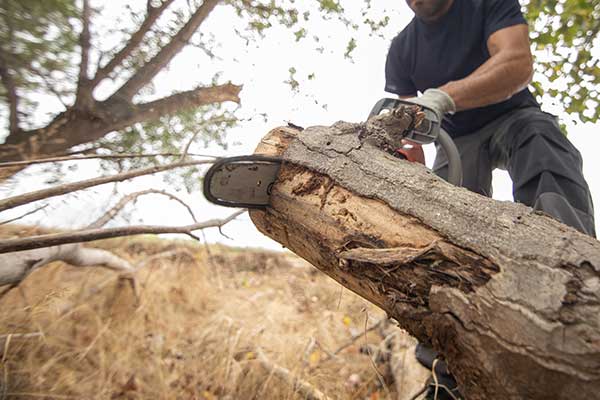
Tree removal around Cibolo has one characteristic you will not find in the Hill Country: the ground itself moves. Deep expansive clay swells and shrinks through the year, and over time that works on root plates, which is why leaning trees are a more common complaint here than they are on rocky ground. Hill Country Land Clearing removes trees across Cibolo and Guadalupe County, from a single leaning hackberry to a fence line of mesquite.
Repeated shrink swell cycles open cracks in the soil, loosen the grip around a root plate, and after a very wet period following a long dry one, trees on this soil can shift. A tree that has developed a new lean with soil heaving on one side deserves attention promptly, because that pattern is different from a tree that has grown at an angle its whole life. Species with shallow or weak root systems are the usual candidates. If a tree has moved recently, do not wait to have it looked at.
Hackberry leads by volume. It grows fast, self seeds everywhere, forms weak wood, and drops limbs or splits at the crotch as it ages. Arizona ash planted decades ago is now at the end of its span across this whole region. Mesquite fails at the crotch as it matures. Cottonwood along the creek bottoms grows large and sheds heavy limbs. Chinaberry and privet grown to tree size get taken out as part of general clearing. Live oaks and pecans are usually the trees people are trying to keep, not remove.
Not every rough looking tree needs removing and we will say so when pruning is the better answer. What generally justifies removal is extensive deadwood in the crown, conks or mushrooms at the base indicating root decay, a hollow or split trunk, a new lean with soil lifting, or storm damage that has compromised the structure. Location matters as much as condition. The same defect is a monitoring item at the back fence and an urgent problem over a house or a barn.
Oak wilt is present in this part of Texas and live oaks are root grafted, so the standard caution applies: avoid cutting or pruning oaks during the high risk window in late winter and spring unless safety makes waiting impossible, and paint any wound immediately. That said, several other things cause oak decline here including drought stress, root decay, and hypoxylon canker on stressed trees. Get a proper diagnosis before making decisions about surrounding trees rather than assuming the worst.
This is one area where Cibolo owners are better off than everyone west of the escarpment. With deep clay and no rock shelf, root balls can be excavated whole rather than tearing into limestone and leaving a crater. Grinding below grade is available where that is all you need, but full removal is genuinely practical, which matters if a driveway, a slab, or a pad is going over the location. We quote both and tell you which one your plans actually require.
On acreage tracts most trees can be felled directionally and processed on the ground, which is faster and safer than sectional work. In the newer subdivisions where houses sit closer together, the same tree comes down in sections from the top with pieces rigged and lowered under control. Access is generally better here than in the older enclaves or on hillside lots, which usually works in your favor on price.
This corridor gets its share of severe weather, and hackberry and ash are exactly the species that fail in it. After a storm the first job is making the situation safe rather than completing a removal: taking down a hanging limb, relieving weight from a leaning trunk, or clearing a tree off a structure or a driveway before the full removal is scheduled. If a tree or limb is on a power line, call your electric provider first, since energized conductors are their responsibility.
Inside Cibolo city limits the city regulates development and tree removal through its code, and requirements differ from unincorporated Guadalupe County. Newer subdivisions frequently add deed restrictions protecting trees regardless of what the city requires. Confirm current requirements with the City of Cibolo or check your restrictions before scheduling. The approval is the property owner’s responsibility.
Tree removal across Cibolo, Schertz, Universal City, Selma, Live Oak, Converse, Marion, Santa Clara, St. Hedwig, Seguin, New Braunfels, and throughout Guadalupe, Comal, and northeastern Bexar counties.
Photos of the tree and what is around it get you an answer quickly. Call 210-942-1961.
A new lean with soil heaving or cracking on one side is different from a tree that has grown at an angle its whole life, and it deserves prompt attention. On expansive clay, repeated shrink swell cycles work on root plates over time and trees can shift, particularly after a very wet period following a long dry one. If it has moved recently, have it looked at.
Because they grow fast, seed themselves everywhere, and form weak wood. Hackberry establishes in any unmaintained corner, reaches size quickly, then splits at the crotch or drops limbs as it ages. It is the most common removal in this area by volume, and it is far cheaper to take them out as saplings than as mature trees.
Yes, and here it is genuinely practical. Deep clay with no rock shelf means root balls can be excavated whole rather than tearing into limestone and leaving a hole that will not backfill. Grinding below grade is available if that is all you need, but full removal is the right choice where a driveway, slab, or pad is going over the spot.
Inside city limits the City of Cibolo regulates tree removal through its code, and requirements differ from unincorporated Guadalupe County. Newer subdivisions often add deed restrictions protecting trees regardless of city rules. Confirm with the city or check your restrictions before scheduling, since the approval is the property owner's responsibility.
It may be, since oak wilt is present in this part of Texas, but drought stress, root decay, and hypoxylon canker on stressed trees all look similar. Get a proper diagnosis from a certified arborist or the Texas A&M Forest Service before making decisions about the surrounding trees. Guessing wrong in either direction is costly.
Height, diameter, species, lean, and above all clearance drive it. Open acreage removals where a tree can be felled whole cost a fraction of the same tree in a subdivision requiring sectional rigging. Access around Cibolo is generally better than in older neighborhoods or hillside terrain, which tends to work in your favor. Stump work is a separate line.
Yes, and it is common work here. Bulk removals along fence lines get quoted by the run or the acre rather than per tree. Bear in mind that mesquite resprouts from the root crown, so cutting alone will produce multi stemmed regrowth. If you want the fence line to stay clear, the crowns need to come out while the equipment is on site.