
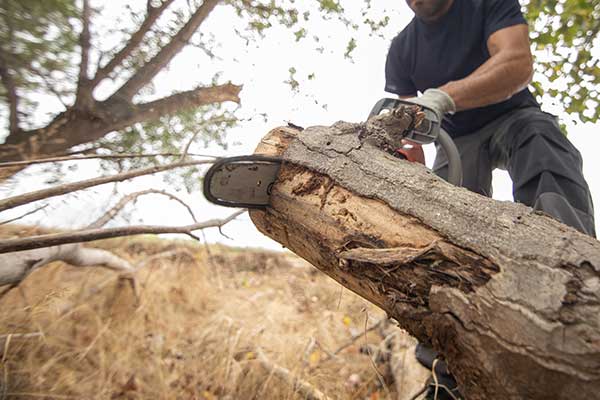
The most common tree call we get in Live Oak is a homeowner watching a mature post oak decline and not knowing why. It is usually not a mystery, and the cause is often something that happened to the property years earlier. Hill Country Land Clearing removes trees across Live Oak, and we would rather explain what is happening to a tree than simply quote taking it down.
Post oaks are survivors of the original savannah here and they are exceptionally sensitive to change. Root zone compaction from vehicles, equipment, or even sustained foot traffic. Grade changes that add or remove soil over the roots. Trenching for a line or a pool. A new irrigation system watering an area that was never irrigated before. Any of those can start a decline, and the tree typically holds on for two to four years before showing it. By the time the crown thins, the cause is usually long forgotten and often mistaken for disease.
This distinction matters and it saves people money. Oak wilt is present in Bexar County and live oaks here are root grafted, so it is a legitimate concern. But post oak decline from disturbance, drought stress, root decay, and hypoxylon canker on already stressed trees all produce similar looking symptoms. Get a proper diagnosis from a certified arborist or the Texas A&M Forest Service before making decisions, particularly before assuming a whole group of trees is at risk when the problem is actually confined to one tree’s root zone.
We would rather recommend monitoring or pruning than sell a removal you do not need, and given the permit situation here it is worth being certain before starting a process. What generally justifies removal is extensive deadwood in the crown, conks or mushrooms at the base indicating root decay, a hollow or split trunk, a new lean with soil lifting, or storm damage that has compromised the structure. A post oak in irreversible decline is also a legitimate removal, since dead ones fail unpredictably.
This is a separate incorporated city with its own government and its own tree requirements, and the canopy is part of the city’s identity. Thresholds differ from unincorporated Bexar County and from neighboring cities. Confirm current requirements with the City of Live Oak before scheduling. Where approval is needed it belongs to the property owner, and we will not remove a protected tree that has not been cleared.
Lot sizes here allow some trees to be felled whole, which keeps cost down. Where a tree stands over a house, a pool, a fence, or a neighbor’s roof, it comes down in sections from the top with pieces rigged and lowered under control rather than dropped. Equipment sits on protection where lawn and driveway condition matters, and critically, we plan the machine route to avoid the root zones of the oaks that are staying, since a removal that damages the neighbors of the tree is not much of a solution.
Grinding takes a stump below grade and suits turf or a bed. Full removal of the root ball is what you need if a pool, a pad, a driveway, or an addition is going over the location. The sandy surface soil here makes grubbing more practical than it is on rocky ground west of the city, though it still disturbs a wider area than grinding does, which matters if adjacent oaks share that ground.
After a storm the priority is making the situation safe rather than completing a removal, which may mean taking down a hanging limb, relieving weight from a leaning trunk, or clearing a tree off a structure or driveway first. If a tree or limb is contacting a power line, call CPS Energy before anyone approaches it, since energized conductors are their responsibility and not something for a homeowner or a crew to handle.
Where several trees are in question, assessing them together is more economical than separate visits and gives you a better picture. It also lets us tell you which trees genuinely need to come out, which are declining but stable for now, and which are fine. On a property where post oaks are involved, understanding the pattern across the lot often reveals a shared cause, such as an old grade change or a drive that has been parked on for years.
If you are replacing a removed tree, think about what the site will actually support rather than what you would like. Post oaks are difficult to establish and do not transplant well, which is part of why the existing ones are worth protecting so carefully. Live oaks, cedar elms, and several other natives establish more readily on this soil. Plan the location before the stump is ground so the two decisions work together.
Tree removal across Live Oak, Universal City, Selma, Converse, Schertz, Cibolo, Windcrest, Kirby, and neighboring San Antonio areas.
Photos of the tree, the crown, and everything around it get you an answer quickly. Call 210-942-1961.
Something probably did change, just years ago. Post oaks are exceptionally sensitive to root disturbance, and compaction, grade changes, trenching, or new irrigation over the root zone can all start a decline that takes two to four years to show. By the time the crown thins, the cause is usually forgotten and often mistaken for disease.
It may not be, and that distinction saves money. Oak wilt is present in Bexar County and live oaks here are root grafted, so it is a real concern. But post oak decline from disturbance, drought stress, root decay, and hypoxylon on stressed trees all look similar. Get a proper diagnosis before assuming a whole group of trees is at risk.
Likely, for protected trees. This is a separate incorporated city with its own tree requirements, and thresholds differ from unincorporated Bexar County and from neighboring cities. Confirm current requirements with the City of Live Oak before scheduling, since approval is the property owner's responsibility rather than the contractor's.
Sometimes, if the cause is identified early and can be reversed or reduced, which is a conversation for an arborist rather than a removal crew. Once decline is well advanced it is generally irreversible, and a dead post oak is worth removing because they fail unpredictably. Getting an assessment before assuming either outcome is worth the small cost.
It should not, if the work is planned. The risk is not the removal itself but the equipment route, since driving across the root zones of the oaks that are staying can put them into the same decline you are removing this tree for. We plan machine routes around root zones and use protection where crossing is unavoidable.
Grinding below grade suits turf or a planting bed and disturbs less ground. Full removal of the root ball is needed where a pool, pad, driveway, or addition is going over the spot. The sandy surface soil makes grubbing more practical here than on rocky ground, but it disturbs a wider area, which matters if adjacent oaks share that soil.
Clearance drives it more than the tree does. A tree with room to be felled whole costs a fraction of the same tree over a house or pool requiring sectional rigging. Lot sizes here often allow whole felling, which works in your favor. Stump work is a separate line, and permit timing can affect the schedule.