
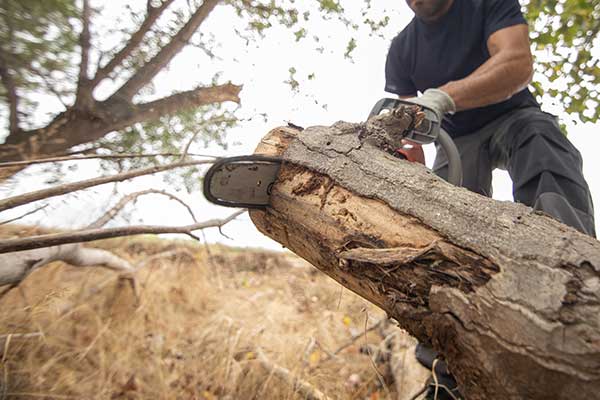
Some trees have to come out. A dead live oak leaning toward the roof, a mesquite splitting at the crotch, a row of trees standing where the shop is going, or a limb that came down in a storm and took the fence with it. Hill Country Land Clearing removes trees across San Antonio and Bexar County, from single hazardous removals near a house to dozens of trees on a lot being developed.
Not every ugly tree is a dangerous one, and we will tell you when a tree can be saved with pruning instead. The signs that usually justify removal are a large dead section in the crown, mushrooms or conks at the base indicating root rot, a hollow or cracked trunk, a fresh lean with soil heaving on one side, or damage from a storm that has left the structure compromised. Proximity matters too. The same tree is a low concern in the back forty and an urgent problem twenty feet from a bedroom.
Central Texas has a serious oak wilt problem and San Antonio sits in the middle of it. The disease moves between trees through root grafts and by beetles attracted to fresh wounds. That is why the guidance across the region is to avoid cutting or pruning oaks during the high risk window in late winter and spring whenever the work can wait. When an oak has to come out during that period for safety reasons, wounds get painted immediately and equipment is cleaned between trees. If you have oaks and no emergency, timing the work is a decision worth making deliberately.
San Antonio regulates tree removal within the city through its development code, and significant and heritage trees generally require a permit before they can be removed, with the specific thresholds depending on species and trunk diameter. Dead and hazardous trees are treated differently from healthy ones. Rules also vary between the city, unincorporated Bexar County, and individual HOA covenants. We raise this before scheduling so nobody ends up on the wrong side of an ordinance, though the permit itself is the property owner’s responsibility.
Open acreage is straightforward, with trees felled directionally and processed on the ground. Tight residential sites are different. Where a tree cannot drop in one piece we section it down from the top, rigging pieces to a controlled landing rather than letting them fall. Equipment sits on protection where lawn or driveway condition matters. Everything gets cut up and either removed or processed to your instruction, and the site is raked before we leave.
Removal leaves a stump, and what you do with it depends on the plan for the ground. Grinding takes it below grade and is enough for lawn or landscaping. Full grubbing pulls the root ball and is what you need under a foundation, a driveway, or a structure. We quote both so you can decide rather than discovering later that grinding was not sufficient.
Live oak is the most common removal in San Antonio neighborhoods, usually because of oak wilt, root rot, or a structural failure in a mature specimen. Ashe juniper comes out in volume on acreage. Mesquite fails at the crotch as it ages and drops large limbs without much warning. Hackberry and chinaberry are frequent removals because they grow fast, break easily, and end up in the wrong place. Ligustrum and other invasives get cleared from fence rows. Each species behaves differently on the way down, which is part of what we assess before quoting.
Height and diameter are only the starting point. We look at the lean and where the weight sits, what is within the drop zone, whether equipment can reach the base, the condition of the wood since decayed trunks cannot be climbed or rigged the same way, proximity to power service, and where debris can be staged. Two identical trees on two different lots can differ substantially in price for reasons that have nothing to do with the tree itself.
Tree removal across San Antonio, Alamo Heights, Terrell Hills, Olmos Park, Leon Valley, Helotes, Converse, Schertz, Cibolo, Universal City, Live Oak, Selma, Boerne, and Bulverde.
Photos of the tree and what is around it get you an answer fast. Call 210-942-1961.
Price depends on height, trunk diameter, species, lean, and above all what is underneath the tree. An open field removal is a fraction of the cost of the same tree standing between a house and a power line, because the second one has to come down in sections with rigging. Stump grinding and debris haul off are usually quoted as separate line items.
Often yes inside city limits. San Antonio's development code protects significant and heritage trees, with thresholds based on species and trunk size, and removal of those generally requires a permit. Dead or hazardous trees are handled differently from healthy ones. Unincorporated Bexar County is less restrictive, but HOA rules may still apply. We flag likely permit issues before scheduling.
Outside the high risk oak wilt window in late winter and spring, if the tree is not an immediate hazard. Fresh wounds during that period attract the beetles that spread the fungus between trees. When an oak must come out urgently, painting the wounds immediately is the standard precaution and we do it as part of the work.
We offer it, and whether you need it depends on your plans for the spot. Grinding takes the stump several inches below grade and is enough for grass or landscaping. If you are building, paving, or installing a driveway over the location, the root ball needs to come out entirely, which is grubbing rather than grinding.
Yes. Confined removals are sectioned from the top rather than felled whole, with pieces rigged and lowered under control. It takes longer than an open lot removal and costs more, which is why access and clearance drive the quote as much as the tree itself. Photos showing the tree and its surroundings let us assess it quickly.
Yes. After a storm the priority is making the situation safe, which may mean removing a hanging limb, relieving weight from a leaning tree, or clearing a tree off a structure or driveway before the full removal happens. If a tree is on a power line, call CPS Energy first, since energized lines are their responsibility and not something to approach.
Your choice. It can be hauled off, cut to firewood length and stacked on the property, chipped, or mulched on site. Many acreage owners keep oak and mesquite for firewood or cooking wood. Haul off adds cost because it means trucking and disposal fees, so we confirm the plan when we quote.