
Tree removal around Seguin covers a wide range, from a single failing pecan over a farmhouse to a fence line of mesquite across forty acres. What most of the calls have in common is that the tree is worth something, either in shade, in production, or in what it would cost to replace. Hill Country Land Clearing handles removals across Guadalupe County.
Before removing a pecan, it is worth knowing whether it needs to come out. Pecans decline for a lot of reasons that are not terminal, including drought stress, poor drainage, nutrient issues, and damage from old construction or grade changes. A tree with dieback in the upper crown may still be productive and worth keeping for years. If a pecan is genuinely failing, it should come out, but on a tree that size and that value the assessment is worth having before the decision rather than after.
What generally justifies removal is extensive deadwood in the crown, conks or mushrooms at the base indicating root decay, a hollow or split trunk, a new lean with soil lifting on one side, or storm damage that has compromised the structure. Location weighs heavily alongside condition. The same defect is a monitoring item at the back of a hundred acres and an urgent problem over a house, a barn, or a pen where livestock stand.
The Guadalupe has a real flood history and high water does damage to trees that is not obvious afterward. Bottomland trees can be undermined, partially uprooted, or left with soil scoured from around the root plate while still standing upright and leafing out normally. Months later they fail without much warning. After a significant high water event, trees near the river are worth having assessed even where nothing appears wrong.
On soil with shrink swell behaviour, repeated wet and dry cycles open cracks and work on root plates over time. A tree that develops a new lean with soil heaving or cracking on one side, particularly after a very wet period following a long dry one, deserves prompt attention. That is different from a tree that has grown at an angle its whole life. If it has moved recently, have it looked at rather than waiting.
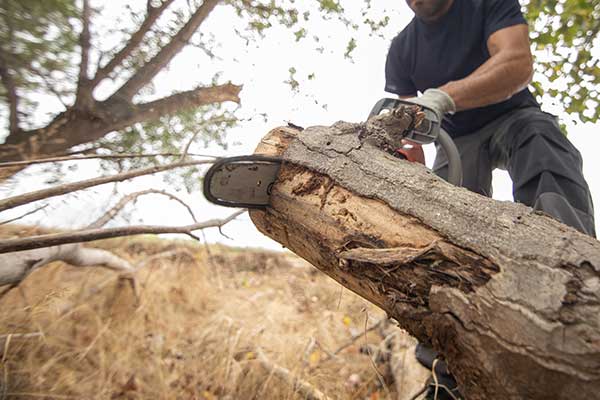
On acreage most trees can be felled directionally and processed on the ground, which is faster and safer than sectional work and costs considerably less. Near a house, a barn, or a fence, the same tree comes down in sections from the top with pieces rigged and lowered under control. Clearance rather than the tree itself is usually what drives the price, and on rural property here clearance is often generous, which works in your favour.
Deep soil with no rock shelf means root balls can be excavated whole rather than tearing into limestone and leaving a crater. Grinding below grade is available where that is all you need, but full removal is genuinely practical, which matters where a driveway, a slab, a pen, or cultivated ground is going over the location. We quote both and tell you which one your plans actually require.
Pecan and oak are worth keeping for firewood or cooking wood, and plenty of owners here do. Material can also be mulched, chipped, or hauled. If a tree or limb is contacting a power line, call your electric provider before anyone approaches it, since energized conductors are their responsibility and not something for an owner or a crew to handle.
Where a property has multiple trees in question, looking at them in one visit is more economical than separate trips, since mobilization to a rural tract is a fixed cost either way. It also lets us tell you which trees genuinely need to come out, which can be pruned or monitored instead, and which are fine. On a property with pecans, that distinction is worth real money rather than being a formality.
Tree removal across Seguin, Marion, Cibolo, Schertz, New Braunfels, McQueeney, Geronimo, Kingsbury, Luling, Gonzales, and throughout Guadalupe, Comal, and Caldwell counties.
Photos of the tree and what is around it get you an answer quickly. Call 210-942-1961.
Not necessarily. Pecans decline for reasons that are not terminal, including drought stress, poor drainage, nutrient issues, and old construction or grade damage. A tree with upper crown dieback may still be productive for years. Given what a mature pecan is worth, an assessment before the decision is money well spent rather than an unnecessary step.
Possibly. High water undermines root plates, scours soil from around roots, and partially uproots trees that still stand upright and leaf out normally. The damage often shows up months later when the tree fails without warning. After a significant high water event, trees near the river are worth assessing even when nothing looks obviously wrong.
A new lean with soil heaving or cracking on one side deserves prompt attention, particularly after a wet period following a long dry one. On soil with shrink swell behaviour, repeated cycles work on root plates over time. That is different from a tree that has always grown at an angle, so if it has moved recently, have it assessed.
Yes, and here it is genuinely practical. Deep soil with no rock shelf means root balls come out whole rather than tearing into limestone. Grinding below grade is available if that is all you need, but full removal is the right choice where a driveway, slab, pen, or cultivated ground is going over the location.
Yes, and it is common work here. Bulk removals along fence lines and field edges are quoted by the run or the acre rather than per tree. Bear in mind that mesquite resprouts from the root crown, so cutting alone gives you multi stemmed regrowth. If you want the line to stay clear, the crowns need to come out while equipment is on site.
Clearance. On open ground a tree can be felled directionally and processed where it lands, which is fast and safe. Near a house, barn, or fence the same tree has to come down in rigged sections, which takes far longer. On rural property here clearance is usually generous, and that works in your favour on price.
Your choice. Pecan and oak are worth keeping for firewood or cooking wood and plenty of owners here do exactly that. Material can also be mulched on site, chipped, or hauled off. Haul off adds cost through trucking and disposal fees, so we settle the plan when we quote rather than assuming.