
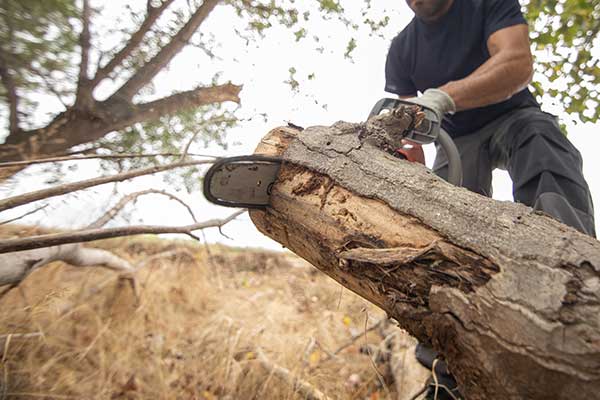
Tree removal in Timberwood Park covers a wide range on lots that are mostly still wooded: a failing live oak over a roofline, a leaning cedar beside a driveway, or several hundred standing dead junipers after a dry stretch. Hill Country Land Clearing handles all of it, and the first thing we sort out is whether anyone needs to approve it.
There is no municipal tree ordinance here because there is no city. That leads owners to assume tree removal is entirely their own affair, and on many lots it is not. Deed restrictions in this area can protect trees above a specified size, and the property owners association is the body that enforces them. Read your documents or ask the association before scheduling. Where approval is needed it belongs to the property owner, and we will not remove a protected tree that has not been cleared.
Live oaks here are extensively root grafted, frequently across property lines and sometimes along a whole street. Oak wilt travels through those connections as well as through beetles drawn to fresh wounds, which is why the guidance across central Texas is to avoid cutting or pruning oaks during the high risk window in late winter and spring unless safety makes waiting impossible. When an oak must come out then, wounds are painted immediately and equipment is cleaned between trees. Containing an active centre involves more than one tree.
Several conditions look like oak wilt. Drought stress is common on thin soil over limestone, and root decay and hypoxylon on already stressed trees produce similar decline. Removing a healthy tree helps nobody. Get a proper diagnosis from a certified arborist or the Texas A&M Forest Service before deciding, particularly where the answer will affect trees on neighbouring lots as well as your own, which given the root grafting here is frequently the case.
Dry years leave standing dead juniper across these lots, and it is among the most flammable material in Texas sitting in a wooded subdivision. It tends to concentrate in the back sections and along boundaries where nobody has looked in years. Removing standing dead material near the house, the outbuildings, and the driveway is straightforward work with a very high return in a bad fire year, and it is usually bundled into a broader clearing job rather than priced per tree.
Plenty of rough looking trees here are structurally sound and we will say so rather than quoting a removal. What generally justifies taking one out is extensive deadwood in the crown, conks or mushrooms at the base indicating root decay, a hollow or split trunk, a new lean with soil lifting on one side, or storm damage that has compromised the structure. Location weighs heavily, since the same defect at the back of an acre is a monitoring item and over a bedroom is not.
On the open parts of a wooded lot, trees can often be felled directionally and processed on the ground, which is fast and safe. Near the house, a pool, or a driveway, the same tree comes down in sections from the top with pieces rigged and lowered under control. Where the street and drive allow it, a crane makes confined removals faster and safer. Equipment sits on protection where lawn and driveway condition matter.
On a wooded lot the removal is rarely the risk to the other trees. The equipment route is. Driving repeatedly across the root zones of oaks that are staying can put them into decline that shows two or three seasons later, which is a poor trade for taking out one tree. We plan machine routes around root zones and lay protection where crossing is unavoidable, which matters more here than on an open property.
Grinding below grade suits lawn or a planting area and is usually the better choice here. Full grubbing removes the root ball and is necessary where a pool, a pad, or a driveway is going over the location, but on thin soil over limestone it can mean tearing into rock and leaving a hole that does not backfill neatly. We tell you which result is realistic on your lot rather than promising clean ground and delivering otherwise.
Tree removal across Timberwood Park, Bulverde, Stone Oak, Fair Oaks Ranch, Garden Ridge, Spring Branch, Hollywood Park, Shavano Park, and throughout northern Bexar and southern Comal counties.
Photos of the tree and everything around it get you an answer quickly. Call 210-942-1961.
Possibly, and the absence of a city misleads people. There is no municipal tree ordinance because there is no city, but deed restrictions in this area can protect trees above a specified size and the property owners association enforces them. Read your documents or ask the association before scheduling, since approval is the owner's responsibility.
It may be, since northern Bexar County is inside the affected region and the oaks here are heavily root grafted. But drought stress on thin soil, root decay, and hypoxylon on stressed trees all look similar. Get a proper diagnosis before acting, particularly since the answer often affects neighbouring lots as well as your own.
Outside the high risk window in late winter and spring, if the tree is not an immediate hazard. Fresh wounds in that period attract the beetles that carry the fungus, which matters where oaks are as connected as they are here. When removal cannot wait, immediate wound painting is standard and part of the work.
Yes, and it is common after dry years. Standing dead juniper is extremely flammable and tends to concentrate in the back sections and along boundaries where nobody has looked in years. It is usually bundled into a broader clearing job rather than priced per tree, which is generally the cheaper way to handle it.
Not from the removal itself, but potentially from the equipment route. Driving repeatedly across the root zones of oaks that are staying can put them into decline appearing two or three seasons later. We plan machine routes around root zones and lay protection where crossing is unavoidable, which matters more on a wooded lot than on open ground.
Grinding below grade suits lawn or a planting area and is usually the better choice here. Full removal is necessary where a pool, pad, or driveway is going over the spot, but on thin soil over limestone grubbing can mean tearing into rock and leaving a hole that will not backfill cleanly. We say which is realistic first.
Clearance drives it more than the tree does. A tree with room to be felled whole costs a fraction of the same tree over a house or pool requiring sectional rigging. On these lots there is often more room than in older neighbourhoods, which works in your favour. Stump work is quoted as a separate line.