
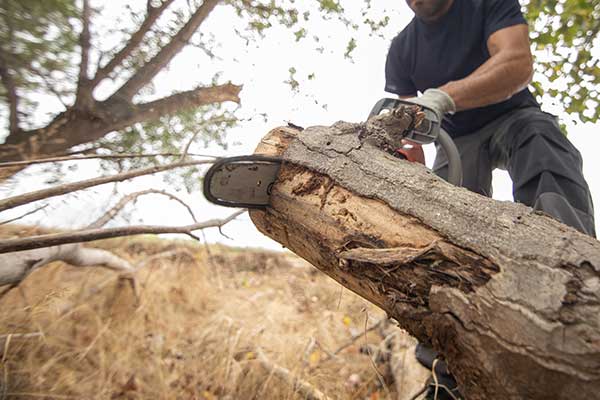
Tree removal in Universal City covers the usual suburban range: a failing hackberry over a driveway, an Arizona ash at the end of its span, a live oak in decline, a limb down after a storm. What is less usual is how many of these properties are rentals or are owned by someone who is not in Texas, which changes how the decision gets made and how quickly it should be.
A declining tree over a house you rent out deserves prompter attention than the same tree over your own. Somebody else is living underneath it, and a failure affects them and possibly a neighbour rather than just you. Deferring the decision because you are stationed elsewhere and cannot see it easily is the situation most worth avoiding. We can assess it, photograph it, and give you a clear recommendation you can act on remotely. What your specific obligations are is a question for your property manager or attorney, but the practical answer is usually to deal with it rather than wait.
Hackberry leads by volume, since it seeds itself everywhere, grows fast, forms weak wood, and splits at the crotch or drops limbs as it ages. Arizona ash planted across this region decades ago is now reaching the end of its span. Chinaberry and Chinese tallow reach removal size quickly. Live oaks and post oaks are usually the trees people are trying to keep, and when one of those is genuinely failing it is worth a proper diagnosis first.
Post oaks on these lots predate the subdivision and are unusually sensitive to disturbance. Compaction from vehicles or equipment, grade change over the root zone, trenching for a line or a pool, even new irrigation on ground that was never irrigated, can all start a decline. The tree typically looks fine for two to four years afterward, then thins and dies, by which point nobody connects it to the cause. Worth knowing before assuming a declining post oak has a disease.
Oak wilt is present in Bexar County and live oaks here are root grafted, so the standard caution applies: avoid cutting or pruning oaks during the high risk window in late winter and spring unless safety makes waiting impossible, and paint any wound immediately. But drought stress, root decay, hypoxylon on stressed trees, and post oak decline from old disturbance all look similar. Get a proper diagnosis before making decisions about surrounding trees.
We would rather recommend pruning than sell a removal you do not need. What generally justifies removal is extensive deadwood in the crown, conks or mushrooms at the base indicating root decay, a hollow or split trunk, a new lean with soil lifting on one side, or storm damage that has compromised the structure. A post oak in irreversible decline is also a legitimate removal, since dead ones fail unpredictably.
Lot sizes allow some trees to be felled whole, which keeps cost down. Where a tree stands over a house, a pool, a fence, or a neighbour’s roof, it comes down in sections from the top with pieces rigged and lowered under control. Equipment sits on protection where lawn and driveway condition matter, and we plan the machine route to avoid the root zones of oaks that are staying, since a removal that damages the neighbours of the tree is not much of a solution.
Grinding takes a stump below grade and suits turf or a bed. Full removal of the root ball is what you need where a pool, a pad, a driveway, or an addition is going over the location. After a storm the priority is making things safe rather than completing a removal. If a tree or limb is contacting a power line, call CPS Energy before anyone approaches it, since energized conductors are their responsibility.
Where a property has multiple trees in question, looking at them in one visit is more economical than separate calls and gives a clearer picture. It also lets us tell you which genuinely need to come out, which can be pruned for clearance, and which are fine. For an owner who is not local, one thorough assessment with photographs is far more useful than a series of individual quotes over months.
Tree removal across Universal City, Selma, Live Oak, Schertz, Cibolo, Converse, Windcrest, Kirby, Garden Ridge, and neighbouring San Antonio areas.
Photos of the tree, the crown, and everything around it get you an answer quickly. Call 210-942-1961.
Have it assessed and act on the recommendation rather than deferring. Somebody is living underneath it and a failure affects them and possibly a neighbour. We can assess it, photograph it, and give you a clear recommendation you can act on remotely. What your specific obligations are is a question for your property manager or attorney.
Possibly. This is a separate incorporated city with its own permitting, and requirements are set locally rather than by San Antonio or a neighbouring city. Confirm with the City of Universal City before scheduling. Where approval is needed it belongs to the property owner rather than the contractor.
Something probably did change, just years ago. Post oaks are unusually sensitive to root disturbance, and compaction, grade change, trenching, or new irrigation over the root zone can start a decline that takes two to four years to show. By the time the crown thins, the cause is usually forgotten and often mistaken for disease.
It may not be, and that distinction saves money. Oak wilt is present in Bexar County and live oaks here are root grafted, so it is a real concern. But drought stress, root decay, hypoxylon, and post oak decline from old disturbance all look similar. Get a proper diagnosis before assuming a group of trees is at risk.
They grow fast, seed themselves everywhere, and form weak wood, so they establish in any unmaintained corner, reach size quickly, then split at the crotch or drop limbs as they age. Hackberry is the most common removal here by volume, and taking them out as saplings costs a small fraction of removing mature ones.
It should not if the work is planned. The risk is the equipment route rather than the removal, since driving across the root zones of oaks that are staying can put them into the same decline you are removing this tree for. We plan machine routes around root zones and use protection where crossing is unavoidable.
Clearance drives it more than the tree does. A tree with room to be felled whole costs a fraction of the same tree over a house or pool requiring sectional rigging. Lot sizes here often allow whole felling, which works in your favour. Stump work is a separate line, and permit timing can affect the schedule.