
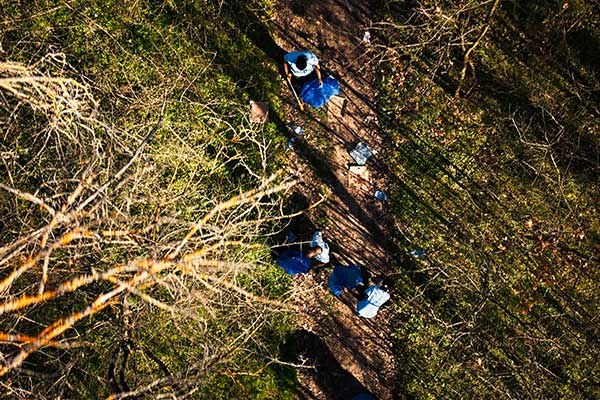
In Alamo Heights the canopy is the asset and the understory is the problem. Under eighty year old live oaks and pecans, ligustrum and nandina have filled in until the ground level is a wall of green, the lawn is gone, and you cannot see from your patio to your back fence. Underbrush clearing removes all of that and leaves the trees, which is usually exactly what a 78209 homeowner wants.
Out goes ligustrum, nandina, privet, chinaberry, hackberry saplings, greenbriar, poison ivy, English ivy climbing the trunks, and the volunteer growth crowding the base of better trees. Staying are the live oaks, pecans, cedar elms, and any specimen or planted tree you point at. We walk the property with you and mark keepers before anything starts, and where a plant is ambiguous, we ask instead of deciding for you.
Almost every underbrush job in this neighborhood is a ligustrum job. It was planted widely as a hedge decades ago, birds spread the seed into every unmaintained corner, and it grows fast enough in shade to outcompete everything native. A mature stand of it takes water and nutrients from the oaks above it, blocks the light that turf needs, and turns a wooded lot into an impassable thicket. Removing it is the single change that transforms these properties, and unlike a lot of landscape work, the effect is immediate.
English ivy and Boston ivy climbing an oak or a pecan is worth addressing separately. It adds weight and wind load to the canopy, holds moisture against the bark, and hides structural defects from anyone trying to inspect the tree. We cut the vines at the base and remove what pulls free cleanly, then leave the upper material to die back rather than ripping it off and stripping bark with it. The dead vine drops over the following months.
This is hand crew heavy work in Alamo Heights. Saws, loppers, and small equipment where a gate allows it, because the whole point is to leave mature root zones and existing landscaping undisturbed. Cut material is carried out and loaded rather than dragged across a lawn. Stumps of resprouting species are ground below grade or treated, since cutting ligustrum flush simply produces a multi stemmed version of the same problem next spring.
Live oaks in this area are heavily root grafted, which is why oak wilt spreads through these neighborhoods along connected root systems rather than tree by tree. Understory work should not wound oaks at all, but where a cut or a scrape happens during the high risk window in late winter and spring, it gets painted the same day. If your block has a known oak wilt history, tell us at the walkthrough so we can plan around it.
Open ground under a full canopy, with the trunk lines of the mature trees visible for the first time in years. Most owners find their lot is noticeably larger than they had come to think it was. Turf and native ground cover generally recover over the following season once light reaches the soil, though heavily shaded areas may need shade tolerant planting rather than lawn.
Dense understory next to a house is cover, and it brings what cover brings. Rats, raccoons, opossums, and occasionally snakes live in ligustrum thickets and use them as a highway to the roofline. Clearing the understory back from the structure removes that corridor, which is a common reason homeowners here call us after a pest control visit rather than a landscaping one. It also makes the property easier to inspect for anything else developing near the foundation.
You do not have to clear everything at once. Some owners start with the area closest to the house and the sight line they most want back, then handle the rear boundary the following season. That spreads the cost and lets you see how the property responds before committing to the rest. It also lets you judge how much light actually reaches the ground once the first section is open, which is useful before deciding what to replant.
Underbrush clearing across Alamo Heights, Terrell Hills, Olmos Park, Lincoln Heights, Mahncke Park, Northwood, and neighboring San Antonio blocks.
Tell us what you want to be able to see and use when we are finished. Call 210-942-1961.
Underbrush clearing removes what grows beneath the canopy and leaves the mature trees, soil, and general landscape intact. Land clearing takes a footprint down to bare, workable ground including stumps. On an Alamo Heights lot where the oaks are the reason you bought the property, underbrush clearing is almost always the service you actually want.
It generally helps them. Dense ligustrum competes directly with mature trees for water and nutrients and holds moisture against the trunk base. The risks are mechanical damage and oak wilt through fresh wounds, both manageable by keeping equipment out of root zones, doing close work by hand, and painting any oak wound the same day during the high risk season.
Usually, though not everywhere. Areas that get partial sun once the ligustrum is gone often recover within a season. Ground under dense evergreen canopy may still be too shaded for turf, in which case shade tolerant ground cover or a mulched bed is a more realistic plan than repeatedly reseeding grass that will not hold.
Yes. We cut it at the base and remove what comes free without damaging bark, then leave the upper growth to die back on its own over the following months. Pulling established ivy directly off a trunk tears bark and can do more harm than the ivy was doing. Ground level ivy is removed with the rest of the understory.
It is quoted by the job. The drivers are how dense the understory is, how much of the work has to be done by hand versus machine, how many trees have to be worked around, and haul off volume. Because Alamo Heights lots usually require hand work and full removal of material, the price per square foot runs higher than the same job on open acreage.
Plan on a light maintenance visit every one to three years. Ligustrum and hackberry reseed continually in this neighborhood and resprout from any crown left in the ground, so some return is expected. Keeping up with it annually is far less expensive than letting a lot close back in and paying for full clearing a second time.
That is the reason most of this work is done by hand here. Crews carry material out rather than dragging it, and we ask about irrigation lines, low voltage lighting, and bed edges before starting. Where a machine is used, it goes only where you have agreed it can go. Mark anything buried that we would not be able to see.