
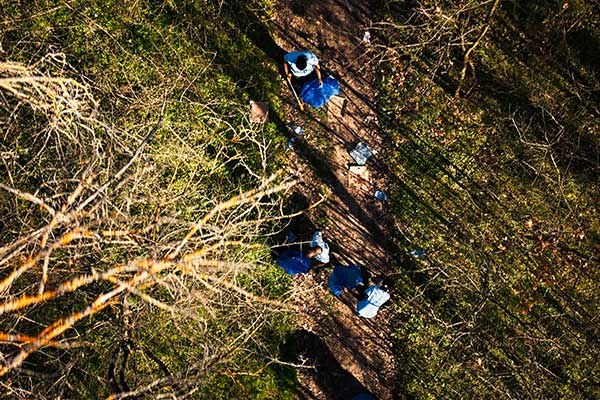
Underbrush clearing is what most Bulverde landowners actually mean when they say they want their acreage cleared. Rather than taking the tract to bare ground, we pull the cedar and understory out and leave the live oaks, the Spanish oaks, and the shade. What comes back is a property you can walk, see across, and use, which is generally what you were picturing when you bought it.
Out goes Ashe juniper in the understory, young mesquite and persimmon, whitebrush, greenbriar, deadfall, prickly pear, and the volunteer growth crowded around the base of better trees. Staying are live oaks, Spanish oaks, cedar elms, mountain laurel, and any specimen tree you point at. We mark keepers with you before machines start, and where a plant is a judgment call, we ask instead of deciding on your behalf.
A live oak with cedar grown up through and around it is losing the competition for water on soil that is only inches deep. Thinning juniper out from around your oaks generally gives you healthier trees, better structure as they respond to light, and grass returning underneath within a season or two. It also removes the ladder fuel that lets a ground fire climb into a canopy that took a century to grow and cannot be replaced in your lifetime.
On subdivided Bulverde acreage this matters more than people expect. Recorded restrictions commonly cap the percentage of a tract that may be cleared, protect trees above a certain trunk size, and require association review. Selective underbrush work is usually the approach that fits comfortably inside those limits, since the canopy stays and only the understory changes. Bring your restrictions to the walkthrough and we will plan the work to sit inside them.
Most of it is mulching, because it clears standing understory without disturbing soil or the root zones of trees you are keeping. Larger removals get felled and processed. Hand crews with saws work in close to trunks, along fence lines, and around structures where a machine has no business being. Material is left as chip, which protects thin soil, holds moisture, and gives the property a tended look rather than a scraped one.
This county is well inside the oak wilt region and live oaks here are extensively root grafted, sometimes across entire hillsides and property lines. The disease travels through those connections and through beetles drawn to fresh wounds, which is why the standing guidance is to avoid wounding oaks during the high risk window in late winter and spring. When work happens in that period, wounds get painted the same day and equipment stays clear of trunks and root flares. If your area has a known oak wilt history, say so at the walkthrough.
If a house is going up on the tract, understory work near the build area is worth doing before construction rather than after. It gives crews room to work, reduces fire risk from equipment operating in dry fuel, and lets you see the site properly while the pad location is still a decision rather than a fact. It also means the finished property is not a construction zone surrounded by an impassable wall of cedar on the day you move in.
There is no requirement to open the whole tract at once, and on larger acreage there are good reasons not to. Many owners start around the house and the main access, then work outward over several seasons. That spreads the cost, lets you see how the land responds before committing to the rest, and gives wildlife time to adjust rather than losing every bit of cover in one week. It also lets you judge how far you actually want the remaining sections opened.
The 281 corridor is wildland urban interface and cedar is among the most volatile fuels in Texas. Understory work close to a house, a barn, or a propane tank does two jobs at once: it opens the property up and it removes the ladder fuel that lets a ground fire reach a roofline. Widening the driveway so a fire truck can get in and turn around is worth doing at the same time, since access is what determines whether a structure can be defended at all.
Underbrush clearing across Bulverde, Spring Branch, Canyon Lake, Smithson Valley, Garden Ridge, Timberwood Park, Bracken, Fair Oaks Ranch, New Braunfels, and throughout Comal, Kendall, and northern Bexar counties.
Tell us what you want to be able to see and use when we finish. Call 210-942-1961.
Underbrush clearing removes growth beneath the canopy and leaves mature trees, soil, and ground contour alone. Land clearing takes a tract to bare or near bare ground including stumps. On Bulverde acreage where the live oaks are the reason you bought the place, underbrush work is almost always the service that produces what you actually wanted.
Usually better than full clearing does. Restrictions on subdivided tracts here commonly cap clearing percentages and protect trees above a certain size, and selective understory work leaves the canopy intact so it tends to sit comfortably inside those limits. Bring the documents to the walkthrough so the plan is built around the actual caps rather than around assumptions.
Generally yes. Cedar growing through and around an oak competes directly for water on soil that is only inches deep, and it stacks ladder fuel against a tree you cannot replace. The caution is oak wilt. Any wound to an oak during the high risk window in late winter and spring needs immediate painting, and equipment should stay off root flares.
Usually within a season or two where a seed bank survives in the soil, which on most Comal County tracts it does. Cedar shade and water competition are what suppressed it. Ground that sat under closed canopy for decades sometimes needs seeding, and the chip layer left behind helps hold moisture while that establishes.
Before, for the area around the build. It gives construction crews room, reduces fire risk from equipment working in dry fuel, and lets you evaluate the site properly while the pad location is still open. Doing it afterward means living through a second round of equipment on the property once you have already moved in.
It is quoted per acre and comes in below full clearing since there is no stump removal or grading. Drivers are understory density, how many keeper trees have to be worked around, and slope. Tracts with tight tree spacing take longer per acre than open ground with scattered cedar, because the machine spends more time maneuvering than cutting.
Two to four years for a light maintenance pass on most tracts here, longer where the first pass was thorough and the chip layer is suppressing seed. Cedar returns from seed rather than from stumps, so once the local seed source is thinned the rate of return drops noticeably compared with the initial clearing.