
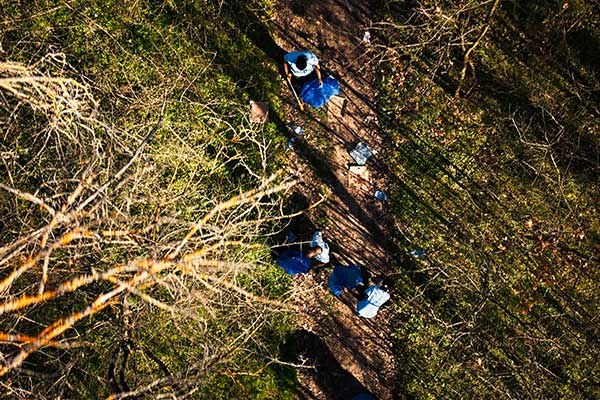
Live Oak is a small, fully built out city, and it is worth being honest about what that means. There is essentially no acreage here to clear. What there is instead is a city of residential lots and commercial parcels carrying genuine remnants of the post oak and live oak savannah this area was before anyone subdivided it. Clearing here is precise work around trees that are older than the houses.
This distinction matters more than it sounds. In a lot of suburban areas the mature trees were planted by builders or early owners forty years ago. Here, many of the post oaks and live oaks were already standing when the neighborhood went in, and they are survivors of the original savannah. That makes them more valuable and considerably more fragile. Post oaks in particular do not tolerate having their root zones disturbed, compacted, or regraded, and they express that damage years later rather than immediately.
This is post oak savannah ground, which typically means a sandy loam surface sitting over a dense clay subsoil. The top layer digs easily and drains fast, which fools people into thinking the site drains well. It does not, because the clay underneath it does not let water through, so after heavy rain you get water perched in the sand layer with nowhere to go. That combination affects where puddles form, how a pad behaves, and why a low spot in a yard stays wet for days.
Live Oak is an incorporated city with its own government and its own tree requirements, and the canopy is part of its identity rather than an afterthought. Tree removal is regulated locally and thresholds differ from unincorporated Bexar County or from neighboring cities. Confirm current requirements with the City of Live Oak before scheduling. Approval belongs to the property owner, and we will not remove a protected tree that has not been cleared.
The most common mistake on a lot like this is protecting the trunk and forgetting the roots. A tree’s critical root zone extends well beyond its canopy, it sits shallow, and driving equipment across it repeatedly compacts the soil in a way that does not recover. We plan machine routes around root zones rather than through them, lay protection where crossing is unavoidable, and keep spoil piles off root areas. On post oaks this is not a nicety, it is the difference between the tree being alive in five years and not.
Houses here went in between the sixties and the nineties, and the ground reflects it. We regularly find old patio and shed slabs, clothesline footings, buried construction debris from the original build, abandoned irrigation, and occasionally remnants of what was on the site before the subdivision existed. None of it matters until you put a structure over it, at which point it very much does. We excavate a footprint rather than grading across whatever is there.
Burning is not appropriate in a built up city and there is no reason to leave a mulch layer on a maintained residential lot. Material is cut, loaded, and hauled to disposal, staged so the truck does not block a street, and loaded out as we go rather than sitting in piles over a weekend. On commercial parcels with larger volumes we plan trips rather than overloading, and the site is cleaned before we leave.
Clearing is usually the first step rather than the whole project. A pool builder, a concrete crew, a shed installer, or a fence contractor is generally behind us, and order matters, particularly where tree protection has to stay up throughout. Some vegetation should come out before excavation so machines have room, and some is better left until after so it is not damaged by construction traffic. We coordinate access, staging, and protection rather than clearing to a line and leaving.
A few minutes of preparation prevents most problems on residential work. Point out irrigation heads, low voltage lighting, the sewer cleanout, and anything else buried that we would have no way of seeing. Confirm gate width and whether the side yard route is actually passable with the AC unit where it sits. Move vehicles off the driveway on work days, and tell us which trees you care most about so protection goes where it matters.
We work throughout Live Oak and the surrounding area, including Universal City, Selma, Converse, Schertz, Cibolo, Windcrest, Kirby, Randolph area neighborhoods, and the neighboring San Antonio blocks along Pat Booker Road, I-35, and Loop 1604.
Send the address, photos of the area, and the route in from the street. Call 210-942-1961.
There is essentially none to clear. Live Oak is a small, fully built out city, so the work here is residential backyard footprints, overgrown lots, and commercial parcels rather than acreage. If you own land outside the city limits we handle that too, but within Live Oak itself the job is nearly always precise clearing around existing trees and structures.
For trees, likely yes. Live Oak is an incorporated city with its own tree requirements and thresholds that differ from unincorporated Bexar County and neighboring cities. Confirm current requirements with the City of Live Oak before scheduling. Approval is the property owner's responsibility, and we will not remove a protected tree that has not been cleared.
Because on these lots the mature oaks are native survivors of the original savannah, not planted landscape trees, and post oaks especially do not tolerate root zone disturbance. Compaction from equipment shows up as decline years later rather than immediately. We plan machine routes around root zones and keep spoil off them, which is the difference between keeping a tree and slowly losing it.
Because the sandy loam surface here usually sits over a dense clay subsoil. The top layer drains quickly, which is misleading, but the clay beneath does not let water through, so after heavy rain water perches in the sand with nowhere to go. That explains low spots staying wet for days and it affects how a pad or footing behaves.
On a lot built between the sixties and nineties, often more than soil. Old patio and shed slabs, footings from structures long gone, buried construction debris from the original build, and abandoned irrigation all turn up. It does not matter until you put a structure over it, which is why we excavate a footprint properly rather than grading across it.
Yes, and access is usually far easier than on residential lots, which makes those jobs efficient. Overgrown parcels along the corridors clear quickly once equipment can get on them. Commercial work generally carries additional city requirements depending on the scope, so confirm what Live Oak needs for your parcel before the schedule is set.
It is quoted by the job rather than by the acre, since the work is defined areas rather than open ground. Drivers are the size of the area, material size, whether a machine can reach it through the gate, how much stump work the project genuinely requires, and haul off volume. Hand only access raises the price noticeably.